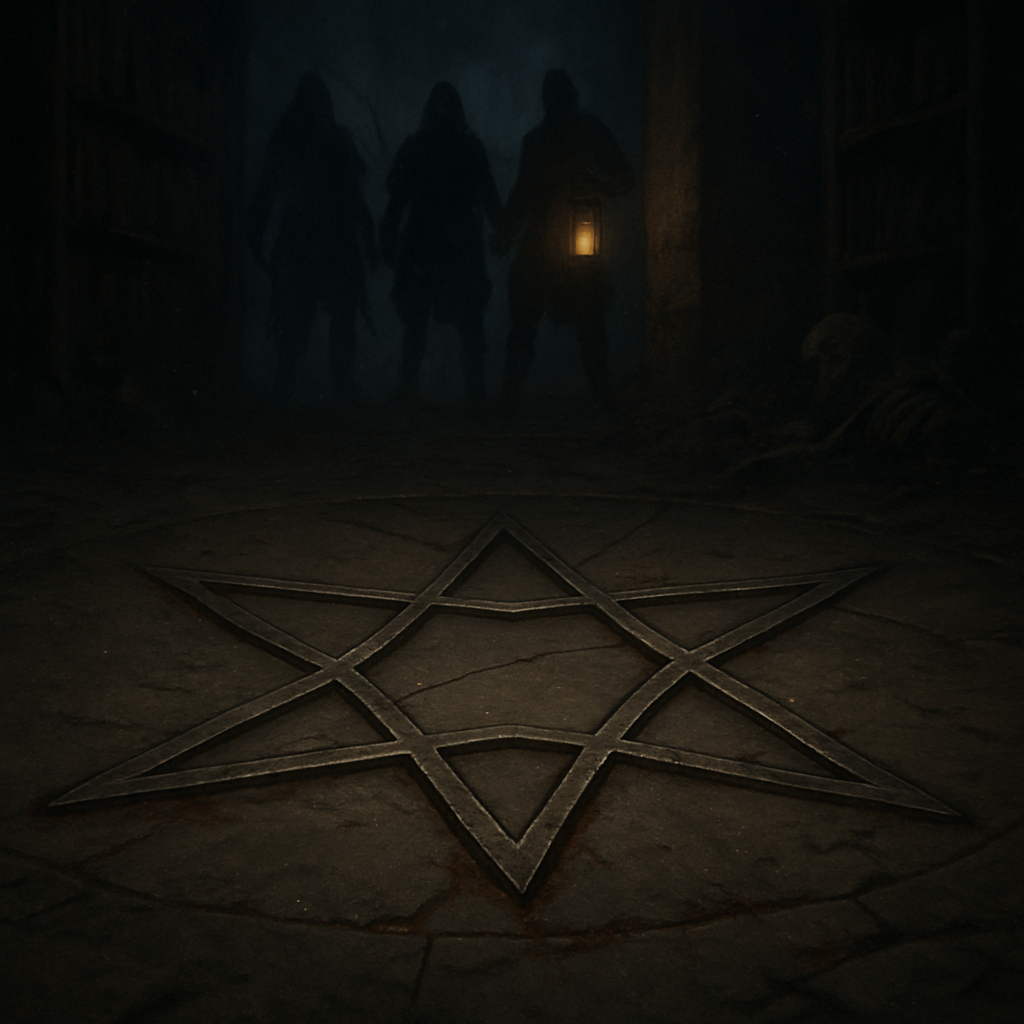
The tower stank of rot and old dust—an odor that clung to the stone like a memory too stubborn to die. Qavitrae stood in its dim heart with both blades drawn, the rhythmic rasp of her breath steadying her as the dead lurched toward her once more. Behind her, steel rang and dwarven curses echoed; ahead, a corpse with gummy teeth clamped onto Thindruk’s arm and worried at it like a starving dog.

She surged forward, twin blades whirling. The creature expected resistance, hesitation—anything but the blurring arc of elven steel. Her strike should have gutted a living foe; instead, she felt the bizarre slack of rotted ribs parting under the blade while the thing merely hissed and snapped again as though annoyed. The dead had no sense of drama, only hunger.

Behind her, Thindruk staggered backward, clutching the heavy tome he’d plucked from the pedestal as though it were as precious as his own blood. His wounded eye had already blossomed into an ugly bruise, swelling his sight down to a miserable squint. But the dwarf was nothing if not practical—he retreated, shuffled behind Qavitrae’s flashing blades, and began rearranging furniture with the single-minded fervor of a man attempting interior design mid-battle. Tables groaned under his grip as he shoved one into a waiting zombie, its clumsy frame crumpling beneath the collapsing wood.

Felrick took advantage of the makeshift barricade, hopping atop the overturned table like some lithe highwayman. He squinted through his one good eye—gods, the other was still a ruin—and raised his pistol. For a heartbeat, the world froze. Then the crack of gunfire rattled the laboratory, and a hole the size of a plum opened clean through an undead chest. Unfortunately, the chest in question belonged to a creature that did not find holes particularly disqualifying.

“Should’ve aimed lower,” Felrick muttered, scrambling to reload as the undead beneath the table thrashed uselessly.

Across the chamber, Nora fought with the quick, decisive brutality of a Blitzballer who knew exactly how to topple a large, shambling opponent. She slid low, shoulder-first, sending one corpse tumbling in a flailing heap. One arm severed clean under her claymore, flying like some grotesque trophy to land near Thindruk’s boots.

“He’s giving you a hand,” Qavitrae called lightly.

Thindruk glared with his one working eye. “Remind me to kill you last.”

Wanda’s response was a grunt and the satisfying crunch of her Morgenstern sinking into undead skull. “Heads off!” she barked. “Elf said so.”

Heads off, indeed. The trick worked—if one had the space, the luck, and the stomach. The undead fought like rabid animals even when bisected, dragging themselves forward by tendon and spite. One creature, nearly carved in half by Nora’s blade, still clawed desperately for its severed lower body, trying to stitch itself together like some horrible parody of mending.

Qavitrae ended its struggle with four rapid strikes, hacking until the head rolled free in a spray of black ichor. Only then did the hateful light gutter out of its eyes. Quiet settled—but not peace, never peace. Only the thick, oppressive silence of a deeper, older dread.

They dragged the corpses outside, their bodies strangely light for things that should have weighed as much as men. Too light. Wrongly light. Qavitrae noted the stitching at their heels—claws sewn where no claws should be—and the teeth that had never belonged to humans. The undead felt like puzzles half-assembled by a madman, pieces borrowed from whatever thing had died nearest at hand.

As the bodies burned in the pyre outside, oily black smoke snaking up toward the gray morning sky, Thindruk fretted over his wound. Qavitrae found a measure of clean river water—“clean” being a generous assumption anywhere near Altdorf—and Wanda insisted he swallow laudanum to dull the pain. It soothed him, but it didn’t soothe his nerves.

Nor his fear.

There were more rooms to explore. More secrets to pry loose. And deeper still—more dead, waiting as though the tower had been holding its breath for a century.

The first chamber they braved was a study frozen in time. Dust lay thick across every surface—save for a narrow path disturbed by someone, or something, passing through sometime in the last hundred years. Portraits hung proudly on the walls: stern men with long noses and thick brows, their lineage stamped into each expression. They stared down at the intruders as if expecting deference. None received it.

A carved staff leaned in the corner, its surface etched in looping script that seemed to twist under the eye. Felrick lifted it with a shrug. “Looks wizardly,” he said. “If it kills me, someone else can inherit it.”

Next came the chest—a wide, shallow thing that Thindruk and Qavitrae opened with reverence. Inside lay maps. Dozens of them. And atop the stack: a familiar triangle carved across the Empire. The same triangle Etelka Herzen had carried.

But this one was old. A century old. As were the notes scribbled along the margins—calculations, star positions, arcane alignments tracked obsessively for years.

Someone in this tower had solved the puzzle of Morslieb long before Etelka. And whatever they found… they never left to tell it.

In the library beyond, skeletal corpses lay slumped between towering shelves, half-awake in that miserable twilight between death and undeath. They twitched weakly when the companions entered; Felrick decapitated one without ceremony. Wanda smashed another back into whatever afterlife it had tried to escape.

The books were half-rotted, mold-eaten, unreadable. Still, eleven tomes remained—rare, strange, and valuable. Some illustrated with obscene diagrams better left undescribed.

Finally, they pushed into the tower’s heart.

A ritual circle. Metal inlaid into the stone. Lines etched so deep they might have been cut by a trembling god. A symbol familiar and yet wrong—six-pointed, deliberate, heavy with intent.

The room felt like a held breath.

A secret that had waited a century for someone foolish enough to open it.

And now the companions stood at its threshold, eyes adjusting to the dim, weapons drawn, each strained by the night’s violence but unwilling to turn back.

The tower was not done with them.

And the secrets carved into its bones were only beginning to wake.


Executive Summary

The party fought through a brutal, chaotic melee inside the tower, ultimately destroying a swarm of undead—including a resilient, regenerating stitched abomination—through repeated decapitations, table-flipping ingenuity, and sheer stubbornness. Thindruk grabbed a mysterious book mid-combat, suffered a swollen black eye, and later barricaded the central door with improvised furniture. After burning the corpses outside, the group discovered that the undead were century-old cultists wearing star-shaped iron keys tied to chaos symbolism.

Inside the tower’s right-hand rooms, they uncovered a dusty study containing portraits, an eerie carved staff, and a chest of astrological maps proving that a sorcerer a century ago solved the same Morrslieb–triangle puzzle as Etelka Herzen. A locked desk—shot open by Felrick—held a dense notebook of obsessive calculations. In an adjacent library, they neutralized two feebly-animated skeletons and salvaged eleven valuable books.

By the end of the session, the party had pieced together major clues about the cult’s historical activities, confirmed the Barren Hills as the epicenter of the ritual puzzle, and stood ready to finally explore the tower’s central, star-marked chamber in the next session.


Session Notes
  • Pre-session and combat setup
    • The group resumes play in the middle of a fight inside the tower, with undead enemies already engaged.
    • There is a brief rules clarification about damage and injuries:
      • Thindruk had previously suffered an injury that was escalated from mild to moderate.
      • They revise the damage rules slightly so that Thindruk is not completely incapacitated.
      • The final outcome: Thindruk is moderately wounded and has a black eye injury that impairs actions relying on sight.
  • Top of the round – Qavitrae engages the zombie chewing on Thindruk

    • The round begins at the top of Initiative with Qavitrae.

    • Qavitrae is between two areas of fighting: she hears combat behind her and sees a zombie in front of Thindruk chewing on him.

    • One zombie nearby is confirmed dead and removed from the map.

    • Qavitrae decides it’s time to engage in melee:

      • She sprints across the room to the zombie at Thindruk.

      • She wields two swords: one main-hand sword named Ornnear (fast, finesse, light, vicious) and another off-hand sword.

      • She confirms that:

        • Fast makes it harder for enemies to dodge.
        • Vicious improves the chance of inflicting injuries.
        • Light grants +1 damage in the off-hand.
    • Qavitrae makes her attack:

      • She rolls a melee attack and scores a critical hit on the zombie.

      • Damage totals 14 (including the +1 from Light).

      • The GM describes the effect:

        • Qavitrae slashes across the zombie’s side, cutting through its rotted clothing and slicing between its ribs.
        • She was anticipating it might dodge, so her attack is more of a slash than a full committed thrust.
        • Despite clearly slicing into its torso, the zombie does not seem significantly hindered.
    • Qavitrae attempts to draw the zombie’s attention away from Thindruk and taunts him:

      • She calls out for Thindruk not to lose more of his arm to these creatures, joking that it’s harder for him to grow parts back.
  • Thindruk withdraws and grabs the mysterious book

    • Discussion arises about the maneuver action:

      • They confirm maneuver lets a character safely take a small step out of engaged range to avoid opportunity attacks.
      • It does not protect against running past multiple enemies; it just covers the immediate disengage.
    • Thindruk considers his options, torn between staying in melee or withdrawing:

      • He notes that there’s a book on a pedestal right next to him.
      • He asks what action cost it would be to grab the book.
    • The GM rules:

      • Grabbing the book is effectively a 0 action point cost because it’s right there and not especially heavy.
    • Thindruk decides to:

      • Use an action to maneuver one meter back, getting behind Qavitrae and out of direct engagement.
      • Grab the book from the pedestal.
      • Move to the corner of the room, effectively cowering behind Qavitrae and out of immediate danger.
    • Thindruk ends his turn holding the book, having pulled himself out of melee while relying on Qavitrae to hold the line.

  • Felrick’s first turn in the session – thinking about shooting into melee

    • Felrick checks whether this is a “new combat” for his personal superstition about not missing his first attack; the GM clarifies the combat is in round four, so it’s the same fight.

    • Felrick asks if he can safely shoot into melee at the zombie engaged with Qavitrae without hitting her:

      • The GM reminds him that he has a specific visual drawback: Black Cataract.
      • Previously, Felrick had an injury affecting his eye; that injury is now healed and replaced by the Black Cataract drawback (permanent impairment).
      • If Felrick misses his shot, he risks hitting Qavitrae because of his impaired vision.
    • The table jokes about the odds of him shooting Qavitrae and whether he would spend Fortune if he hit her by mistake.

    • Felrick weighs his options:

      • Shooting into melee is risky due to his drawback and the chance to hit an ally.
      • He decides to aim rather than fire immediately.
    • Felrick’s action:

      • He spends two action points to aim, gaining +20% to his next ranged attack.
      • He does not fire this round, instead lining up a careful shot for later.
  • Nora’s heavy hit with the claymore – severing a zombie’s arm

    • Nora takes her turn against one of the undead:

      • She chooses to aim (+10%) and then attack with her claymore.
      • She confirms she is using it one-handed at this point.
    • She hits the target with her attack:

      • She uses the finishing quality of the weapon, spending an extra action point to add an extra Fury die (1d6) to damage.
      • Damage is rolled, then an extra die is added.
      • After spending a Fortune point to explode damage, she reaches 19 damage (after initially landing at the “magic 14” the table keeps seeing).
    • The GM describes the result:

      • As the undead swings at her, Nora steps back and sweeps her claymore upward.
      • She severs its arm just above the elbow.
      • The chopped arm flies over Nora’s shoulder and smacks into the wall, then lands near Thindruk.
      • The group makes jokes about the zombie “giving him a hand.”
  • Wanda crushes a zombie’s skull with her Morgenstern

    • Wanda considers whether to focus damage on the weaker undead rather than the more capable, nimble one; the group agrees it’s better to get a 2-on-1 advantage.

    • Wanda’s actions:

      • She aims (+10%) and then attacks with her Morgenstern.
      • She hits with her attack, but the GM spends a Misfortune point to make her reroll.
      • She still succeeds on the reroll and hits the zombie.
    • Damage outcome:

      • Wanda rolls damage, though it ends up below the recurring benchmark of 14.
    • The GM’s description:

      • Wanda brings her Morgenstern down directly on the zombie’s forehead.
      • The skull caves in with a wet squelch, and the body collapses to the ground.
      • The GM reminds them that Cometri told them earlier: for walking dead, they need to separate the head from the body to be sure it’s destroyed.
      • The zombie is down but not necessarily permanently inert until decapitated.
  • The agile undead’s regeneration and failed attack on Wanda

    • The more capable, fleshier undead—distinguished from the slower zombies and skeletons—is described as:

      • Skittering around more nimbly.
      • Having a deeper divot in its head from previous damage.
    • As they watch, the group sees:

      • The deep hole in its skull filling back in with putrescent flesh.
      • It visibly knits itself back together, demonstrating disturbing regenerative abilities.
    • It chooses a target:

      • It locks onto Wanda as its focus.
      • Despite being cunning enough to defend itself, its Intelligence is still low; it forgoes aiming and simply throws itself at Wanda in a reckless attack.
    • The GM rolls:

      • The attack roll comes up as a clear failure (96, then 83 after reroll), regardless of the sheet’s misconfigured chance.
      • Wanda is not hit; the undead fails to land a blow.
  • Another zombie attacks Qavitrae but is easily parried

    • While the agile undead focuses on Wanda, another undead targets Qavitrae.

    • It lunges at her with slow, clumsy attacks.

    • Qavitrae’s response:

      • She uses parry with her defensive weapons.
      • She gets a +10% bonus from the defensive property.
      • She successfully parries the blow.
    • The GM notes:

      • The zombie’s attacks are slow and clumsy.
      • Qavitrae, with her twirling blades, easily deflects the strike.
  • Qavitrae attempts a takedown (perilous stunt) on the agile undead

    • Qavitrae decides to attempt a perilous stunt: Takedown against the agile undead.

    • Mechanics discussed:

      • Takedown requires a Coordination (or Athletics if charging) test from Qavitrae.
      • If she succeeds, the target must make a Coordination check to resist being knocked prone.
    • She rolls:

      • Her Coordination test fails, even after spending a Fortune point to reroll a 40% chance.
    • Result:

      • The takedown attempt does not work; the agile undead remains standing.
    • With the failed stunt, Qavitrae then:

      • Later in the round, she opts for a standard approach: stepping, aiming, and trying to hack off its body parts.
      • She moves (free 1-meter step), aims, and then makes a melee attack to cut it apart.
      • She misses this attack as well after a poor roll, and although she considers using coins, they adhere to the “one coin per roll” rule, and the roll stands as a miss.
  • Thindruk studies the lab briefly, then uses a table as a weapon

    • Thindruk considers healing his eye or treating himself in the field:

      • The GM explains there’s no straightforward self-healing in combat besides things like laudanum or healing drafts.
      • Qavitrae holds most of the healing supplies, so he doesn’t have one on him.
    • Thindruk instead chooses to examine the room:

      • He notes multiple tables covered in alchemical apparatus—glassware, burners, and beakers.
      • There are chalk writings on the walls, ceiling, and floor; he might need an Education test later to interpret them.
    • Thindruk shifts from investigation to improvisation:

      • He asks whether he can topple a table to create cover for Felrick or use it to interfere with a nearby zombie.
      • The GM notes his high Brawn bonus (6) and rules that he can use a table in a perilous stunt.
    • Thindruk’s perilous stunt:

      • He moves into position, then uses an Athletics-based Takedown by shoving the table into the zombie.
      • He fails the first roll but uses a Fortune point to reroll and succeeds.
      • The zombie attempts a Coordination check to resist but fails its roll.
    • Result:

      • Thindruk slams the table into the zombie’s waist, doubling it over.
      • He flips the table so that it pins the zombie underneath one end, leaving only one arm free.
      • Glassware shatters everywhere.
      • The GM notes the table isn’t heavy enough to permanently trap it, but it is prone and pinned for the moment.
  • Felrick climbs the table and attacks the pinned zombie’s head

    • Felrick wants to attack the pinned zombie safely:

      • He asks if he can stand behind or over the table to avoid zombie claws while attacking its head.
    • The GM clarifies:

      • The zombie has only one arm free under the table, imposing an attack penalty if it tries to strike.
      • Felrick can climb onto the underside/top of the table and attack downward at the zombie beneath him.
    • Felrick’s actions:

      • He moves behind/onto the table.
      • He switches from his firearm to his hunting sword (costing an action point).
      • He attacks the pinned zombie in melee.
      • Because the zombie is prone, he gains an extra Fury die on damage if he hits.
    • Felrick’s roll:

      • His first attack roll fails.
      • He spends a Fortune point to reroll and succeeds.
    • Damage:

      • The damage roll totals 13, slightly under their recurring “14” benchmark.
    • Description:

      • Felrick’s smaller hunting sword wedges into the side of the skull at an angle.
      • He creates a gap in the skull and something leaks from inside, but the zombie is still animate and not yet destroyed.
  • Nora executes a clean decapitation of a downed undead

    • Nora asks what it takes to take the head off the undead that was previously knocked down and isn’t actively resisting.

    • The GM rules:

      • It costs one action point.
      • No attack roll is needed; it’s considered effectively helpless.
      • It counts as an attack action but automatically succeeds.
    • Nora’s action:

      • She grips her two-handed weapon and brings it down in a heavy overhead chop.
      • She slices clean through the neck of the downed undead.
    • Result:

      • The head pops free.
      • The twitching stops, confirming that decapitation is effective against these creatures.
      • Qavitrae is vindicated in her earlier advice about severing heads.
  • The agile undead stands up and attacks Wanda but is parried

    • Later in the combat, after previous hits and a takedown:

      • The agile undead spends two action points to stand from prone.
      • It then uses its remaining points to attack Wanda.
    • Wanda’s response:

      • She uses parry, gaining +10% from her shield’s defensive bonus.
      • The GM spends a Misfortune point to make her reroll, but she still succeeds.
    • Result:

      • The agile undead’s attack fails to land.
      • The creature ends its turn and has expended all its action points.
  • The zombie pinned under the table struggles but fails to escape

    • The pinned zombie attempts to free itself:

      • It makes an Athletics check to wriggle out from under the table and get closer to Felrick.
      • It fails its attempts, even after spending multiple action points.
    • Result:

      • The zombie remains stuck under the table, effectively neutralized for the moment.
      • The table-and-dwarf combo is recognized in-character as an effective tactic.
  • Qavitrae finishes the pinned zombie by decapitating it

    • Qavitrae turns her attention to the zombie pinned beneath the table.

    • She moves into position and attacks:

      • She uses a double aim (+20%) and then strikes with her sword.
      • She hits, and the damage roll is once again 14 before spending Fortune.
      • She uses a Fortune point to explode the damage, bringing the total up to 20.
    • The GM’s description:

      • Qavitrae hacks cleanly through its neck as part of the attack.
      • The head is lopped off, rolls away, and the body goes limp.
    • The pinned zombie is now definitively destroyed.

  • Thindruk barricades the central door with a table and lectern

    • With the immediate threats mostly contained, Thindruk turns his attention to securing the area:

      • He moves over to another table near the central door.
      • He confirms the door swings inward into the room, despite having no visible hinges.
    • Thindruk’s action:

      • He drags and swings the table in front of the magically-operated door, creating a makeshift barricade.
      • Later, he also heaves a gargoyle-shaped lectern on top of the barricade to add weight and stability.
    • Result:

      • The central door is now blocked with a sturdy combination of table and lectern.
      • If something attempts to force the door, Thindruk plans to brace it and resist with Athletics.
  • Felrick continues to aim, holding a shot rather than risk friendly fire

    • Felrick, in another round, wants to line up a shot on the agile undead from the hall.

    • He considers shooting over Nora’s shoulder through the doorway.

    • The GM explains:

      • If the party positions themselves smartly (e.g., using corners and stone walls), Felrick can shoot without risking hitting them.
    • Felrick’s choice:

      • He spends more actions aiming, stacking additional bonuses.
      • He chooses not to take the shot yet, giving Nora and Qavitrae another opportunity to finish the creature in melee before he risks a bullet in close quarters.
      • He announces that if they fail again, he’ll take the shot next turn, even if it risks someone.
  • Nora tries to takedown the agile undead and uses Soldier of Fortune

    • As the fight with the agile undead continues:

      • Nora uses aim and then attempts another Takedown (a perilous stunt).
      • She rolls a Coordination test with +10% from aiming.
    • The undead resists:

      • It makes a Coordination roll that initially succeeds.
    • Nora’s Soldier of Fortune talent:

      • This talent causes the enemy’s resist roll on perilous stunts to be flipped to fail.
      • After flipping, the undead’s result becomes a failure.
    • Result:

      • The agile undead is knocked prone again.
      • This sets it up for the others to strike it with extra Fury dice.
  • Wanda repeatedly attacks the agile undead and eventually nearly cuts it in half

    • While the undead is prone:

      • Wanda aims (+10%) and attacks with her Morgenstern, gaining an extra Fury die against a prone foe.
      • The GM spends coins to force rerolls on some of her hits, but she continues to land solid blows.
    • On a key hit:

      • Wanda explodes the damage with Fortune, reaching 21 damage.
    • The GM describes the effect:

      • She winds up and hits the creature as hard as she can.

      • There’s the sound of wet flesh ripping and bones cracking.

      • The undead is almost cut in half, its top half dangling from the bottom:

        • Guts and entrails spill out.
        • It stumbles and plops wetly onto the ground.
      • Despite this, its head and body are still trying to move, illustrating its unnatural resilience.

  • The agile undead attempts to reassemble itself, pulling its body back together

    • After being grievously injured:

      • The undead falls to the ground, almost fully torn apart.
      • Its head lolls; only one hateful eye actively watches them.
      • One arm flips up, grabs part of its lower body, and it begins trying to drag the lower half back toward the top half.
    • The group reacts with horror and disgust:

      • They express that they might need to cut it into pieces and send them to different parts of the country.
      • Everyone is increasingly convinced decapitation and destruction of the head are crucial.
  • Qavitrae tries and fails repeatedly to finish the agile undead

    • Qavitrae attempts to step in and sever the head:

      • She moves across the room to reach the writhing mass of undead near the doorway.
      • She aims and attacks a prone, dismembered creature, adding the extra Fury die ahead of time.
    • Multiple attempts:

      • She rolls to hit and misses, then uses a Fortune point to reroll, but it comes up the same.
      • The undead is flailing and rolling enough that she cannot get the angle she wants on its neck.
    • The GM describes:

      • Qavitrae hacks at it, but the creature’s movement and contortions prevent a clean decapitation.
      • The head continues to watch her hatefully as it struggles to pull itself together.
  • The agile undead uses a stunning blow against Qavitrae

    • While still on the ground but partially reassembled, the undead lashes out:

      • It attempts a stunning blow targeting Qavitrae.
    • Attack and resist:

      • The creature succeeds on its stunning blow attack.
      • Qavitrae must resist with a Toughness test.
      • She fails the Toughness test.
    • Result:

      • Qavitrae is stunned, losing one action point on her next turn.
      • The GM notes that, thanks to Qavitrae’s earlier “elf stare” ability, if the creature had inflicted damage, some of it would have been reduced by her Fellowship bonus, but the attack’s main effect here is the stun.
  • Final decapitation of the agile undead by Qavitrae

    • On Qavitrae’s next turn, despite having one fewer action point:

      • She steps to the side to reposition around the thrashing mass.
      • She aims once and then makes another determined attack, directing multiple rapid strikes at the neck.
    • She rolls:

      • She hits this time.
      • She rolls damage (14 again), then spends a Fortune point to explode the damage and reaches 20 total.
    • The GM’s final description of the creature’s destruction:

      • Qavitrae places her boot on its chest to pin it down.
      • She delivers a series of rapid, precise strikes to the neck, avoiding her own foot thanks to her training.
      • She fully severs the head.
      • The cadaver emits a rattling, wheezing sound from within.
      • The snaking innards stop moving, and black ichor spreads out in a pool.
      • The head ends up in a dark corner, making a few final jaw-popping motions before becoming completely still.
    • The agile undead is finally and definitively destroyed.

  • Post-fight reactions and decision to leave the tower briefly

    • Nora reflects:

      • She notes this is likely her first direct encounter with undead.
      • She is relieved that she didn’t pass out and would prefer it remain her only such experience.
    • Qavitrae:

      • Congratulates Nora on how well she handled the undead.
      • Clarifies that these creatures are not demons, which is a different category of horror.
    • Thindruk:

      • He now sports a large, swollen shiner over one eye from the earlier injury.
      • His vision out of that eye is notably compromised.
    • The party discusses leaving the tower:

      • Thindruk, clearly rattled, suggests stepping outside for fresh air and burning the corpses to ash.
      • The others agree burning the bodies is wise, both to prevent reanimation and to eliminate the threat.
    • They decide:

      • To drag the corpses out.
      • To burn them on the pyre they had already started outside the tower.
      • Possibly to carry some furniture like a table as firewood.
  • Checking whether the undead’s feet match the earlier footprints

    • Before burning the bodies, Felrick asks:

      • Whether the mutated creature’s feet match the footprints they had tracked earlier.
    • The GM confirms:

      • The long-toenailed, clawed feet of the creature match the earlier prints.
      • A claw has been sewn onto the heel of the foot, matching the unusual heel impressions.
      • The physical size suggests it should have sunk deeper into soft earth, implying its step was supernaturally light.
    • The party confirms:

      • This creature was indeed the source of the strange tracks around the tower.
  • Dragging the corpses out and burning them

    • The group drags the various undead corpses out of the tower:

      • Decapitated zombies.
      • The agile stitched-together undead.
    • They throw the bodies on the existing pyre:

      • They add fuel (including wood/table pieces).
      • A thick, oily black smoke rises from the burning corpses.
    • They remark that the smell will be awful, but the bodies do burn, and this provides finality.

  • Wanda’s bite and Qavitrae’s uncertain knowledge about undead contagion

    • Wanda has been bitten by one of the undead.

    • Qavitrae attempts to recall what she knows:

      • She makes an Education test to determine whether undead bites carry specific afflictions or contagions.
      • She fails to recall specifics.
    • The GM clarifies:

      • In general, undead bites can be dangerous and may be venomous or cause infection.
      • However, Qavitrae does not know exactly what effect this particular undead’s bite might have.
    • Wanda’s response:

      • She washes the wound with “clean” river water from nearby.
      • The GM notes that the river water upriver of Altdorf is at least better than the filth downstream.
  • Discovery of star-shaped iron keys on the undead

    • As they drag the bodies, Qavitrae, Nora, and Thindruk (after Awareness checks) notice:

      • Each of the shambling cadaver-like undead wears something around their neck.
    • On the three (or four) cadaverous undead:

      • Each has an iron object resembling a key.
      • The ends of these keys are shaped like a six-pointed star.
      • These star-shaped keys are smaller but similar in design to the larger key the party already has—likely the one they used on the tower.
    • On the agile, more powerful undead:

      • It wears a longer iron rod around its neck, about six inches long.
      • The end of this rod is shaped as a five-pointed star.
      • It is not exactly a key, more like an iron staff or rod with a star-pointed end.
    • Qavitrae’s occult understanding:

      • She recognizes these symbols as typical of occult and chaos-related symbology used by followers of the Ruinous Powers.
      • Such items can be used to channel magical power.
    • The group speculates:

      • These star keys may be related to opening and closing the doors in this tower.
      • The five-pointed rod may grant higher access or be associated with a different rank or function within the cult.
  • Ascertaining the age of the undead and their cultist origin

    • Qavitrae examines the clothing:

      • Despite being ragged and rotten, the style appears consistent with about a century ago.
    • This matches:

      • The known age of the tower, which is roughly 100 years old.
    • The party notes:

      • The bodies seem to be former cultists from around the tower’s construction period.

      • Their patchwork nature is evident:

        • The bodies are mostly human.
        • Extra claws, teeth, and bony protrusions are stitched in from other sources.
    • Qavitrae and Thindruk both, having lived in the Empire during that era, recognize the clothing as appropriate for that time period.

  • Laudanum for Thindruk’s wounds and corruption gain

    • The group discusses Thindruk’s moderate wounds and impaired fighting capacity:

      • He also suffers the Black Eye affliction which flips vision-based tests to fail or adds severe penalties.
    • Qavitrae suggests using laudanum:

      • She marks a dose of laudanum off the party stash.
    • Outcome:

      • The laudanum reduces Thindruk from moderately wounded to lightly wounded, making further natural healing easier.
      • He gains 1 point of Corruption as a side effect.
      • The party accepts this tradeoff to improve his condition.
  • Revisiting why they are in the tower at all

    • The party reminds themselves of their purpose:

      • They are here because a mage, Etelka Herzen, involved with a chaos cult, had marked this tower on her map.
      • This tower and the creature in it seem connected to the cult and to the Barren Hills.
      • The undead had been eating dwarves, which provided a more immediate reason to clear the place.
    • They intend:

      • To thoroughly investigate the tower.
      • To understand what the cult was doing here, especially in connection with the triangle marked on the map of the Empire.
  • Entering the right-hand room – the dusty study with paintings and a staff

    • After burning the corpses, the party returns to the tower.

    • With the central door barricaded, they decide to explore the right-hand door first.

    • Using their key from outside:

      • The door opens easily when they approach with the key.
    • Inside the right-hand room they find:

      • A large desk.
      • A chest with a shallow lid and internal document mechanism.
      • A drawing board (like an architect’s board or easel).
      • Several paintings hanging on the walls.
      • An ornately carved staff leaning in the corner.
      • All surfaces are heavily coated in dust, except a faint path through the center of the room, implying it hasn’t been used in a long time.
    • The paintings:

      • Three portraits of human noblemen, all dressed well and posed formally.

      • They share familial features: aquiline noses, high foreheads, and bushy eyebrows.

      • They appear to be around late 40s to early 50s.

      • There are no names on the paintings.

      • The portraits do not resemble Etelka Herzen:

        • She was a blonde woman.
        • These are dark-haired men.
        • Their facial structure differs from hers.
    • The staff:

      • It is carved from gnarled wood with intricate, looping designs.
      • Etched writing spirals around it in a language that is not Reikspiel.
      • It gives off a “hinky” or suspicious vibe to the characters.
    • Felrick takes the staff:

      • He picks it up with the expectation it may be magical or dangerous.
      • The GM notes it feels like a sturdy walking staff.
      • There is no immediate magical backlash or unusual sensation upon touching it.
  • The chest of maps and the triangle of the Empire

    • The chest:

      • Has a shallow lid with a hinged mechanism inside.
      • Holds several large parchment sheets in a fan-like arrangement, likely maps.
      • There is additional storage below them.
    • When opened:

      • The topmost document is a map of the Empire.
      • It strongly resembles the map they saw with Etelka Herzen.
      • A large triangle is drawn on it, connecting three regions.
      • While brush strokes differ, the intersection points of the triangle match those on Etelka’s map.
    • Other maps in the mechanism:

      • More detailed regional maps centered on each vertex of the triangle:

        • One in Talabec Land in the east, near the mountains.
        • One in the Norland/Middenland region in the west.
        • One at the Barren Hills in the south.
      • Margins contain calculations and notes:

        • Thin lines.
        • Mathematical-looking scribbles.
        • Occult annotations.
  • Qavitrae and Thindruk analyze the maps and confirm Morrslieb-based calculations

    • Qavitrae and Thindruk, both trained in Education, examine the maps together:

      • They cooperate, with one assisting the other.
    • They succeed on an Education test:

      • They recognize that these notes are astronomical and astrological calculations.
      • They specifically concern the movement of Morrslieb, the chaos moon.
      • The notes show someone obsessively tracking Morrslieb’s motion and deriving occult significance from its positions and conjunctions.
    • They see:

      • The calculations ultimately highlight the Barren Hills as the key location.
      • The work appears to show a person solving a long puzzle and concluding that the Barren Hills are central to whatever ritual or phenomenon they were trying to exploit.
  • Logical timeline: who solved the puzzle first?

    • Qavitrae and Thindruk reason through the timeline:

      • The tower is about a century old.
      • The maps here are old, fragile, and mildewed but well-preserved by darkness; they have clearly been here for a long time.
      • If Etelka already had the key to this tower, it would have been easier for her to come here first instead of going to the remote Barren Hills.
    • They conclude:

      • Someone a century ago—likely the tower’s original owner(s)—solved the same Morrslieb puzzle.

      • That person mapped out the triangle and identified the Barren Hills.

      • Etelka either:

        • Independently solved the same puzzle, or
        • Found related information or a key in the Barren Hills and then used it to locate and access this tower.
    • This implies:

      • Etelka never visited this specific room before them; otherwise, she would have had these exact maps instead of her own separate copy.
  • The locked desk and the leather-bound notebook of calculations

    • There is a separate desk (distinct from the map chest):

      • It is locked, with a visible keyhole.
    • While Qavitrae and Thindruk are deep in discussion over the astrological maps:

      • Felrick decides to solve the lock in his own way.
      • He fires his pistol at the desk’s lock, blasting a hole through it.
    • The desk is forced open:

      • Inside are:

        • Some dried-up bottles of ink.
        • Old quills.
        • A stack of blank parchment.
        • A leather-bound notebook.
    • Qavitrae and Thindruk examine the notebook:

      • It contains many pages of calculations, far more extensive than those on the maps.
      • These are again astrological/occult notes concerning Morrslieb and its phases and positions.
      • It reads as the work of someone thorough and obsessive, extrapolating patterns and attempting to tie them to magical phenomena.
      • It reinforces the conclusion that the tower’s original occupant solved complex Morrslieb-based sorcerous puzzles long before Etelka.
  • Entering the library room – more undead remnants and a room full of books

    • The party then proceeds to explore the next chamber:

      • They go through another door (still on the right side of the tower layout).
    • Inside, they find:

      • A library with floor-to-ceiling bookshelves filled with books.
      • A reading desk or table with a burned-down candle, used to study books.
      • Two near-skeletal bodies on the floor near the shelves.
    • As they approach the skeletons:

      • These bodies are mostly skeletal, with only scraps of flesh remaining.
      • They do stir slightly when the party gets close, showing remnants of animating force.
    • The party quickly neutralizes them:

      • Felrick immediately goes for a neck cut and decapitates one that twitches when they approach.
      • Wanda pulverizes another, smashing it so it cannot rise.
    • Result:

      • Neither skeletal corpse poses any meaningful threat.
      • They both fail to mount any real attack before being destroyed.
  • Sorting the library for valuable books

    • The party turns to the bookshelves:

      • Many of the books are moldy and fall apart when opened.
      • The goal is to sort out which volumes are still intact and valuable.
    • Nora’s approach:

      • She specifically looks for books with pictures, creating a pile of illustrated volumes that might be of interest.
    • Thindruk and others:

      • They use Bargain (and Education where relevant) to appraise the library’s contents and determine which books would be valuable to a bookseller.
    • After a couple of hours of careful searching:

      • They identify 11 books that are:

        • In relatively good condition.
        • Potentially valuable on the market.
      • The GM notes:

        • These volumes might sell for a few crowns up to around 10 crowns each, depending on rarity and buyer.
    • The content of the 11 books:

      • Some are histories.
      • Some are secret histories or esoteric accounts.
      • Some are alchemical treatises.
      • Some have disturbing or unsavory illustrations.
      • Some are in Classical or other languages rather than Reikspiel.
    • None of the books:

      • Are identified as the continuation of the Ludwig von Falkenhorst saga that Thindruk has been reading.
      • Are recognized as mundane, friendly reading; most are either academic or unsettling.
  • Approaching the central chamber and ending the session

    • With the right-hand side of the tower explored (study and library) and the outer undead threat neutralized, the party’s attention turns toward the central room.

    • The central door:

      • Has already been barricaded by Thindruk with a table and gargoyle lectern.
      • When revealed on the map, the central area appears to include a large metal structure or circle (specific details are not yet explored in the transcript).
    • The session ends:

      • They stop just after revealing part of the central area on the map, before actually investigating the chamber.
      • Corruption rolls and reward point (experience) awards are handled out-of-character after this point.
      • The in-world cliffhanger is: the party is poised to investigate the central, star-marked heart of the tower in a future session.