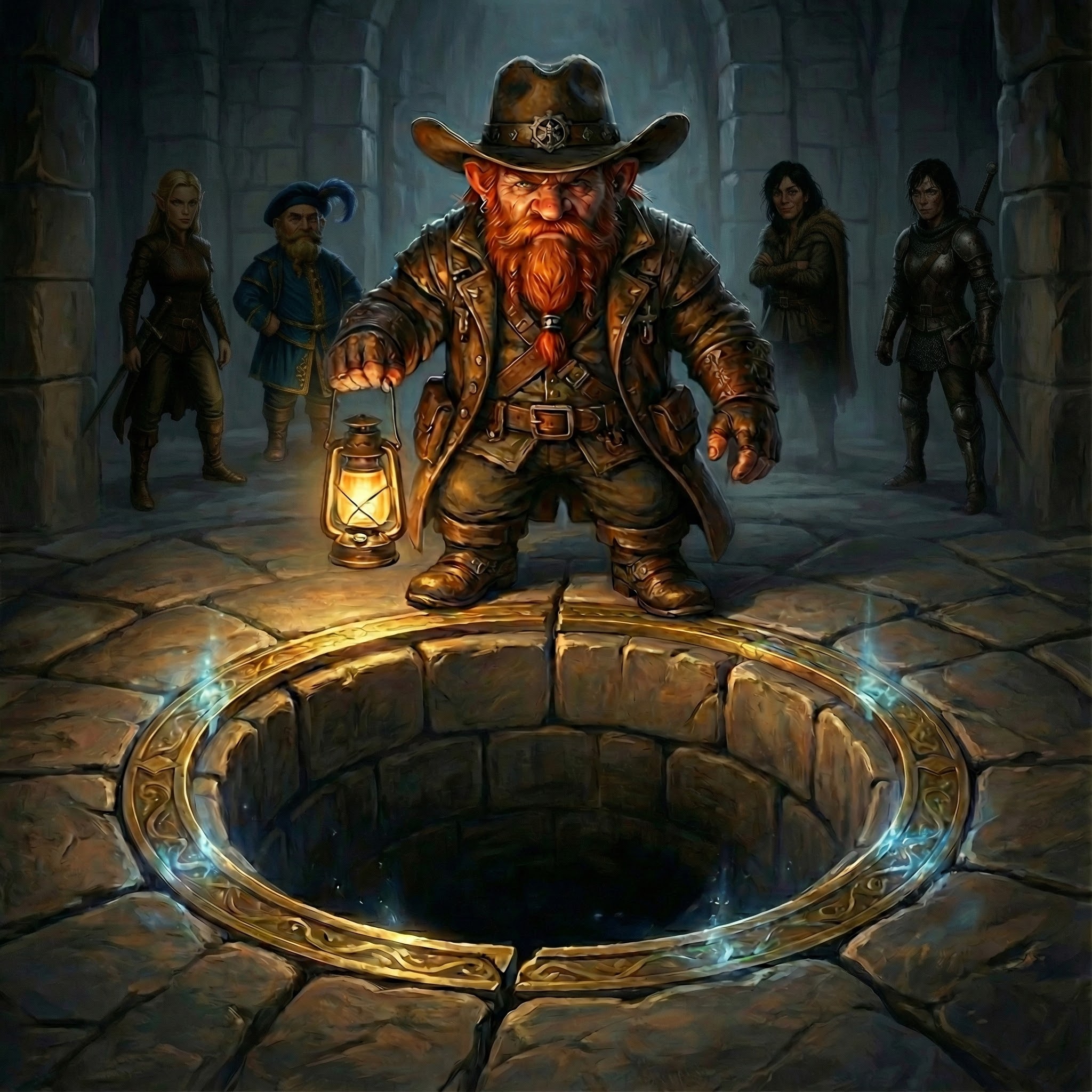
The stench of old blood clung to the stone like a stubborn ghost as the fellowship descended again into the tower’s bowels. The screams and scrapes of the dead still echoed faintly in memory, but the chamber now lay quiet, lit only by the faint bluish glow seeping from the brass inlay at the floor’s center. Qavitrae studied that glow with narrowed eyes, taut as a bowstring. There was something wrong about its silence. It was the silence of a predator that had already fed.
Thindruk lingered nearby, battered but stubbornly upright. His eye had swollen into an impressive plum, but the dwarf refused to let pain slow his appraisal of the hexagram gleaming beneath the table. His pride might have been bruised, but curiosity, that old ember, burned bright.
The others fanned out through the chamber, each wrestling with unease in their own way. Nora toyed with the severed zombie limb she’d taken earlier, tossing it into the circle with the cautious bravado of someone hoping the answer would be simple. It wasn’t. The limb hit stone with a wet slap—nothing more. No sizzle, no curse, no rising horror. The absence of a reaction was somehow worse.
“Could seal the whole place in stone,” Qavitrae muttered as she circled the edge of the inlay. “Entomb it like a blight.”
“And doom half the mountain with it,” Thindruk sniffed. “This is dwarven stone. Sacred. You don’t bury secrets in it unless you want them to hatch.”
Felrick—who had spent much of the conversation eyeing the keys like a starving man eyes a roast—slipped a finger along the teeth of one. The things had a hateful artistry to them. Each was shaped like some impossible star, each with a raised node at its center. “We came all this way,” he said, voice low. “Be a shame not to see what the damned thing does.”
No one agreed. No one had to. The gnome was already moving.
He pressed the first key into its matching divot. The brass receded like wax under flame, reshaping into the star’s silhouette. A satisfying click followed. Felrick’s eyes gleamed. He pressed another. Then another. Soon the chamber rang with six identical clicks, each one a small betrayal of common sense.
“A moment, Felrick—” Qavitrae started.
Too late.
The keys turned.
The table in the center shuddered, split neatly down the middle, and slid apart like a pair of eyelids opening. Below, the floor simply… vanished. Stone dissolved into nothing, revealing a shaft of unnatural darkness and a ladder descending into its throat.
“Ah,” Felrick breathed. “A special hole.”
Qavitrae pinched the bridge of her nose.
They wedged the doors open before venturing deeper—no one wished to be sealed in a chaos-touched oubliette—and then Felrick swung onto the ladder, lantern dangling from his belt. The others followed, one by one, boots scraping the ancient rungs.
The air below was shockingly clean, free of the rot and ruin that plagued the tower above. The chamber stretched out in a perfect hexagon, its floor painted with a twelve-pointed star that seemed to shift as one stared at it. A desk lay near the ladder, open books resting atop it like abandoned thoughts. Six alcoves extended from the central chamber, each lined with shelves of older, stranger tomes.
Qavitrae’s breath caught when she opened the first book. Not because of the writing—though the archaic script was as pretentious as any human attempt at scholarship—but because the title page bore a name she had hoped never to read again.
Dagmar von Wittgenstein.
A century-dead wizard. A man whose prodigious arrogance had already stained Imperial history. And here lay his journal.
She read, lips tightening with every line. His writings spoke of omens, of the green moon’s strange influence, of celestial patterns that pointed toward one horrific conclusion: something had fallen from the sky nearly two hundred years ago, a shard of corrupted celestial matter. Warpstone. A nucleus of raw magic, potent enough to warp flesh and will.
And Dagmar had gone to find it.
The final entry chilled her more than any ghost. The wizard’s quill had scraped feverishly about prophecies, power, ascension—and a decision to travel to the Barren Hills. To retrieve the stone. To use it.
She shared the translation with the others. They read in grim silence, each face shifting through its own shade of dread.
“So the cursed town…” Nora said quietly. “Wittgendorf.”
“The castle,” Thindruk murmured, rubbing his now-throbbing eye. “Wittgenstein Castle sits above the village. His home. His descendants. If he made it back…” He didn’t finish.
Wanda leaned against a pillar, arms folded. “Even if he didn’t, the stone did. And someone’s been breathing its air for a hundred years.”
There was no need to mention the mutants they’d encountered weeks earlier. Or the child who’d pleaded for her broken town. The implications hung thick, a noose woven of dread and duty.
They debated their next steps, voices hushed despite the emptiness around them. Altdorf offered knowledge, healers, and danger. Wittgendorf offered only peril—and the chance to seize the stone before the cultists they’d thwarted caught up to it.
In the end, the choice came not from bravery or folly, but inevitability. Whatever festering horror Dagmar had birthed, it was spreading. And someone had to face it.
“Then we go south,” Qavitrae said. The others nodded. Even Felrick, who hid his caution behind a crooked smile.
But first, they stripped the underground library clean. Books of magic, prophecy, and blasphemous history—dangerous to possess, deadly to abandon. The chamber yielded no stones, no artifacts, nothing but knowledge, potential, and doom.
A final awareness sweep revealed a single hidden vial—before Wanda shattered it by accident. The green liquid sizzled uselessly across the stone. Felrick gagged in anticipation of melted flesh, but the spill lay cold.
“Could’ve been valuable,” he muttered.
“Or poisonous,” Wanda countered. “Let the floor drink it.”
They ascended from the depths, loaded with books and unease.
The journey south brought a knife’s edge of luck. They passed through Altdorf under disguise, sold their cargo at a fortuitous price, and delivered their bank note before slipping away. But the road was not kind: Wanda’s festering wound worsened to the point of fever, and only the city’s healers kept infection from claiming her limb.
And so the days passed. The dwarf’s black eye faded. The elf buried herself in forbidden tomes. The gnome polished his pistol until its metal gleamed with anticipation. Nora watched the horizon, stomach fluttering with equal parts dread and purpose.
Six days later, the Dandiefraulein cut through dark waters toward Wittgendorf.
No lanterns burned in the village.
No smoke rose from its chimneys.
The streets were overgrown, choked with weeds. Buildings sagged like they were sinking into the earth. A half-starved dog darted across the road and vanished into silence. Above the cliffs, the crooked silhouette of Castle Wittgenstein leaned as though the land itself was trying to shrug it off.
The air tasted of abandonment. And something else—like the first breath before a storm breaks.
The fellowship exchanged glances.
Whatever Dagmar had woken a century ago, it waited here.
And it knew they were coming.
Re-entry into the blasphemous basement chamber The ritual circle itself (physical description and initial caution) The floor contained a hexagram set into a ring, described as a metal inlay (brass), glowing independently. Qavitrae chose to inspect at a distance, circling it without crossing the line. The GM called for an Awareness test for Qavitrae with a +20 bonus; Qavitrae did not gain decisive insight from the roll. The party discussed destruction and containment options: Wanda directly asked: “How do we destroy this?” Qavitrae proposed two courses: Concern remained that the circle’s glow implied magic, but no one could immediately explain its function. Testing the circle and accounting for bodies Nora proposed an experiment: remove a leg from an incapacitated undead and toss it into the circle to see what happens. The GM confirmed there were no spare limbs lying around in this specific ritual chamber, though the party had seen jars with body parts in an earlier room with glassware. The party revisited the fate of the missing dwarves: The group discussed proper treatment of dwarven remains: Looking for signs of recent activity The party asked whether anyone besides victims and monsters had been here recently. The GM called for additional Awareness checks with a +20 bonus. Thindruk and Nora succeeded, and the GM described: Keys inventory and matching the divots The party counted their keys: From a safe distance, the party assessed whether the keys fit the divots: Felrick initiates the key mechanism (while the party argues) While others debated risks (turning it off vs summoning something worse), Felrick placed a key into a divot beside him. The GM described the mechanism: Felrick removed the key: Felrick repeated this in-and-out cycle multiple times, then left the chamber with the others. Researching the recovered tome and scribbled calculations Qavitrae took the large book (taken earlier from a lectern/podium) to reading desks in the library. The GM clarified the book’s language: Qavitrae began an extended, hard Education test, assisted by Thindruk, to study the tome over much of the remaining day. Meanwhile, Thindruk examined the chalked and scrawled writings in the laboratory areas: From extended study, the party learned: Commitment to the six-key action With no direct evidence the mechanism was explicitly tied to demon summoning, the group leaned toward engaging it. The party agreed to wedge doors open so they would not be trapped if the key mechanism tried to close the doors: Inserting all six keys: correct placement and activation Felrick collected the keys and inserted them in the appropriate divots. The GM specified key placement rules: When the final key was inserted: The newly revealed shaft and descent Lower chamber: layout, symbols, and atmosphere The GM revealed the lower area as a hexagonal chamber with a multi-pointed star painted on the floor (the party recognized it as a composition involving two 6-pointed stars, forming a larger star motif). A desk sat near the base of the ladder. There were multiple alcoves radiating outward from the central chamber, lined with bookshelves in the adjoining spaces. A red object on the floor was identified as a rug, not a coffin or sarcophagus. Environmental shift: Books on the desk: titles and identification The party examined three books at the desk: Titles identified: The GM called for: Qavitrae deciphers the spidery script title page Qavitrae recognized the script as the “language of magic”, used for complicated, esoteric concepts. She determined the title page was a clumsy transcription of Reikspiel into magical script, which she found characteristically human. Qavitrae translated the title page as: The GM clarified the nature of the journal: Translated excerpts and “notes from the signal tower” thread The GM provided translated pages for the party to read (the group referenced them as “notes from the signal tower”). From these notes, the party focused on: A historical account involving unusual celestial events and a period-based phenomenon (the party discussed a “hundred year period” framing). References to meteorites falling in different places, including: The party connected these writings to Chaos themes and the god referenced as Zinj: Digging into Dagmar’s journal: the final entry Qavitrae used the “classic” approach of starting from the last entry. The GM identified the final entry’s title as “If I Did It.” The party interpreted the entry as: Qavitrae and others discussed the implications: Strategic debate: what to do next The party identified multiple possible paths: Concerns driving the discussion: Despite suspicion of Altdorf’s risk, the party remembered an important practical need: Looting the tower and denying resources to enemies The party agreed to: The GM quantified the haul: The party discussed hiding contraband: Searching the lower library: awareness results and the broken vial The GM called for Awareness checks for those searching. Wanda suffered a critical failure: The GM distinguished the lower library’s character from the upper: Travel and commerce decision: stop at Altdorf The party committed to a quick turnaround in Altdorf: The GM framed the timeline so that reaching Altdorf placed them on the 16th (as referenced in play), with departure shortly thereafter. Medical complications: infection and injuries The GM introduced a pressing injury complication: Mechanical implications stated in-play: The party opted to secure treatment in Altdorf (the largest city, where skilled care could be found). Selling textiles: bargain outcome and profits Wanda handled the sale of textiles in Altdorf with a negotiated deal: The GM justified the market conditions in-world: Transaction numbers stated at the table: Purchases and treatment in Altdorf The party paid for: The healer’s competence was described as very high (treated as 80% skill for the relevant work). Thindruk’s injuries: Wanda’s infection: The party discussed that a lead-lined container would be ideal for warpstone, though they did not purchase a custom lead box at this point. Disguises to avoid trouble in Altdorf Organizing funds and obligations Studying the looted magical books during river travel During the river journey away from Altdorf, the GM allowed time for reading while travel remained relatively quiet. The GM called for hard Education checks to glean usable information from the strange magical texts: Information the party extracted about warpstone (also called witchstone and mage’s gold): Arrival at Wittgendorf (end-of-session scene setting) After travel time quantified by the GM (six days from Altdorf), the party arrived in the region on Festag, Sigmarzeit 22nd, mid-afternoon. The GM described Wittgenstein Castle looming on high cliffs: The village of Wittgendorf was about a mile downriver from the castle and was the first reasonable point to bring in a boat and proceed inland. The party debated approach: Final village description (the session’s closing image): Session wrap (mechanical state)Session Notes