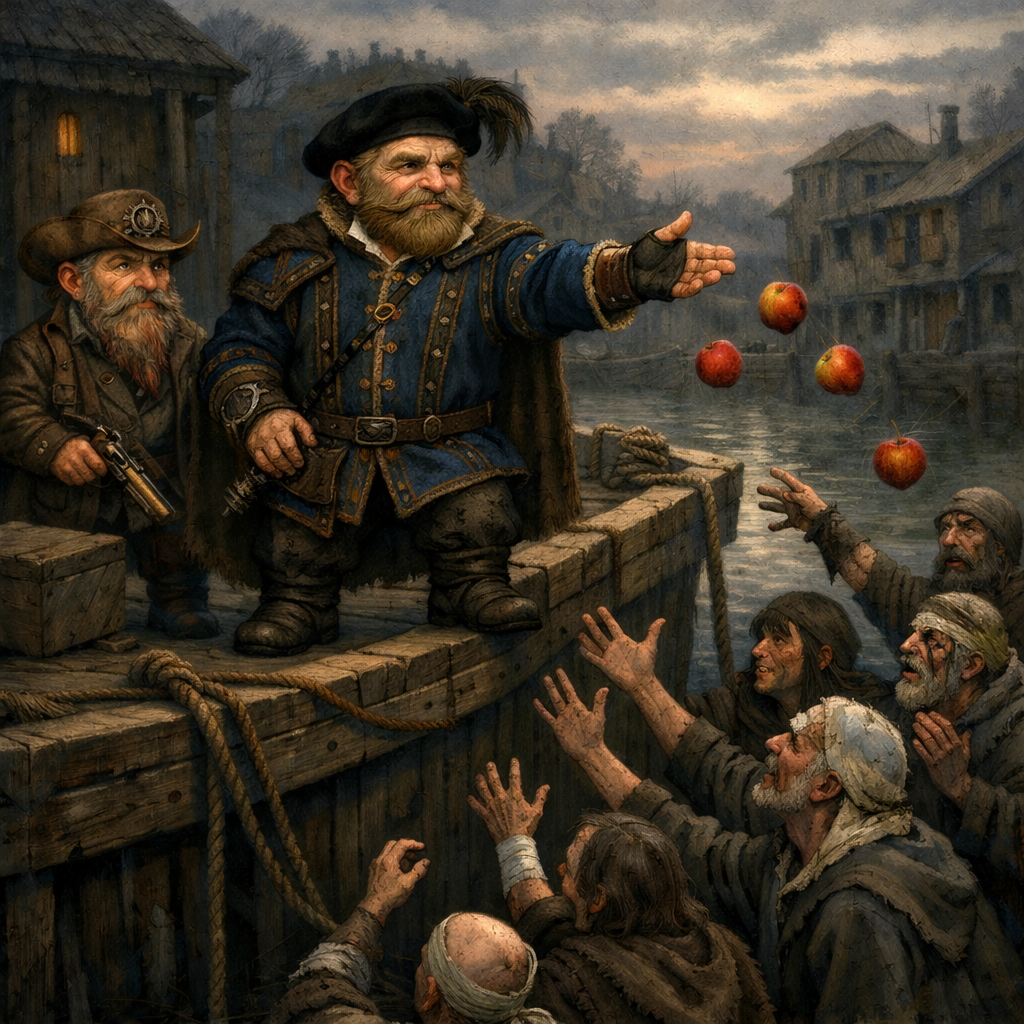
The Fraulein slid against the rotting dock with a tired groan of wood and rope, her hull heavy with stolen knowledge and ill-gotten relics. Wittgendorf rose before them like a wound that refused to close—empty streets choked with weeds, shuttered houses sagging inward, and a silence so complete it felt accusatory. Even before the first figures appeared, the place radiated failure: of gods, of lords, of every promise the Empire ever made to its forgotten corners.

They came out of the boathouse in ones and twos at first, then in a miserable knot—nine shapes that might once have been people. Hunger clung to them like a second skin. Their bodies told stories without words: missing limbs wrapped in rags, sores crusted and raw, mouths warped by too many teeth or too few, eyes dulled by pain and want. The smell of sickness drifted over the riverbank. Felrick’s instincts tightened, old reflexes from bounty roads and bad towns—this was not a crowd you let press too close, not if you valued your spine unbroken and your blood inside your body.

Thindruk did what nobles did when confronted with desperation: he raised his voice and imposed order upon chaos, if only by insisting it recognize him. His words—measured, practiced, and heavy with implied authority—cut through the shuffling misery. The beggars slowed, then halted, hope and suspicion warring in their hollow faces. Apples followed, arcing out from the deck, and the fragile order nearly shattered at once. Hands clawed. Bodies shoved. A knife flashed, not in threat but in the careful division of food too precious to waste. Felrick kept throwing until the scuffle lost its edge and hunger dulled into gratitude.

They spoke of plague. Of a storm that rolled in black and wrong, of crops that withered afterward, of animals sickening and then people. Two years of decline compressed into a handful of broken sentences. Sigmar, some said, had abandoned them. Others muttered prayers anyway, out of habit if nothing else. The name of the castle downriver surfaced again and again, like a tooth worrying a sore.

Then the guards arrived.

Eight figures in partial plate, steel dulled by neglect rather than use, faces hidden behind visors and masks. They moved stiffly, as if armor were not the only thing constraining their joints. At their head rode the captain, who lifted his visor only to reveal another mask beneath—polished, expressionless, and deeply unsettling. He did not greet them so much as demand justification for their presence, invoking quarantine and authority with the flat certainty of someone unused to being questioned.

Thindruk answered as he always did: with rank, implication, and a refusal to explain more than necessary. The exchange went nowhere. No writ was produced, no invitation accepted. The Baroness would receive them—tomorrow. Until then, Wittgendorf offered “hospitality,” the word sounding thin and brittle in the captain’s mouth. With that, the guards turned and marched away, leaving behind the sense that the village was less quarantined than contained.

The beggars scattered the moment steel withdrew, melting back into the boathouse like animals fleeing a torch. Silence returned, thicker than before.

They did not all leave the boat. Prudence demanded a watch, and Felrick stayed behind with Nora, eyes on the river and hands never far from weapons. The rest took to the village paths, passing shuttered homes and watching faces peer out from behind cracked boards. At the inn, an older man in better health than most examined an offered apple as if it were a loaded weapon before biting into it. The gesture lingered with Qavitrae—a reflex born not of mistrust, but of survival.

Not all within Wittgendorf had surrendered to rot. In a fenced garden of living flowers stood a man dressed too well for the place, his Bretonnian finery and powdered face an absurd contrast to the decay around him. Jean Rousseau introduced himself as the village physician, a foreigner by birth and temperament. He spoke easily, with practiced charm, but his words carried weight. He had seen this sickness from its beginning. He could treat symptoms, nothing more. True progress, he claimed, came from Lady Marguerite herself—studious, brilliant, and dangerously curious.

Dinner was arranged, wine promised. Rousseau’s interest in Thindruk was unmistakable, his gaze lingering just long enough to cross from politeness into intent. Thindruk, for his part, neither encouraged nor rebuffed him. In a place like Wittgendorf, alliances—even personal ones—were resources.

The Temple of Sigmar loomed above the village, its lead-clad roof dull beneath a grey sky. Once, it had been built with money and faith both. Now, its gilded hammer had been scraped nearly bare. Inside, the offertory lay smashed, the silver dish gone. Frescoes of Sigmar’s victories watched silently as if unsure whether they still mattered.

There was no priest to greet them.

The attached cottage told the rest of the story. Fire-scorched walls, a collapsed roof, charred bindings and half-burned pages scattered like dead leaves. Months old, perhaps more. No blood. No bones. Just absence, deliberate and violent. Someone had decided the priest—and his books—were no longer welcome.

The temple itself was not corrupted. That, at least, was something. Ransacked, defiled by desperation, but not tainted by the Ruinous Powers. Qavitrae felt the thin relief of that truth even as unease settled deeper. A temple raised a century ago, contemporary with Dagmar von Wittgenstein. A castle buckled after a terrible storm. A sickness that followed knowledge unearthed and uncontained.

By the time they left the temple, the light was fading. Dinner awaited. So did tomorrow, and the Baroness, and whatever truth lay coiled beneath Wittgendorf’s rot. The Fraulein remained at dock, her crew divided but alert, suspended between courtesy and violence.

The Enemy Within had not yet shown its face—but it was everywhere they looked.


Session Notes
  • GM recap of prior events leading into this session
    • The party previously ventured into an accursed basement chamber where a brass hexagram glowed with unholy light on the floor.
    • At the center of the chamber was a blood-stained table beneath a trapdoor described as being meant to channel lightning from the heavens.
    • The party had recovered six strange keys from undead abominations.
    • Felrick Flappan placed each of the six keys into its correct divot in the table.
      • When the final key was placed, it turned of its own accord.
      • The table then split apart, and the floor vanished, revealing a secret shaft (the GM described it as “a special hole”) descending into darkness.
    • Instead of immediate horrors below, the party discovered a sealed library, seemingly untouched by time.
      • In the library, on a desk among ancient tomes (including prophecy and astronomy), they found the journal of Dagmar von Wittgenstein, described as a wizard most foul.
      • Dagmar’s writings spoke of:
        • Fell meteorites
        • Warpstone and its “terrible power”
        • The Chaos god Tzeentch, who corrupts those who seek forbidden knowledge
    • Recognizing the danger, the party resolved to deny these secrets to their enemies.
    • The party then plundered the tower entirely, loading books, furniture, and other arcane materials onto their vessel, the Dandy Fraulein, and set sail for Altdorf.
      • In Altdorf, the GM specifically highlighted that Wanda’s bargaining went well.
      • The GM mentioned:
        • The Imperial Army demanded cloth for new uniforms.
        • Physicians treated severe wounds, “cutting away infection’s poison” with blade and leech.
    • Six days later, armed with knowledge gleaned from dangerous texts, the party arrived at Wittgendorf, a village in the shadow of a crooked castle.
      • The streets appeared empty, choked with weeds and debris.
      • The only sign of life at first was a wretched hound slinking through the ruins.
  • Arrival at Wittgendorf and initial layout

    • The party’s vessel, the Dandy Fraulein, pulled up to the dock at Wittgendorf.

    • The GM clarified a location detail: the castle is south of the village, not on the immediate approach as previously described.

      • The castle is visible from the village but sits a decent distance away, up on a cliff face farther down the river.
    • The village itself is a small cluster of buildings along the riverside, estimated at a couple dozen structures.

    • Two obvious “purpose” buildings were pointed out:

      • A boathouse (with a worn trail from the riverbank used for hauling poles/working on boats).

      • A Temple of Sigmar on the rise above the village, described as the largest building in town.

        • A statue of Sigmar with his hammer held high stands atop the roof, looming over the village.
  • Background context and rumors about Wittgendorf

    • The party discussed when the town was “condemned” / warned against:

      • The GM stated the rumors placed it at over a year ago, roughly a year and a half (with the note that word travels slowly).
    • The group recalled earlier travel in which they had sailed past this village when first going down to Grissenwald and Nuln.

    • The party connected the village to prior encounters:

      • Elsbet (the “creepy-voiced” girl) had said she was from Wittgendorf.
      • The party recalled that the mutants who attacked them had also said they were from Wittgendorf.
  • Thindruk’s interest in lead roofing

    • Thindruk Steelbone asked whether any of the grander buildings had lead sheet roofing (as used historically).

    • The GM confirmed:

      • The Temple of Sigmar has lead roofing.
      • The smaller buildings do not.
  • First visible townsfolk: the sick crowd from the boathouse

    • As the party secured the boat and began to disembark, the first villagers appeared:

      • A group emerged from the boathouse and shuffled toward the dock.
      • The party counted nine people in this initial group.
    • The party assessed whether the group was threatening:

      • They did not move with aggression or speed, but did not look healthy.
    • Awareness checks were called for as the group approached.

      • The GM described the general impression for those who didn’t get a strong read:

        • The villagers were thin and unwell.
        • They had sores on their skin.
        • They wore dirty rags.
        • They looked like they were suffering.
      • Specific details noticed by successful observers:

        • Nora Abendroth noticed clear signs of mutilation / missing limbs among the group:

          • One person appeared to be missing a left arm (the shoulder area sagging under a sack-like tunic).
          • Another was a woman missing her right hand.
        • The GM added that, as they got closer, additional injuries/deformities were apparent:

          • Missing noses, eyes, and ears among some villagers.
          • One villager had a mouthful of teeth that looked too large (an entire mouth of oversized teeth).
        • Felrick Flappan, on a critical success, noticed behavior suggesting desperation and discomfort:

          • Several villagers seemed eager to get close to the boat.
          • Many were scratching, implying severe irritation or infestation.
          • Felrick also noticed one villager discreetly producing a flask from their rags and taking a large draft when they thought no one was watching, then hiding it again.
    • When close enough, the villagers begged in raspy voices:

      • They asked for alms, food, and coin, crowding around the party as they climbed onto the dock.
  • Thindruk asserts authority and creates space

    • The party considered how to respond (fight vs. talk), but ultimately attempted to manage the crowd.

    • Thindruk, from the deck/dock area, spoke in a formal, commanding tone, claiming:

      • The party arrived on a secret mission from the Emperor, assured to restore the town.
      • They needed cooperation and, first and foremost, room to work.
      • They had brought immediate aid, but their mission could not be delayed.
    • The GM called for a social roll; Thindruk used Guile (noting it fit since the “imperial mission” was not official).

      • Thindruk succeeded, and the crowd backed off enough to give the party space, though they remained close and expectant.
  • Distributing aid: apples and the resulting scuffles

    • The party discussed what food they had available.

      • The GM explained the party did not have huge stores but did have enough to provide modest food without fully draining provisions.
      • A bushel/basket of apples was identified as available.
    • Felrick began distributing apples into the crowd.

      • As the first apple landed, the person who caught it was wrestled by others for it.

      • As more apples were thrown, the crowd realized there might be enough to go around.

      • The situation escalated into serious scuffles (though not a full-scale fight):

        • Villagers in slightly better health took apples from weaker villagers and tucked them away.
        • Some villagers tore into apples immediately.
        • One villager produced a small pin knife to cut off a piece of apple.
        • The GM reiterated signs of hardship: many villagers were missing teeth (aside from the one with the oversized mouthful of teeth).
  • Attempt to identify leadership in town

    • Thindruk asked if there was someone who spoke for the town or held authority.

    • After initial hesitation, the villagers responded:

      • “No, no, no. We’re just miserable beggars now.”
      • They gestured downriver, indicating the Lord lives there.
      • Another villager said the Lady is in the village today, and suggested the party might want to speak to her.
    • Nora asked (and the party considered) whether the local nobility were suffering like the villagers or doing better.

      • The GM requested a Scrutinize check.

      • With successful scrutiny in the group, the GM described:

        • Villagers were reluctant to be the first to speak.
        • Eventually someone said the nobles “do their best to provide,” and that “the lady Vic von Wittgenstein” provided care to the ill.
        • The GM noted the statement did not sound sincere to those who read the situation well.
  • Thindruk tries to summon the Lady to the boat

    • Thindruk clarified his social position:

      • As a Viscount, he had status, but he did not directly command the local Baron’s household on their own land.
      • He decided to attempt a diplomatic approach rather than wading through town immediately.
    • Thindruk addressed the healthiest-looking villager (a man in his late 20s) and asked him to deliver an invitation:

      • Invite the Lady of Wittgendorf to come to Thindruk’s vessel to speak with him urgently.
      • Thindruk offered a silver coin (a shilling) as payment for the errand.
    • The GM described that the messenger perked up at the mention of payment and left at a better clip than the others, heading into the village and disappearing past the first buildings.

    • Thindruk realized he had crowns but not a shilling, and asked Qavitrae if she had one.

      • Qavitrae produced a silver coin with a flourish.
  • What the villagers do with coin / how they survive

    • The party asked where villagers were spending money and whether merchants came by.

    • Villagers explained:

      • River merchants occasionally dock and sell meager rations for what little coin remains.
      • Merchants exploit their suffering but still take their money, keeping the village from outright starvation.
  • Timeline and cause of the village’s decline (as told by villagers)

    • When asked how long this had been going on, villagers said:

      • It had been almost two years.
    • Villagers described a key event:

      • A terrible wicked storm with roiling black clouds and unholy lightning.

      • After the storm:

        • Crops began to die.
        • Animals got sick.
        • Then the village got sick.
      • They called it a “terrible plague.”

    • Religious despair surfaced among villagers:

      • Some invoked Sigmar for protection.
      • Others declared Sigmar cares nothing for them, questioning why he would allow this.
  • Thindruk’s attempt to restore morale

    • Thindruk countered the despairing sentiment by suggesting:

      • Sigmar might be testing them to see if they are worthy of his favor.
      • They should take hope and overcome the challenge.
    • The GM described the response as half-hearted, with very little genuine hope remaining.

  • Questions about the castle

    • The party asked whether the castle was damaged by the storm and what its state had been previously.

    • Villagers claimed they had never been inside and emphasized:

      • The cliffs are treacherous.
      • The storm may have washed out part of the cliff face under the crooked-looking tower, causing it to buckle.
    • The GM noted there were “drawings of the castle,” and that they appeared improbable.

  • Arrival of armed guards

    • A group of armored men emerged onto the riverside road:

      • Eight armed men total.
      • One rode a large brown warhorse (destrier).
      • The others walked, fanning out around the rider.
    • Their equipment and appearance:

      • Partial plate armor
      • Longswords
      • Crossbows
      • Full-face mask helmets
    • The party assessed their condition and readiness.

      • The GM called for Awareness checks.

      • Thindruk critically assessed them:

        • They did not have the bearing of disciplined soldiers.
        • Their gear was not ruined, but had spots of rust and did not look carefully maintained.
        • Their weapons did not look heavily used in battle (no extensive wear consistent with war service).
        • Their armor did not show obvious signs of being patched from fatal battles.
        • Some moved with a stiffness/clumsiness, suggesting injuries or poor health despite being more vigorous than the beggars.
  • Confrontation with the Captain of the Guard

    • The mounted figure demanded: “State your names.”

    • Qavitrae formally announced:

      • They were graced by Viscount Thindruk Steelbone, owner of the vessel Dandy Fraulein, out of Bögenhafen.
      • She asked who they had the pleasure of addressing.
    • The guard leader introduced himself as:

      • Captain of the Guard of Castle Wittgenstein, Schiff Doppler.
    • Doppler’s mask and presentation:

      • He flipped open his helmet visor.
      • Underneath was a well-polished metal mask—the only thing the GM described as truly well maintained.
    • Doppler relayed information and questioned them:

      • He referenced Lady Marguerite being in town that day and being told of the party’s arrival.
      • He asked why they had disregarded the Prince of the Reikland’s quarantine of the village.
    • Thindruk responded by doubling down on his stated justification:

      • His reasons were his own, but they were of high priority to the Emperor and the Empire.
    • Doppler asked for proof:

      • Requested letters verifying the party’s authority and purpose so he could communicate to his lady.
    • Thindruk refused to provide documentation and pressed for a face-to-face meeting:

      • Said matters were best handled delicately and directly.
      • Asked if there was any reason his invitation would not be accepted.
    • Doppler’s response:

      • Said Lady Marguerite was taking word back to the castle, and that the Baron and Baroness would be informed.
      • Claimed the family would need a day to be ready to receive the party.
      • Stated the village would show “every hospitality,” but delivered it flatly.
    • The party attempted to read sincerity from Doppler’s statement (Scrutinize under difficult circumstances due to his masked face).

      • The outcome was effectively inconclusive: the GM emphasized Doppler’s delivery was flat and not welcoming.
    • Thindruk accepted the delay (a day) despite being offended by the tone and circumstances.

    • Thindruk attempted to invite Doppler aboard the Dandy Fraulein for hospitality.

      • Doppler did not accept or engage; he turned his horse and departed with the guards.
  • The beggars disperse

    • As soon as the armed guard arrived and then departed, the GM described the beggars’ behavior:

      • They scattered quickly but discreetly, hurrying back to the boathouse.
  • Assessing the village’s condition after the guard encounter

    • The GM described the overall village state:

      • Buildings needed maintenance, but were not all collapsed ruins.
      • Overgrowth was widespread (grass, hedges, weeds).
      • Many windows were shuttered.
      • People occasionally peeked out to watch events at the dock.
      • A small fenced agricultural area/garden was visible but overgrown and not currently producing food.
  • Discussion of the castle’s river access and approach

    • The party considered traveling toward the castle by boat.

    • The GM clarified:

      • The castle sits on a cliff and is not easily accessible from the southern riverside.

      • Approaching from the southern side would likely require:

        • Weighing anchor
        • Potentially swimming to shore
        • A wilderness hike through woods and up the cliff face
      • The dock at Wittgendorf is the most practical nearby mooring point.

  • Party theory: the meteorite / warpstone and the lead box

    • The party recapped their working theory from Dagmar’s writings:

      • Dagmar von Wittgenstein, through prophecy and astronomy, determined where a meteorite (warpstone-related) landed.
      • He retrieved it roughly 100 years ago.
      • A letter indicated he had a lead box and a place ready for it in the castle.
      • Since it was not in Dagmar’s tower, the party suspected it may have been brought to Castle Wittgenstein.
    • The party connected the village’s condition with the timeline:

      • They suggested the box may have been opened (or failed) around the time the village’s decline began (~two years ago), possibly explaining the storm and plague.
  • Considering leverage and optics

    • The party recalled they had stripped Dagmar’s tower thoroughly, including potentially taking portraits/paintings.

    • They discussed possible uses for recovered goods when dealing with the Wittgenstein family:

      • Returning items as “found goods” to gain access or goodwill.
      • Questioning why items from the tower might be circulating despite the quarantine.
      • Using a crest or recognizable property to press the nobles for answers.
    • The group’s attitude leaned toward suspicion:

      • Felrick indicated he did not assume the nobles were victims.
      • Others echoed suspicion, especially given the guards’ masks and behavior.
  • Decision: gather information rather than simply wait

    • The party did not want to spend an entire day idle waiting for the Baron and Baroness.
    • They chose to gather rumors and investigate the village in the meantime.
    • They identified the Temple of Sigmar as a likely source of reliable information (assuming a priest would be a key community figure in a crisis).
  • Splitting the party

    • The party decided not to leave the boat fully unattended.

    • They split responsibilities:

      • Felrick Flappan and Nora Abendroth remained behind to guard the Dandy Fraulein at the dock.
      • Thindruk Steelbone, Qavitrae, and Wanda Hahnemann went into the village to investigate and seek information (with the Temple of Sigmar as a key destination).
  • Moving through town toward the Temple

    • As Thindruk, Qavitrae, and Wanda walked through the village, the GM called for Awareness checks.

      • Thindruk was described as distracted, lost in thought about coming political/social complications.
      • Wanda successfully noticed key details along the way.
    • Wanda noticed a building near the path that, despite earlier assumptions about a “boathouse,” had the sign and placement of an inn/public house.

      • An older balding man, in better health than the beggars, stood on the front step with arms crossed watching them.
    • Wanda tossed an apple to the man.

      • He caught it, studied it, looked at the group, gave a small wave, took a bite, and went back inside.
    • Qavitrae made a Scrutinize check about the man’s reaction.

      • The GM described the man’s behavior as a practiced reflex: he inspected food as if he habitually checks whether what he eats is safe.
    • Qavitrae warned Wanda that locals might not trust food and suggested the party should avoid consuming anything from the town.

  • Encounter with a well-dressed gardener

    • Wanda noticed another unusual sight: a tended flower garden near a fenced property.

      • It was described as one of the only still-maintained things in town.
      • A man there wore colorful clothing, a crisp white shirt, gloves, and what looked like a wig.
      • He saw the party, set down a small rake, removed gloves, and politely waved.
    • The party approached the house.

      • The home was described as a well-maintained two-story townhome with glazed windows and a thin wisp of smoke from the chimney.
      • It stood out as notably nicer than most nearby buildings.
    • Education checks were made to identify the man’s style.

      • The party recognized the dress as Bretonnian.
      • The man also wore substantial white powdered makeup, giving him an almost theatrical appearance.
    • The man greeted them, acknowledging they were not from Wittgenstein, and asked what brought them.

    • He introduced himself as:

      • Jean Rousseau, the village doctor, now practicing in the Reikland, originally from Bretonnia.
    • Conversation details:

      • Jean commented on elves and their rarity outside forests; Qavitrae noted she had spent roughly a century within the Empire.

      • Qavitrae asked what brought him from Bretonnia.

        • Jean praised Bretonnian wine and named Bordeleaux as his home province, boasting it made the finest red wines.
    • The party offered to share Bretonnian wine with him.

      • Jean expressed interest in speaking with them and acknowledged:

        • He had been treating the village’s illness as best he could.
        • The plague was unlike anything he had seen.
        • He could treat symptoms.
        • Lady Marguerite was a scholar who had been studying the sickness extensively and had made “inroads” toward true treatment.
    • Dinner arrangements were made:

      • Jean offered to cook a Bretonnian meal, but the party preferred hosting him aboard their vessel.
      • Jean agreed on the condition the boat remained at dock, explaining he had a sensitive stomach and even slight water motion made him ill.
      • Qavitrae stated the boat would remain at dock while their work in service to the Empire was ongoing.
    • Thindruk asked if Jean had a wife or partner.

      • Jean said he was single and solitary.
      • The GM described Jean locking eyes with Thindruk and expressing strong interest in learning more about him.
      • Thindruk made an easy Scrutinize check and determined Jean was flirting.
      • Thindruk did not rebuff him and chose not to encourage overtly, maintaining a neutral stance.
    • A villager interrupted Jean’s conversation:

      • A man named Martin complained that a horrible cough had returned.
      • Jean said he still had medicine and led Martin away to treat him.
    • The party set the expectation that Jean would meet them for dinner around sunset aboard the Dandy Fraulein.

  • Arrival at the Temple of Sigmar

    • The party reached the Temple of Sigmar via a worn path, crossing a rickety wooden bridge over a stream.

    • The GM described the temple as:

      • The largest building in town (big enough to hold most/all villagers).
      • The main roof had lead cladding/shingles.
      • A side extension had a wooden roof and appeared like an attached cottage or living quarters.
    • Architectural and decorative details:

      • A roof structure with a small raised portion and a brass dome.
      • A roughly life-sized statue of Sigmar on the roof.
      • A mechanism allowing the statue to be lit so Sigmar appears aflame and impressive at night.
      • The GM noted this suggested the temple was built when the community had some money (and was perhaps unusually grand for a village this small).
    • Signs of neglect and stripping:

      • Over the entrance was the embossed Sigmarite hammer symbol.
      • It had once been gilded, but much of the gilding was missing—appearing scraped/stripped away rather than merely dirty.
    • Entry:

      • The main doors were heavy wooden double doors, closed but treated as a public entry.
      • Qavitrae opened the door and entered with a brief acknowledgement of Sigmar.
  • Inside the temple: ransacked entry and missing alms

    • The party entered the foyer/antechamber.

    • The normal features of a Sigmarite temple entrance were damaged:

      • A wooden offertory/tithe stand was smashed into several pieces on the ground.
      • The expected dish/tray for offerings (likely silver) had been smashed out and stolen.
    • The GM described frescoes depicting scenes from Sigmar’s life:

      • Sigmar as a large bearded warrior in shining golden armor fighting orcs with his hammer.
    • Qavitrae immediately searched for signs of Chaos defilement.

      • The GM called for Awareness checks.

      • Qavitrae achieved a strong result; Wanda did not.

      • Qavitrae found:

        • No clear Chaos graffiti or subtle defacement.
        • No hidden scratch-marks or symbols.
        • The temple looked ransacked, not ritually corrupted.
  • Searching for clergy and discovering the burned quarters

    • Thindruk called out for whoever maintained the temple (the priest), but there was no answer.

    • The party moved to investigate the attached cottage/quarters around the back side.

    • They found the cottage in severe disrepair:

      • Evidence of a substantial fire inside.

      • Part of the roof had collapsed.

      • What was not burned appeared ransacked and smashed.

      • Furnishings included:

        • A small bed/cot
        • An overturned chest left open
      • Among the ashes, they found remnants:

        • Book bindings
        • Surviving pages/fragments
        • Indicating that books had been deliberately burned.
    • The party looked for evidence of death:

      • No skeletal remains were found.
      • No obvious dried blood was found.
  • Dating the fire and identifying what burned

    • The party attempted to determine how long ago the fire occurred.

      • The GM allowed an Education (or Folklore) approach and treated it as an extended effort due to careful examination.
    • Findings from their careful inspection:

      • The damage was not recent.

      • Smoke odor was faint and only noticeable after rummaging.

      • The cottage had been exposed to the elements:

        • Rain had entered through the damaged roof.
        • Materials had been soaked and dried over time.
      • The GM concluded the fire likely happened months ago.

      • It did not appear anyone had been in the cottage recently, possibly not since the fire.

    • From the surviving fragments:

      • The party concluded the destroyed books were religious tomes and histories associated with the temple.
  • Estimating the temple’s age

    • The party asked how old the Temple of Sigmar might be relative to Dagmar von Wittgenstein’s activities.

    • Based on architectural style and the statue’s style (supported by successful Education checks), the GM stated:

      • The temple appeared to be about 100 years old—roughly contemporary with the era when Dagmar might have been moving warpstone-related materials toward the castle.
  • Session end point

    • The GM noted the party had only explored the entrance and the burned cottage/quarters so far.
    • The group planned to continue next session by looking further around within the main body of the Temple of Sigmar.
    • As the session closed, the party raised a cautionary point remembered from rumor: do not fish around Wittgendorf (the implication being something is wrong with the local fish/waters near the village).