The forest closed around them like a fist.
What had begun as a hunter’s trail narrowed into a single, choked artery through bramble and thorn. Qavitrae felt the shift before she could name it. The air thickened. The hush deepened. The old woods were awake here, not merely growing but watching. She lifted a hand for silence and studied the thicket ahead—a living wall of briar so dense that daylight broke against it like surf on stone. Only the faintest crease in the green betrayed a path.
“Mayflies,” she murmured, her voice low and steady. “This place is warded. Walk lightly. And let there be no needless blood.”
Felrick gave a faint, crooked smile at that, but he did not argue.
They went single file, easing between hooked thorns and snagging vines. Qavitrae’s sharp eye caught the first snare—a bent sapling strung with tension, a trigger hidden beneath leaf litter. Another glance revealed the truth: not one trap, but many. Ropes were laid like spider silk, and behind them spears sat cocked and waiting, angled to scythe through flesh should a foot fall wrong. She guided them through with quiet gestures, her respect for the unseen builders growing with every step.
When they emerged, it was into a green bowl of unexpected life.
Within the thicket’s embrace lay a camp—tents stitched from hide and cloth, cookfires burning low, lines strung with drying garments. It was not a settlement, not yet, but it was no desperate scatter either. This was endurance given shape.
Their arrival shattered the fragile peace. Mothers snatched children from the open. Men and women seized spears and bows, forming a rough line before the heart of the camp. Suspicion flared in every gaze.
It was Thindruk’s measured diplomacy and Wanda’s steady presence that held steel at bay. But it was the wolf-toothed symbol at Wanda’s breast and Qavitrae’s ageless poise that won them audience.
Sigrid stepped forward—a young woman cloaked in brown, a simple blade at her side, eyes too old for her years. She studied them as one studies wolves at the tree line.
“How did you find us?”
“No one sent us,” Thindruk answered, voice smooth as polished stone. “Skill and fortune alone.”
They laid down their weapons at a respectful distance. So did she. The gesture was symbolic; there were enough armed folk behind her to ensure no treachery would go unanswered. Still, it was a beginning.
Around a modest fire they spoke.
Sigrid told them of Wittgendorf’s decay—the storm that had split the sky two years past, the creeping malaise that followed, the von Wittgensteins retreating into their cliff-perched fortress. People taken to the castle never returned. Beastmen roamed the woods by night, yet seemed almost leashed to the castle’s influence. She, a priestess of Raya, had gathered those who would not wait to rot. The forest protected them—barely.
When Thindruk spoke of an ancient artifact brought to the castle generations ago, Sigrid did not dismiss it. “Evil is drawn there,” she said simply. “It festers.”
The murmurs of her people carried anger, grief—and hunger for retribution.
There were caves, she revealed, beneath the castle. Old stories claimed the well in the bailey sank into those depths. They had tried them once. Narrow tunnels. Running water. And horrors in the dark.
“Lashworms,” she called them.
Long, slender things that hid in stone fissures, casting near-invisible filaments across passageways. Trip the thread, and a hooked barb would shoot forth with murderous speed, punching through flesh and dragging meat away. Two of her people had died screaming in that blackness.
Felrick and Wanda recognized the description. Thindruk’s brow furrowed. Knowledge was a blade; now they knew what cut.
They did not promise open war, not yet. Thindruk’s mind moved beyond bloodshed, weighing consequence. If chaos truly ruled those walls, proof would be as valuable as steel. Proof could turn accusations into justification. Justification into legitimacy.
But first, the dark.
Before they departed, Sigrid pressed damp earth and crushed leaves to Wanda’s brow, invoking Raya’s strength against the poison in root and stone. Wanda felt the weight of it—a quiet, natural benediction far removed from Sigmar’s roaring fury.
Then they were led away from camp, through hidden paths that bent and doubled back to avoid the castle’s patrol routes. By noon, they stood before a low, root-choked opening in a mound of earth. A black mouth.
The forest folk would wait nearby, hidden.
Felrick went first, pride and pragmatism intertwined. A dwarf and a gnome might follow an elf through woods, but underground was another matter entirely.
The cave swallowed them.
The first stretch was tight and oppressive. They crawled, wriggled, passed gear through narrow stone throats. The air grew damp and stale. Time dissolved; only the slow guttering of oil and torch marked their passing. Somewhere deeper, Thindruk and Nora began to hear it—the muted rush of unseen water, echoing through rock.
After more than an hour and a half, the tunnel branched.
Near the fork lay a human skeleton, crumpled and long abandoned. Tattered cloth clung to yellowed bone. Dried scraps of flesh still clung in places. Years, at least.
They turned right—the path Sigrid’s people had taken.
And then it came.
A scream.
Not human. Not beast. A shrill, tearing ululation that seemed to claw at the stone itself. It reverberated through the tunnel, directionless and everywhere at once.
Nora’s heart seized. The world tilted. She collapsed without a sound, oil spilling from her fallen lamp as darkness thickened around them.
Felrick caught the direction: right. The scream had come from ahead.
Qavitrae knelt, pressing smelling salts beneath Nora’s nose. The sharp scent snapped her back to breath and fear.
“What in all hells was that?” Nora rasped.
No one had an answer.
They relit a torch. Shadows danced wild across the stone.
As Felrick edged forward, torch held high and pistol ready, he saw it.
From a crack in the ceiling, a face extended—elongated, wrong, humanoid yet not. It emerged on a slick, retracting appendage, eyes glinting in firelight before snapping back into the fissure.
Chaos, Qavitrae thought. The word was both curse and diagnosis.
They pressed on, passing into a cavern faintly illuminated by sickly green glow. Mushrooms carpeted the stone, their bioluminescence dim but pervasive.
Thindruk studied them carefully. Not the sort to burst in choking spores—but wrong all the same. Leave them be.
They moved cautiously, watching the ceiling for filaments, the cracks for movement.
And then they found the nest.
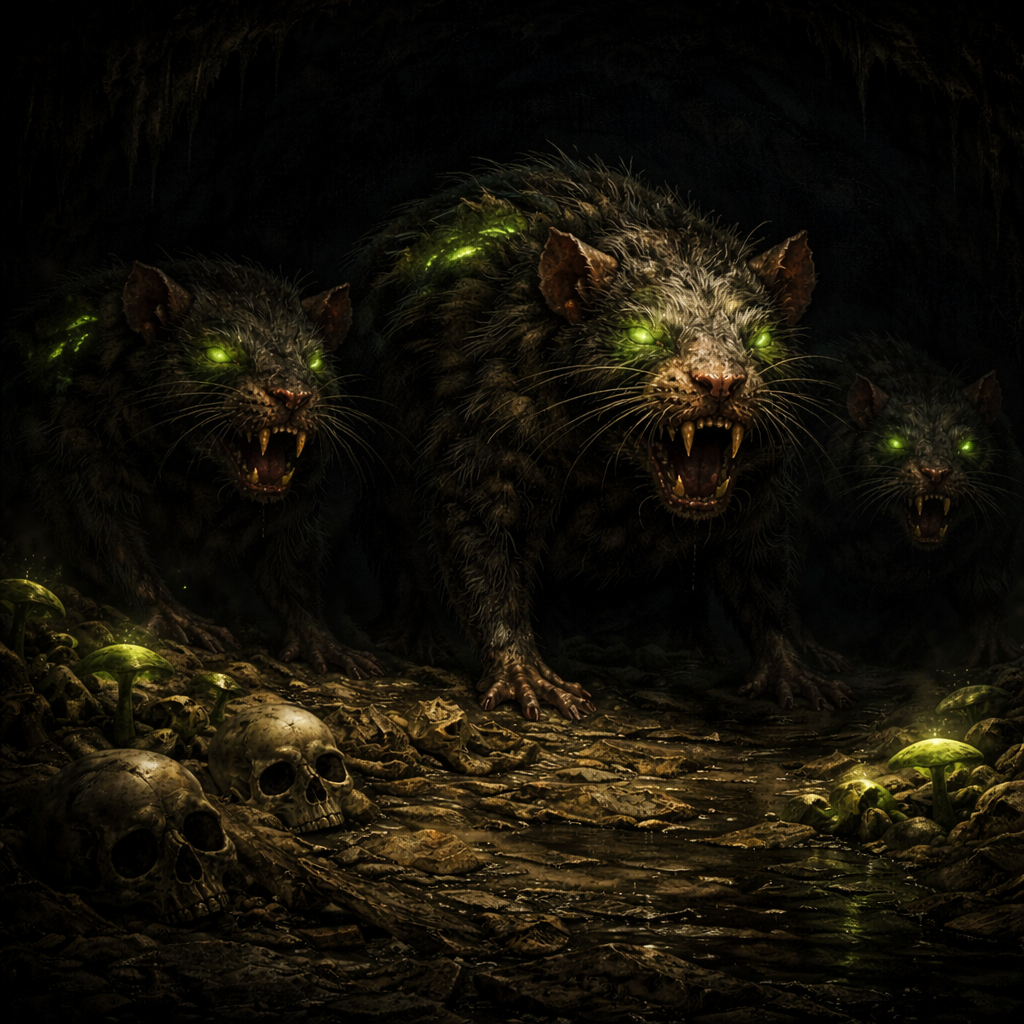
A wider cavern opened ahead, strewn with refuse and gnawed remains. In the gloom, shapes shifted. Six-foot-long rats lifted their heads from the midden heap, fur matted, eyes reflecting torchlight with a hateful intelligence. Their bodies glimmered faintly with the same green corruption as the fungi.
The creatures regarded them in silence, whiskers twitching.
Steel was drawn.
In that breathless moment before violence, each of them felt it—the truth that this was only the threshold. Beneath Castle Wittgenstein, rot ran deep.
And something had screamed.
The party begins the session at the point where they are approaching a dense thicket in the woods near Wittgendorf, following hunting trails that appear more traveled than the village’s “no one goes into the woods” story suggested. The GM gives an event-based recap of the prior session’s key facts: Servants/soldiers of Castle Wittgenstein rode into Wittgendorf and demanded the party turn over their boat as part of enforcing a quarantine. The party refused; the confrontation nearly turned into a “bloodbath.” Wanda intervened to de-escalate, resulting in a revised ultimatum: either leave the village or surrender the boat. The party chose to leave the village, returned to Kemperbad (briefly), did shopping, and reconsidered plans (including Altdorf, but did not go). They formed a plan to learn secret ways into the castle by bribing villagers with food and hired someone to guard the boat. They anchored along the Reik and hiked toward the village; along the hike they noted: The party ended last session approaching an extremely dense thicket with a narrow, obscured path inside it. Qavitrae assesses the thicket. The GM asks Qavitrae for an “elfiest” roll (Survival / Lore of the Wild). Qavitrae succeeds and senses the thicket is protected by old forest magic, likely warding off those the forest believes “shouldn’t be there.” Qavitrae clarifies intent: The GM establishes the condition of passage: Qavitrae warns the party (directing particular attention toward Felrick) to avoid violence in the thicket to prevent repercussions. The party enters the thicket single-file along a narrow path through brambles. Qavitrae notices small human-made icons/tokens hanging among the brambles. Wanda (as a follower of Ulric) and Thindruk (via upbringing/education) identify the tokens: Wanda makes a point of displaying her holy symbol of Ulric prominently on her chest (over armor, with wolf trim), signaling religious alignment with the old ways. The party discovers a lethal trap within the thicket. The GM calls for Qavitrae to make an Awareness check; she succeeds. Qavitrae spots a concealed snare trap in the leaf litter. More importantly, Qavitrae identifies additional hidden mechanisms: Qavitrae carefully guides the party past the trapped area, instructing them where not to step. The party emerges into a concealed camp within the thicket. The interior is notably more verdant and healthy than outside the thicket. The party sees signs of habitation: Their sudden emergence leaves them fully exposed with nowhere to hide. Camp reactions are immediate and mixed: First contact and de-escalation with the camp. Wanda steps forward, presenting herself as respectful of the old ways and stating they mean no harm. Thindruk adds a formal apology for entering unannounced and asks whom they may speak with. Thindruk introduces Qavitrae as their skilled tracker and emphasizes: A young woman steps forward from the defenders: She is skeptical but acknowledges the party does not “smell like” servants of the von Wittgensteins (stated as a figure of speech, with mention that some truly “have a rut”). When the party mentions they have food, the camp visibly reacts to that offer. The camp leader gives directions and begins controlled diplomacy. The young woman identifies herself as Sigrid. She orders three camp members to quietly check the area around camp and return immediately if they see anything. She invites the party to sit at the fire and says she will answer questions. The party gets a quick read on the camp’s permanence: Camp customs and weapon protocols are observed. Felrick assesses the camp’s combat readiness. Felrick makes a Warfare roll and succeeds strongly. Observations: The party and camp begin a structured exchange at the fire. The camp offers the party modest “guest” food: The party considers offering their own rations immediately, but the GM notes it may be better to do so after the camp’s initial hospitality is established. The GM sets the time at approximately 10:00 a.m. for the party’s arrival into the thicket/camp area. Sigrid explains who the camp is and why they’re here. The camp is composed of refugees from Wittgendorf who concluded they had to flee or die. Sigrid identifies herself as a priestess of Raya, tied to these woods (tending forest, animals, and trees), and says she occasionally visited the village. She recounts a familiar timeline: She attributes the worsening to the von Wittgensteins and the castle: Castle forces have tried to find the camp repeatedly. When camp hunters go out, they are sometimes hunted in turn. The castle’s people have “invited foul creatures” into the woods: beastmen. Qavitrae asks if beastmen signs were just track-cover; Sigrid confirms beastmen are real and active. The party explains their broader mission and introduces the artifact. Thindruk describes the party’s pursuit: Sigrid responds that this fits what they have seen: Camp attitudes toward the von Wittgensteins and action against the castle. A man asks directly if the party plans to do something about the von Wittgensteins. The party states their intention is to remove the artifact and acknowledges that dealing with the castle’s occupants is likely unavoidable. Some camp members react with rising hope (“maybe this is our chance”). Sigrid, however, asserts leadership and draws a firm boundary: The camp provides actionable intelligence about castle infiltration. Sigrid confirms there are caves beneath the castle that may lead up into it. The camp estimates they have about 30 people who can fight (with others often out hunting/patrolling). Sigrid suggests practical options if the party can enable entry: The camp notes they lack boats; the party notes their boat could potentially carry many (and the hold is mostly empty aside from recovered furnishings/antiques). Discussion of the camp’s preferred assault concept (if entry becomes feasible). The camp’s outline plan (described as previously discussed among them): They believe their numbers could be comparable to the castle’s defenders (though they suspect more defenders exist than the “20 knights” seen, possibly including converted river travelers/cultists). The party asks about threats in the caves; Sigrid describes lashworms. Sigrid describes creatures in rock holes/cracks that lash out: Party knowledge checks: The party discusses countermeasures: Clarifying the cave risk and uncertainty. Sigrid emphasizes: Discussion of the plague/affliction and notable castle figures. The party asks whether symptoms relate specifically to the face; camp consensus: The party asks about the masked castle captain. Thindruk considers political consequences of overthrowing the castle’s rulers. Thindruk worries that if the party helps the camp take the castle, the Empire might later punish the peasants for defying their feudal lord. He explores whether there is a path to legitimacy: The GM indicates: Thindruk references contacting the plenipotentiary in Kemperbad (a figure they previously befriended) for advice and support. The party decides on priorities: scout first, equip later. The party debates returning to town to buy weapons/rope versus scouting immediately. Concerns raised about purchasing large quantities of weapons drawing attention in town (e.g., “Are you pirates? bandits? mercenaries?”). A cover story is considered (outfitting a mercenary company / claiming to supply conflict elsewhere / war profiteering). Ultimately, the party aligns on: Constraints discussed: Wanda requests a religious blessing before the cave expedition. Wanda asks Sigrid for a blessing, noting it has been a while since she has been among followers of the old gods. Sigrid performs a ritual: The camp helps the party with situational intelligence and planning. The party requests as detailed a sketch as the camp can provide of the castle layout. The GM clarifies the castle structure as understood by camp knowledge: The party discusses whether cave exits into the inner area are likely: Thindruk suggests Sigrid also consider a plan to lure some defenders out into the forest before an assault, reducing castle manpower. The party is guided to the cave entrance. The camp leads the party along obfuscated paths to avoid wider trails used by castle guards during forest searches. Arrival time is set around noon. The cave entrance is described as: Camp guidance: The party prepares for the cave and sets marching order and light sources. Nora takes a large slice of salted/cured meat as potential bait. Light and vision: The group establishes order with Felrick in front (best suited to navigate), with others close behind and a lamp/torch providing light for the rest. The party enters the cave and advances deeper. The cave alternates between: Time is estimated by lamp oil consumption; after roughly 1.5 hours, the party reaches a notable branching point. The party reaches a prepared map point and finds remains. At the branch in the tunnel, the party finds a human skeleton: The party recalls/uses the camp’s reported route: The party detects environmental cues deeper in the cave. The party commits to following the known route toward the lashworms. A stress event occurs as the party turns right. The GM calls for Stress tests. Nora suffers a critical failure: Qavitrae’s oil lamp is affected during the collapse: The party attempts to localize the scream: The scream is described as: Nora is revived. Qavitrae uses smelling salts from her supplies. Nora wakes disoriented and alarmed, stating she heard something but did not see anything. Party members interpret the event as “demonic” or unnatural and prepare weapons. The party re-establishes light and continues. The party finds a dim green glow and discovers glowing mushrooms. Down the tunnel, a faint glow appears. Felrick and Thindruk can see clearly enough to identify mushrooms giving off a dim, sickly green light. The GM calls for Awareness checks; Felrick spots a more immediate threat during this process: The party reacts: The party assesses the glowing mushrooms. Thindruk makes a Survival check assisted by Felrick; the result is a critical success. Conclusions: The party advances past the mushrooms cautiously. They watch for: Weapon readiness is discussed: The party enters a larger cavern and discovers an immediate threat. The tunnel opens into a larger space where the party finds a nest of immense rats: Multiple rats are present and visibly react, staring back as the party’s light enters the cavern. The session ends on the threat reveal. End-of-session mechanics and wrap-up (as recorded in play). The GM awards 100 Reward Points (RP). The GM references using revised rules for corruption exposure in the cave, requiring a Toughness check to determine corruption gain under these circumstances. Due to her earlier critical failure, Nora is required to make an easy Toughness check: The GM grants Nora a session-to-session benefit:Session Notes