The woods around Wittgendorf swallowed sound like a grave. Even the wind seemed reluctant to pass too loudly between the trunks, as though it feared to wake what slept in the shadows. Beneath those roots and stones, under the slow pulse of the earth itself, the party found the throat of the castle—a black mouth opening into damp stone and stale breath.
The villagers had called it salvation: the caverns beneath Castle Wittgenstein. A hidden way in, if one dared to crawl through filth and darkness. They had spoken, too, of lashworms, of beastmen, of a priestess of the old goddess Raya who kept a fragile sanctuary in the woods. What they had not said was how quickly hope curdled once one stepped into that cavern and felt watched.
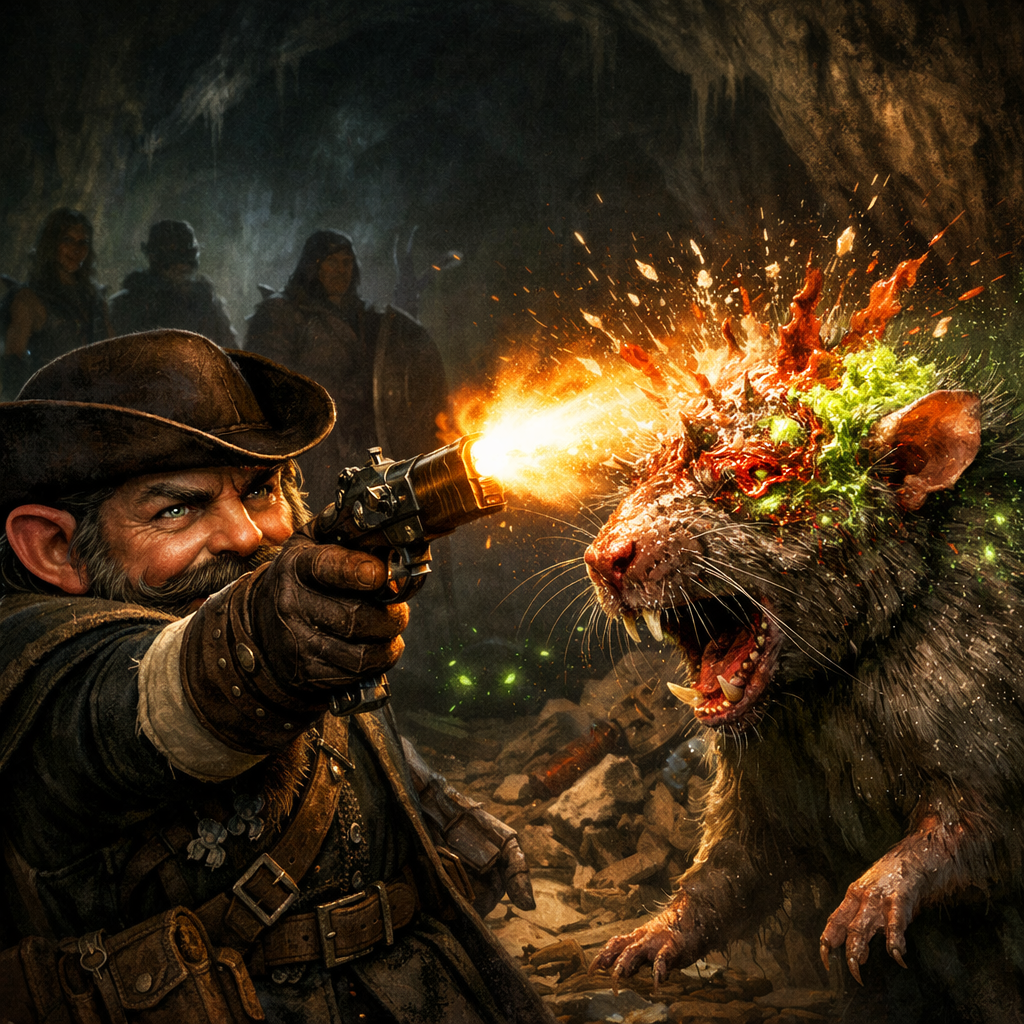
Felrick led them around the bend and into a vast chamber strewn with refuse. Midden heaps rose like rotten cairns, bones and pottery shards and scraps of cloth tangled in damp rot. The glow came first—faint, unhealthy green—before the shapes resolved themselves. Rats, each the size of a large dog, their fur clotted and dusted with that same sickly phosphorescence, their eyes burning like coals buried in ash.
They did not scatter. They watched.
Qavitrae’s voice hissed softly behind him. They could not leave such things at their back. Better to kill vermin now than be gnawed in the dark later.
Felrick sighed, lifted his pistol, and fired.
The report of gunpowder cracked the cavern open. Flame spat from the muzzle. One rat’s skull burst apart in a spray of bone and green-tinged gore, the echo chasing itself down every tunnel. The remaining beasts fled at once, scattering into black passages, claws scraping stone.
The silence that followed felt heavier than before.
They sifted the trash heap warily. Wanda stood guard, shield ready, while the others rummaged through the ruin of human living. This was no random midden. The refuse bore the shape of a story: gnawed vegetable scraps, bones cracked for marrow, torn clothing. Thindruk overturned a shard of pottery and uncovered the cracked skull of a child.
The bone was small. Too small.
More bones followed. Human. Some warped, some bearing strange deformities. A three-fingered arm, stripped to the pale curve of bone, a silver bracelet still looped around its wrist. Flesh had been eaten. Something had fed here.
Drag marks scarred the stone, leading deeper into the caverns.
They followed.
The lashworms waited in the walls.
Felrick’s whip lashed forward into the narrow corridor ahead, probing for danger. Something shot from a crevice—too fast to see clearly—and withdrew just as swiftly. When Nora tossed a slice of meat into the tunnel, a fleshy tendril snapped out and dragged it back into the rock with a wet, violent yank.
The creatures were not subtle. They were hungry.
So the party fed them.
Wanda, gloved against the slime, hauled the carcass of the slain rat and flung it into the corridor. From several unseen cracks came lashing strikes, tearing flesh away in greedy chunks. When the remains were pulled back and cast in again, nothing moved. The worms were sated—for now.
Beyond the lashworms, the air changed. Water ran through the caverns in a narrow stream, clear and cold, cutting through stone worn by ancient floods. They crossed carefully, Nora vaulting with athletic ease, others aided by steady hands and measured breath.
The rats’ trail led them onward.
Then the cavern widened again, and they found the source of the refuse.
A mound of trash lay beneath a shaft of thin daylight. Twenty feet above, stonework lined a vertical tunnel—the interior of a well. Stalactites hung like teeth, and among them clung shapes that made the skin crawl.
Bats. Enormous. Wings folded around bodies as long as men were tall, fur dusted with the same green powder as the rats. They slept in uneasy clusters, claws dug into stone, their chests rising and falling in slow rhythm.
One cry, one spark, and they would descend.
They did not linger.
Instead, they edged along the cavern wall and found, carved into the stone, a spiral stair.
It wound upward for long minutes, each step a measured risk. Thindruk’s dwarven eye traced the masonry as they climbed. Human stonework, yes—but clever. Old. Not ancient like the well, but forgotten enough that moss crept across the steps untroubled.
At the top waited a small, featureless room.
No doors. No windows.
Only stone.
Thindruk studied the walls and saw what others would have missed: the faint pivot points, the careful balance of weight. A hidden door, disguised as solid masonry, waiting to turn.
They listened.
Through the thickness of stone came faint voices. Not nobles. Not lords in silks and arrogance. Servants. Hungry, whispering about food and cures that did not work. The castle was not at ease.
They did not open the door.
Instead, Thindruk leaned a copper coin against the hidden seam—a silent sentinel to tell them if the door was used in their absence—and they descended.
At the base of the stairs, darkness stirred.
Wanda caught the movement first—a shape hurtling from the black. She raised her shield just as a rock the size of a man’s skull slammed into it. The impact jarred her arm to the bone.
A lumpy, slapping sound echoed as something fled into the dark.
They flung a torch toward the motion and glimpsed it for an instant: a twisted figure, limbs disproportionate, skin hanging in folds, a face stretched in a rictus grin. It moved like a sack of meat dragged across stone, yet it leapt with unnatural speed.
Joe’s crossbow bolt struck its back before it vanished. The creature screamed—a high, wet shriek that scraped against memory—and then it was gone.
Later, in a narrow passage choked with mushrooms, Felrick felt its gaze upon him again. He looked up in time to see the grinning face peering from a crevice overhead, a rock poised to fall. He hurled himself backward as the stone crashed down where his skull had been.
The creature fled once more, slipping into the labyrinth of cracks beyond reach.
They found no further path through the mushrooms, no second route to the castle walls. The bats slept on, undisturbed. The lashworms gorged. The caverns offered no easier road.
So they withdrew.
The forest air felt cleaner than it had any right to be. They returned to Sigrid’s camp before dusk and told their tale: the lashworms, the bats, the hidden stair, the servants’ murmurs. A forgotten way into the castle existed. Dangerous, but real.
Plans were laid in low voices around the fire. They would carry only what rope was necessary, lowering lines from the walls once inside. Stealth above all. A small handful of the villagers’ quietest would accompany them. The rest would wait below the northern wall, ready to climb at a signal.
The castle would not be stormed by siege.
It would be opened from within.
With that resolved, they returned to the riverbank to rejoin their vessel.
The bank was empty.
No hull rocked in the current. No sail furled against the wind.
Only reeds and mud.
Qavitrae’s sharp eye caught what the others missed: crossbow bolts scattered near the waterline, their fletching half-buried in the damp earth. Shots fired from the river toward the shore.
Blood did not stain the mud. No body floated in the shallows.
But the boat was gone.
The loss hung in the air like smoke. Perhaps pirates. Perhaps river wardens. Perhaps Wittgenstein’s own men.
It scarcely mattered now.
The road to Kemberbad was cut off. Weapons would not be purchased. Reinforcements would not arrive by sail.
The only way forward was through stone and shadow.
They would take Castle Wittgenstein—or die beneath it.
The party returns to the cave map area and reorients to their current position. The GM describes a large cavern (roughly 60 yards across) ahead, containing heaps of trash, midden, and bones. Within the heaps are very large rats: The party assesses the cavern conditions and the rats. Ambient sound is minimal: mostly echoes of trickling water; otherwise quiet. The party discusses whether to engage or bypass the rats. Felrick tries to determine the rats’ behavior and whether they are setting a trap. Felrick initiates combat with the rats. Felrick fires his pistol at the closest rat at approximately 20–25 yards (long range for his pistol). Damage is rolled; Felrick considers whether to “push damage” but instead uses rules/bonuses to maximize the result. Final damage totals high enough to kill the rat outright (25 damage is stated as lethal). Felrick explicitly does not take an aim-related bonus, narratively describing the shot as casual rather than carefully aimed. Result: The party chooses not to pursue the fleeing rats into the darkness. The GM indicates where the rats run: The GM removes/hides the rats from the scene as they vanish into the cave network. The party investigates the trash heap and midden. Multiple characters conduct Awareness checks with different focuses: Findings: No hidden rat ambush emerges from the trash piles. No immediate sign of the rat that fled in the “south” direction looping around behind the party. The trash is clearly human in origin: A more disturbing discovery is made: Thindruk attempts to infer the source/direction of the trash. The GM confirms no overhead chute or ceiling hole large enough to explain the midden; only condensation/water drips from the ceiling. Evidence suggests the trash was dragged into this cavern: The party concludes that following the direction the trash came from may lead toward an entry point connected to the castle (or at least to where the trash is being produced). The party examines additional bone evidence for signs of mutation/Chaos influence. Nora asks whether the child skull is deformed; the GM says it looks normal. However, further scrutiny of the bones reveals something abnormal: The party interprets this as a sign of Chaos corruption or mutation affecting victims associated with the area. The party discusses how the remains could have reached the cavern. The castle is about a mile downriver from the village; the party is roughly a mile from Wittgendorf. The party considers whether a child could have wandered this far, and whether the bones were feasted upon by rats or something else. A Survival-based attempt to identify exact bite/chew patterns is discussed. The party proceeds along the tunnel indicated by drag marks, watching for lashworms. Felrick and Thindruk (both able to see well in darkness or with available light) make Awareness checks while advancing. The group uses cautious probing techniques to avoid lashworm attacks: The party confirms lashworm presence and tests feeding behavior. Near an intersection, the GM describes brief movement: Nora tests the lashworms by tossing a slice of meat into the hallway. The party looks for signs of where the rats went and whether anyone died here. The party recalls/establishes lashworm behavior and forms a plan to neutralize them temporarily. The party feeds the lashworms a glowing rat corpse to clear the passage. The party reassesses directionality at the lashworm intersection and chooses a northern branch. A check to determine the drag-mark direction is attempted; due to distraction and conditions, the party does not get a confident read at that moment. The party proceeds north, where the sound of running water grows louder. The group reaches an underground stream: Qavitrae considers cave formation: The party decides how to cross the stream. The group considers ropes/guidelines but lacks a clear anchor point (no pitons, nothing suitable to tie off to). Wanda, being taller, takes a long stride across first and positions herself to help others. Athletics checks are made to jump across with Wanda’s assistance. Everyone ends up across without getting wet. The party follows signs of trash/detritus beyond the stream and finds a larger cavern. The GM describes a cavern with higher ceilings and stalactites. Large bats are present: In the center of the chamber: The party recognizes this as the rumored connection to the castle’s well. The party evaluates access options to the well shaft and the risks posed by the bats. The well opening is high above the cavern floor (the GM initially estimates ~20 feet to the stonework visible; daylight comes down as a narrow shaft). The party debates how to reach it: The party also considers timing: The party continues exploring and discovers a constructed stairwell leading upward. Away from the central bat chamber, the party finds a stone stairwell that ascends. Thindruk examines the workmanship and age. The stairwell’s stonework appears human-made and inferior (as characterized by Thindruk), but notably more recent than the eroded well stonework. The stairwell is still likely very old (centuries), but newer than the well system. There is minimal infrastructure for light: Growth (moss/lichen) and lack of worn divots indicate the stairwell has been used infrequently over its lifespan. The party debates who should ascend to scout quietly. While Felrick and Thindruk scout upstairs, the party below encounters an unseen threat. Everyone at the bottom makes Awareness checks. Wanda notices movement in the darkness beyond the reach of the dim lamp light (approximately 30–40 feet away, beyond the effective light radius). Something is hurled from the dark toward the group: The object is revealed as a large rock (fist-sized or slightly larger in the initial description; later described as dangerous enough to seriously injure if it struck the head). The party hears a lumpy, thudding, slapping movement as something retreats rapidly into the dark. The party uses light to identify the rock-throwing creature. A torch is lit from the lamp and thrown outward to illuminate the darkness briefly. In the torchlight, the party glimpses a strange creature: Qavitrae (and/or the group) attempts a rapid ranged response. The party interprets the creature as the likely source of the earlier scream heard in the caves. Felrick and Thindruk complete the upstairs scout of the stairwell terminus. After climbing a long spiral (legs burning, stopping to catch breath), they emerge into a small, featureless stone room: Thindruk examines the stonework to determine whether a doorway was sealed or disguised. Awareness check is made. Thindruk identifies a cleverly balanced pivoting wall mechanism: There are no signs it has been used recently: Felrick and Thindruk listen carefully on the other side. Both make Eavesdrop checks and succeed strongly. They hear faint murmuring voices: They assess the voices as common folk (servants/low-status inhabitants), not nobles or highborn. The party below manages fear and tension after the creature encounter. Felrick and Thindruk decide not to open the secret pivot door. They weigh the risk: Thindruk places a copper coin as a “sentinel” marker: Felrick and Thindruk descend and regroup with the party below. The group discusses: The party debates whether to continue exploring or retreat to report to the camp. The party backtracks through the caves, checking side branches. They note an offshoot cavern that appears to be a dead end and choose not to over-scrutinize it. They re-enter the mushroom chamber (green glowing mushrooms present). The party attempts to explore an exit near the mushrooms. They move single-file through a narrow passage. Felrick leads and makes an Awareness check, succeeding. The GM calls for a stress check as Felrick sees a grinning, wrinkled, lumpy face peering from a crevice above. The creature attempts an ambush: It holds a large rock above Felrick, preparing to drop it directly down. Felrick chooses to dodge rather than attempt a shot that would not prevent the rock from falling. The creature’s attack roll succeeds (it would hit if Felrick failed to evade). Felrick’s dodge result is good enough to avoid being struck: The party considers retaliatory options (including a thrown bottle bomb) but rejects them due to the risk of igniting themselves or otherwise escalating hazards in a confined space. Felrick warns the group to watch above and proceeds cautiously onward. The party confirms a further explored area is a dead end. The party returns to the cave entrance and reunites with the Wittgendorf guides. The party attempts to cover their tracks returning through the woods. The party reports to Sigrid at the forest camp and begins operational planning for the assault on Castle Wittgenstein. Reported cave findings and route features include: Sigrid and the camp discuss feasibility concerns: Alternative approach options are discussed: external approach to the castle walls at night. Sigrid provides reconnaissance-based assessment: The party highlights a key uncertainty: The group discusses force composition and stealth priorities. The camp is willing to send a small number (three or four) people with the party as an advance element. The party debates whether they should bring: The party trends toward selecting stealth-capable people because: The party conducts tactical planning and compares rope strategies. The party explicitly considers two logistical approaches: A Warfare-based planning test is run as an extended test for strategic evaluation (with assistance). Conclusion from the planning: A light-load approach is favored because: The primary strategic principle is to avoid sounding an alarm until the infiltrators have enabled the main force to get onto the wall (or otherwise seize a key position). Additional operational thought: The session advances into an immediate complication after planning: the party’s boat is missing. The party returns through the woods to the riverbank where they had anchored their boat. The boat is gone. The party searches the riverbank for evidence: Evidence found: The party interprets possible explanations: Practical result: Session end state and immediate next objectives implied by the events: The party has confirmed at least one viable subterranean route into the castle via the well-linked caverns. The party has discovered a constructed stairwell that leads to a secret pivot-wall door opening into an area of the castle occupied by common folk voices (likely servants or low-status inhabitants), and has marked it with a coin to detect use. Known cave threats have been identified and partially mitigated: The assault plan now requires:Session Notes