The thunder had followed them down into the earth. It rolled through the stones of Wittgenstein, rattled the rusted hinges, and shivered in the black water far below the manor. Above, the storm thickened under Morrslieb’s sickly green glare. Down in the dungeons, candlelight crawled over walls slick with damp and old iron. The castle had looked rotten from the outside. Inside was worse.
They stood outside the dungeon keeper’s chamber with one killing already behind them and another still to do.
Bruno’s body lay where it had fallen, one more servant of this house whose name they had learned too late to do him any good. Nobody suggested turning back. Aubrey was still caged, the cells held starving captives, and the warpstone was somewhere above them in Wittgenstein hands. Whatever mercy had survived the road to this place had gone narrow and practical. Nobody argued that the keeper of these cells deserved to live; the only question was how quietly he could be killed.
Thindruk took the center, as he usually did. The dwarf carried a confidence that had no business existing in a place like this, and it steadied everyone anyway. At his gesture, Nora and Wanda hauled both doors open. The hinges complained, but the snoring inside swallowed the sound.
Slagdar slept like a felled ox. He was too big for the bed and nearly too big for the room. His green limbs spilled over the bedding, orange hair bristling across his chest and arms, his bald head lolled back with the jaw open, showing teeth that had either been filed to points or grown that way on their own. His apron hung on the wall beside his bone saw, and his hood of human skin rested nearby like an old work cap.
One look at him explained most of what they had seen down here. The villagers’ wounds, the doctor’s oily calm, Aubrey’s condition: all of it led back to this one reeking shape.
Felrick went in alone, pistol in hand, while the others held their breath in the hall. The dark favored him. His boots found the spaces between the filth and the old stains, and Slagdar’s snores gusted hot and sour past his face. He got close enough to see the ogre’s eyelids twitch. Then he set the pistol against that bald skull and fired.
The ball went straight through. For one bad moment the ogre’s eyes opened and found Felrick, confused, almost hurt, as if the real offense were being woken this way. Then they emptied, and the great body sagged back into the bedding. Thunder rolled overhead.
For a while nobody spoke. The echo of the shot crawled off through the tunnels, and from somewhere beyond the barred door marked with a skull came a low wail, then a heavy thud against wood and iron. Whatever was shut away beneath the pit had heard the gun. They noted it and kept working. There was nothing else to be done with it.
Felrick found the keys hanging beside the bone saw. Little else in the chamber was worth taking, unless someone wanted a belt of badly mummified heads, a heap of damp animal skins, or a chamber pot of genuinely heroic size. They left Slagdar where he lay, shut the door on him, and went back to the cells.
Dr. Fritz still sat in his cage in the torture chamber, a scrawny, ancient-looking little man with leeches clinging to his skin. He looked mildly put out, like a guest whose tea had gone cold. He had expected them to come back with Slagdar.
Thindruk jingled the keys and offered, very courteously, to lock the doctor’s cage for his own comfort. Fritz accepted without catching the joke. He talked about knives and leeches and hot irons the way a craftsman talks about favorite tools, and he did not seem to notice that nobody in the room thought of him as a healer. The lock turned, and they moved on to the prisoners.
Aubrey shared a cell with a man whose fine clothes had rotted to rags, starved nearly past speech. In another cell, five villagers huddled together, hollow-eyed but alive enough to beg when they saw the key ring.
Thindruk freed Aubrey first. She could hardly believe the sight of them. Her relief was real, but there was a hard edge under it. Whatever the dungeon had done to her, it had not broken her. It had sharpened her.
The villagers pleaded to be let out. Thindruk warned them that the hall beyond their bars was not safety yet. Qavitrae kept watch with old suspicion, Wanda and Nora stayed ready, and Felrick listened to the stone.
The prisoners told what little they knew. Aubrey had been brought up from the river landing below, dragged off the boat and thrown into a cell. The villagers had been taken from the village over the past months, ever since the great storm. Lady Marguerite claimed she was bringing the afflicted to the castle to cure them; none of them ever went home. Every so often someone was taken from the cells, supposedly to see the young lady. They did not come back either.
Nobody had seen the Lord and Lady Wittgenstein in a long time. The household said they were ill, and in this house that word was doing a great deal of work.
Then Qavitrae and Thindruk heard stone scrape against stone, from a cell that should have been empty.
One of the villagers admitted, fearfully, that she had heard movement from that direction some nights back, maybe even a door opening. She had not dared to look.
Qavitrae searched the cell and found nothing at first. Felrick joined her, his gnomish eyes better in the gloom, and spotted it low on the rear wall: mortar scraped or clawed out from between the stones. The lower half of the wall was no wall at all, just loosened bricks stacked carefully enough to pass for one. Qavitrae pulled one free, and cold air sighed out of the gap.
Behind the stones ran an earthen tunnel, black as a throat. Thindruk looked it over and his face settled into a scowl. The digging was rough but better made than it had any right to be, with supports holding where they mattered, and it curved down and out of sight. Some of the stones bore pale scratches that were not tool marks. They looked more like claws.
The castle already held more horrors than they could deal with, and nobody was eager to hunt up new ones. They locked the cell and left whatever used the tunnel on its own side of the wall. It went on the list with the monster pit and the skull-marked door: problems for after they survived the current one.
Aubrey had not forgotten Fritz.
As the party made ready to leave, she asked for the keys. Qavitrae had already given her a knife, but Wanda offered something bigger, and Aubrey took the mortuary sword in hands still shaking from hunger. Fritz understood too late what was coming and began to protest that this was improper.
Aubrey ran him through the bars. Fritz sputtered, choked, and bled out in his cage while she watched. She did not gloat, and she did not look away. When it was over she handed the sword back.
With the prisoners freed and Slagdar’s keys in hand, the party went down the spiral stairs toward the river landing.
The air turned wet and cold, and the smell of black water rose to meet them. The river ran in beneath the castle through a cavern big enough to hide a small fleet. The Frow Line was moored there, and near it a smaller pleasure craft in von Wittgenstein livery, its old elegance gone moldy with neglect. A heavy portcullis barred the way out to the river, with a wheel-and-chain mechanism standing beside it to raise the gate.
Aubrey pointed out a wooden shed against the cave wall. The guards slept there.
Felrick and Thindruk crossed the cavern quietly and heard snoring behind the closed shutters, several bunks’ worth. The shed was timber. Qavitrae put an oil lamp through the window.
The fire caught for one hopeful moment. Then the guards woke, and they woke disciplined, shouting for blankets and stamping out the flames before they could spread. Felrick sighed and shot one of them.
The ball took the man in the chest and dropped him. The rest scrambled up shouting, and the party rushed them before anyone could reach a weapon. Whatever else these men were, they were not eager to die for the house. They surrendered fast, patches of decaying flesh showing on otherwise ordinary bodies, and begged for mercy with blades and bows leveled at them.
Mercy came with labor attached. The two survivors were put to the portcullis wheel, straining and sweating while the gate rose from the water link by clanking link, swearing all the while that they had only been following orders and did not need to be killed. They gave their names as Gundolf Platz and Hartwig Bier.
While they cranked, Felrick looked over the smaller boat. It was a river cruiser, once finer than the Frow Line, now moldering and stale inside. It carried no mounted weapons and showed no sign the family had used it for piracy. It was just a rich family’s toy that nobody had cared about in years.
Then they checked their own vessel and found the hold emptied.
The paintings, the food, the recovered belongings, the chest of gold: all of it hauled upstairs at Lady Marguerite’s command. The food had gone to the larder, the paintings and family relics to somewhere near Marguerite’s chambers, and the gold to the lady herself.
The party had come for the warpstone, and to burn out the corruption at the heart of Wittgenstein if they could manage it. But six hundred and eight gold coins were six hundred and eight gold coins, and nobody intended to leave them in a mutant noblewoman’s bedroom.
The rescued villagers were offered the smaller boat. They were weak, but they were river folk, and the village lay barely a mile upstream. There was no food to send along, since the party’s own stores had been stolen with everything else, and they chose to go anyway. They rowed out through the raised gate, and one of the stronger women turned at the stern to give a Sigmarite salute before the dark closed over them. The party listened for a while afterward. No screams came back down the river.
Aubrey stayed with the Frow Line, armed and exhausted, chewing the end of a loaf scavenged from the guards’ stores. Felrick told her she was back on the clock and got a tired smile for it.
Gundolf and Hartwig were marched back upstairs as conscripted pack mules. The party stripped the guardroom of anything useful and sent the two men ahead, with the understanding that they would stay alive exactly as long as they stayed useful.
On the way up, Thindruk questioned them. The skull-marked door, they said, held the leavings of Lady Marguerite’s work, the ones her experiments had ruined worst. They had been thrown down into the dark and left, and at some point the wretches had begun to stick together. Nobody asked the guards to explain what that meant. The party passed the door without opening it.
Marguerite, the guards explained, was a scholar. She believed the von Wittgensteins could lead the Empire if she finished her work. Sigmar had taken power by might, had he not? Why shouldn’t power crown whoever was bold enough to grasp it? It was the kind of reasoning that ended in a castle like this one.
The guards named the others waiting upstairs. Krakatz, the horned beastman. Lord Ludwig, shut away in the tower with an affliction that reportedly involved far too many arms. And a guest: Ulfrin the Nordman, a champion of the ruinous powers, huge and armored and devout in the worst way.
That name settled hard on Qavitrae. The northern tribes had fed the armies of Chaos through wars older than some kingdoms, and their champions came out of those wars changed, grown into their armor, carrying gifts nobody sane would ask for. Not all of them were equal, but even the least was worth fearing.
Above them, the castle thudded. Something heavy was moving.
The party came up onto the ground floor and caught an acrid smell that had not been there before, bitter and chemical, drifting down from the upper stairs. Outside, the storm boomed on.
They found the larder and set Gundolf and Hartwig to hauling food down to the Frow Line. Thindruk promised them a fistful of coins for good work and showed them the other kind of fist for the alternative. The coins were almost certainly imaginary, but the two men worked harder for them anyway.
Then the party turned toward the upper floor.
They climbed quietly, or tried to. The thunder covered a great deal, but not everything, and old houses are treacherous. Felrick reached the top first and stopped dead.
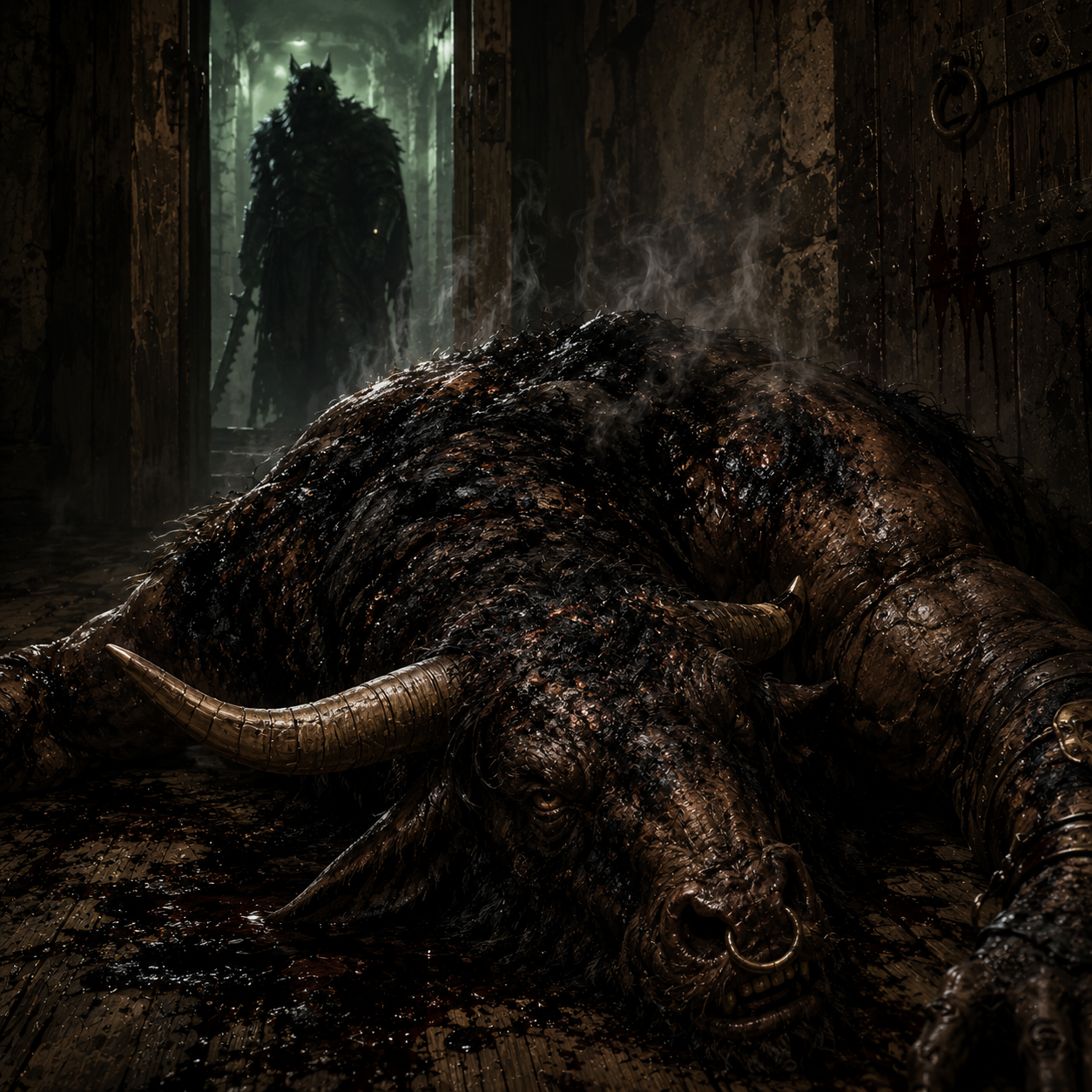
Sprawled across the landing lay a minotaur, its huge bull-headed body charred and scorched. Burn marks blackened the floor around it, yet the fire had spread nowhere else. The smell was worst here, sharp and wrong: burned flesh with something chemical underneath it.
Wanda, blind in the dark behind Felrick, walked straight into him. The two of them stumbled forward in a clatter of gear and went sprawling over the dead beast. Anywhere else it might have been funny. The minotaur never stirred, not even when Wanda’s fall cracked something in its skull. Dead, then, and recently, killed by something that had burned it where it stood.
The hallway beyond was dim and lined with doors. Then Qavitrae and Wanda heard heavy footfalls behind one of them, and the party scattered into position. Nora gave herself room to charge. Wanda found cover and readied her bow, Qavitrae settling in behind her with pistol and crossbow close to hand. Felrick melted into a shadowed corner. Thindruk withdrew partway down the stairs, where, as he would surely have put it, leadership could be exercised from a defensible position.
The door opened, and the thing that came out had to turn sideways to fit through the frame.
It wore plate from head to foot, steel sized for a body no ordinary man could own. A wolf’s head crowned the helm and a wolf-pelt cloak hung from its shoulders. No flesh showed anywhere, only metal, fur, and whatever watched from behind the eye slits. In its hands was a huge two-handed sword with a saw-toothed blade.
Ulfrin stepped into the hall, saw the dead minotaur, and stalked toward it, every footfall shaking dust from the old boards.
The party held still in the dark, weapons trained, while the storm hammered the walls and the chemical stink thickened. Somewhere above them waited Lady Marguerite, their stolen gold, and the stone that had dragged them into this ruin.
Felrick watched the eye slit of the helm. One pistol ball had been enough for Slagdar, but Slagdar had been asleep. Nothing about this one would be so simple.
The Chaos warrior came on.
Session Notes
-
The session opened with the party discussing the aftermath of the previous session in the dungeon beneath the von Wittgenstein manor.
- Wanda observed that the group probably should have killed Dr. Fritz as well.
- Qavitrae noted that nothing stopped them from doing so later.
- Wanda pointed out that Dr. Fritz was in an unlocked cage and was most likely the torturer.
- The GM recapped that the party had returned to the manor during a worsening storm, with thunder and lightning intensifying and the green moon casting a baleful light.
- The party had entered the servants’ house, found servants watching the storm outside, and convinced them they were guests of the Lord and Lady von Wittgenstein.
- The servants had been dubious, but the party’s guns and swords made their claim persuasive.
- The party demanded to be shown to the dungeons, saying they needed to question a prisoner.
- They were shown a discreet, secret door beneath the stairs leading down into the dungeon.
- Their servant guide, Bruno, had led them through the dungeon.
- The party had encountered Dr. Fritz, a strange, wizened physician covered in leeches, sitting in a cage in the torture chamber.
- They had seen prisoners in cells but lacked access to the cells because the dungeon keeper, Slagdar, had the keys.
- Bruno told them Slagdar was resting in his chambers.
- The party stacked up outside Slagdar’s chamber doors and murdered Bruno.
- The session began with the party still positioned outside Slagdar’s chambers.
-
The party prepared to open both doors into Slagdar’s chamber at the same time.
- Thindruk coordinated the two groups positioned at separate doors.
- Nora and Wanda were the ones intended to open the doors simultaneously.
- Thindruk waited and organized the timing rather than taking another action.
- The GM adjusted initiative so Nora and Wanda could act together on Wanda’s initiative.
- Qavitrae and Felrick were moved slightly later in the initiative order for simplicity.
- The group wanted to open the doors quietly if possible.
- The GM called for Stealth checks opposed by Slagdar’s sleeping awareness, with Slagdar’s check made very difficult because he was asleep.
- Nora and Wanda were not especially quiet, but Slagdar failed much worse.
- The doors made noise on their hinges, but the sound was mostly buried under Slagdar’s thunderous snoring.
- The group described the timing as opening the doors in rhythm with his snores.
-
The party saw Slagdar asleep in his chamber.
- Slagdar was revealed to be an ogre.
- He was about ten feet tall, far too large for his bed, and sprawled awkwardly across it.
- He had bright green skin, orange hair on his chest, arms, and legs, and a bald head.
- His mouth hung open as he slept, revealing nasty teeth that might have been sharpened or naturally jagged.
- His apron and favorite bone saw were hanging on the wall nearby.
- His hood of human skin was draped over a chair.
- He was not wearing armor and was naked while sleeping.
- Nora suggested that one of the stealthier black powder users should sneak up and put a gun to his temple.
- Felrick agreed to do it.
- Qavitrae also wanted to be ready to shoot Slagdar with a crossbow.
- Wanda prepared to charge in and put herself and her shield between Slagdar and the others if needed.
- Thindruk stayed in the rear guard and remained alert for Dr. Fritz or anything else coming from behind.
-
Felrick crept into Slagdar’s chamber and shot him while he slept.
- The GM confirmed the room’s scale and corrected the map’s yards-per-pixel issue so the chamber was no longer absurdly large.
- Felrick had enough movement to reach Slagdar without issue.
- Felrick made a Stealth check to approach him.
- Slagdar remained deeply asleep.
- Felrick used his pistol at close range.
- Felrick rolled 32 damage.
- Slagdar was not wearing his armored apron or any other armor.
- The shot put a bullet directly through Slagdar’s head.
- Slagdar’s eyes flickered open, he looked at Felrick in confusion, and then the life drained from his eyes.
- Slagdar died from the single pistol shot.
- Felrick joked that nobody noticed the puddle at his feet when Slagdar’s eyes looked at him because the floor was already filthy and dark.
- Nora gave a golf clap once the sound of the gunshot faded.
- The GM noted that Slagdar had several talents and traits prepared, including abilities related to grabbing victims and eating them, but he died before using any of them.
-
The pistol shot disturbed something elsewhere in the dungeon.
- After the report of Felrick’s pistol, Thindruk heard a wailing moan from the direction of the barred door.
- The sound came from the door that was nailed shut and painted with a crude skull.
- There was a heavy thud against that door.
- Felrick’s earlier sense of direction indicated that this door likely led beneath the pit.
- The party understood this as another unresolved danger but did not open the door.
-
Felrick searched Slagdar’s chamber.
- Felrick looked for the keys and anything else of interest.
- A key ring was hanging next to Slagdar’s favorite bone saw.
- Felrick found no gold or valuable loot in the room.
- The room contained a belt with poorly mummified heads, filthy animal skins, and a very large chamber pot.
- Slagdar’s bone saw was large, rusty, and sized for an ogre’s hand.
- Felrick tossed the keys to Thindruk.
- Qavitrae posted in the corner and watched the stairs with her crossbow.
- The party closed the chamber door and moved back toward the holding cells and torture chamber.
-
The party returned to Dr. Fritz and the prisoners.
- Dr. Fritz remained in his cage in the torture chamber.
- He was described as a scrawny, wizened man of indeterminate age, covered in leeches.
- He had previously acted as though he were a guest of the von Wittgensteins and had offered the party tea.
- Thindruk told Dr. Fritz that Slagdar had been sleeping and they did not want to disturb him, but that they now had the keys.
- Dr. Fritz claimed to be a physician and a healer, but not one of the “druid” types.
- He described himself as a man of science who used leeches, knives, and fire.
- Thindruk offered to lock Dr. Fritz’s cage for him, saying it might enhance his holiday.
- Dr. Fritz said he found it comforting to have the door locked at night.
- Thindruk locked Dr. Fritz in his cage.
-
Thindruk opened the prisoners’ cell and spoke with Aubrey.
- The prisoners were held in four cells.
- Aubrey was in one cell with a man who had once worn fine clothes, though they were now tattered and filthy.
- The man with Aubrey was near starvation and barely spoke.
- Five lowborn villagers were crammed into another cell.
- The villagers were weak and in poor condition but not as close to death as the man in Aubrey’s cell.
- Aubrey appeared to be in the best health of the prisoners, though she had clearly received attention from Slagdar.
- Thindruk beckoned Aubrey over and asked whether the man in her cell would cause any trouble.
- Aubrey said he had barely spoken.
- Thindruk unlocked the cell and let Aubrey out, then closed the cell behind her.
- Aubrey was surprised the party had come for her.
- Qavitrae said the von Wittgensteins and their servants had fallen to the Ruinous Powers.
- Wanda asked whether the party was rescuing only Aubrey or everyone.
- Qavitrae argued that the party should secure its own exit before helping others.
- Thindruk agreed that the party needed to help itself first before helping anyone else.
-
The party heard something suspicious near the empty cells.
- The GM called for hard Eavesdrop checks.
- Qavitrae and Thindruk succeeded.
- As the villagers realized the party was here to rescue Aubrey, they began pleading to be released.
- Qavitrae and Thindruk heard the sound of stone shifting, as if stone grated briefly against stone.
- The sound came from one of the empty cells.
- Thindruk looked through the small window in that cell door.
- The cell appeared empty.
- Qavitrae drew her sword, stepped toward the cell, and said she thought that cell had been empty.
- Thindruk told the prisoners that it was no safer outside the cells than inside them yet and asked them for useful information about recent events in the castle or what lay downstairs.
-
Aubrey and the villagers told the party what they knew.
- Aubrey said she had been brought up from a water landing by way of a spiral staircase.
- She said the von Wittgensteins had sailed the Frow Line back to the castle, dragged her off the boat, carried her up, and threw her directly into the cells.
- She had not seen much else.
- The villagers said people from the castle had been coming to the village for months and taking villagers.
- They linked the disappearances to a major storm about a year earlier.
- After that storm, the Lady said she was bringing people to the castle to cure them.
- No one taken to the castle ever returned cured.
- The villagers said Lady Marguerite took people away one by one.
- Those taken to see Lady Marguerite did not come back to the cells.
- The villagers had been in the dungeon for a few days.
- They came from the town rather than the castle.
- They had not seen the Lord and Lady von Wittgenstein in a long time and had been told the elder Lord and Lady were ill.
- When asked about the empty cells, one village woman said that a couple of nights earlier she had heard something moving in the neighboring cell and thought she heard the door open.
- She did not see anything and had not wanted to look closely.
- Qavitrae peered through the empty cell’s window but saw nothing.
-
The party investigated the empty cell and found a hidden tunnel.
- Thindruk shut the door behind the party so anything that had possibly come from the cell would need to open the door to leave.
- Qavitrae asked Thindruk to open the empty cell while she drew her blades.
- Felrick stood behind Qavitrae and covered her.
- Felrick made an Awareness check as the door opened.
- Felrick saw that the cell was mostly clean but contained small fragments that looked like dried mortar.
- He noticed that the lower half of the back wall had missing mortar between many of the stone bricks.
- Felrick pointed this out to Qavitrae and said the stones looked loose.
- Qavitrae examined the wall and found that the bottom three feet across much of the wall seemed to be stacked loose stone.
- The bricks could likely be knocked in with a strong kick or removed carefully one by one.
- Qavitrae carefully removed the uppermost loose brick.
- Cool air flowed out from the darkness beyond.
- A candle revealed an earthen and stone tunnel about as wide as the cell.
- The tunnel was pitch black beyond the candlelight.
-
Thindruk inspected the tunnel.
- Thindruk, being able to see in the dark and knowledgeable about tunnels, looked into the passage.
- He made an Awareness check and succeeded well.
- The tunnel was narrow, small, and curved downward.
- It was roughly made but supported in places with beams.
- Thindruk judged that it was not built to dwarven standards but was unlikely to collapse soon.
- The tunnel seemed better made than expected.
- Thindruk saw marks on some stones that looked like claw marks or white scratches made by nails, not tool marks.
- He did not immediately see obvious footprints or other signs of recent traversal from where he stood.
- Thindruk concluded that something with claws had been through the tunnel.
- He said he loved a good tunnel but was not sure there was any profit in exploring a place where clawed creatures had been walking.
- Qavitrae agreed that the party already had enough problems without adding another.
- The party decided to add the tunnel to their list of problems for later and to prevent anything from coming out behind them.
- They backed out of the cell and locked it again.
-
The prisoners pleaded to be taken to safety.
- As the party locked the tunnel cell, the villagers begged not to be left behind.
- They said they could walk and could arm themselves if needed.
- They were weak and wobbly but made an effort to stand straight.
- Wanda said she would clear the way first.
- Thindruk considered whether he had food to give them but concluded he likely did not, since the party had not planned on camping in the castle.
- The supplies the party had gathered for the forest camp had largely been left elsewhere.
- The party decided to move toward the spiral staircase down to the water landing and the boat.
-
Aubrey executed Dr. Fritz.
- As the party prepared to leave, Aubrey asked for the keys because Dr. Fritz was still locked in his cage.
- Aubrey said Dr. Fritz had sat and watched while Slagdar hurt prisoners and had chatted with the ogre.
- Aubrey said she wanted to draw blood from both Slagdar and Dr. Fritz before leaving if possible.
- Qavitrae gave Aubrey a throwing knife hilt-first.
- Wanda offered Aubrey her mortuary sword, which was larger.
- Thindruk unlocked Dr. Fritz’s cage and told Aubrey to make it quick because the party did not have unlimited time.
- Dr. Fritz protested that the situation did not seem proper and referred to the keys as Slagdar’s.
- Aubrey took Wanda’s sword, thrust it through the bars, and ran Dr. Fritz through.
- Dr. Fritz sputtered, choked, and bled out.
- Aubrey watched him die, then handed the sword back over her shoulder.
- Wanda told Aubrey to hold on to the sword for now.
- Qavitrae told Aubrey she could keep a weapon until they recovered her own equipment.
-
The party questioned Aubrey about the water landing.
- Thindruk asked Aubrey what was down the spiral stairs.
- Aubrey said there was a large cave where the river ran in.
- She said there had been guards when she arrived, perhaps three of them.
- The party tried to estimate the time.
- They believed it was in the small hours of the morning, likely after midnight.
- They remembered that the raiding party was supposed to act around midnight.
- The group discussed whether the forest allies had secured the outer castle or not.
- They noted that the castle defenses had been divided, with portcullises and gates closed behind the party.
- The party believed they had access from their side to mechanisms that could reopen some defenses if needed.
- Felrick raised the possibility of sailing away, returning to the main keep, and bringing an army to attack the supernatural threats.
- The group debated whether to bring the prisoners to the boat immediately or leave them while they secured the exit.
- They decided to bring the prisoners down, partly because they did not want to make repeated trips through the castle and partly because they wanted to secure the boat.
-
Thindruk presented himself to the prisoners as their rescuer.
- Thindruk gave an inspiring speech to the prisoners.
- He emphasized the magnanimity of their new lord and that he was conveying them to safety.
- Qavitrae referred to them as Thindruk’s first subjects.
- Thindruk said the prisoners would tell their children’s children the story of Lord Steelbone’s rescue.
- The party moved with the prisoners down the spiral staircase toward the water landing.
-
The party reached the underground river landing.
- At the bottom of the stairs, the party could smell river water.
- They saw two boats moored in the cave.
- One was the Frow Line.
- The other was a smaller river boat.
- The smaller boat made Thindruk the owner of two boats, and the group joked about admiralty and captaincy.
- The cave contained a wooden shed built against the cave wall.
- A portcullis blocked the river exit.
- The mechanism to raise the portcullis was visible nearby, consisting of a winch-and-chain or wheel mechanism.
- The gate was currently down and would likely take effort and time to open.
- Aubrey pointed to the shed and said the guards were, or had been, in there.
- Felrick saw that the shed had wooden shutters over a window, currently closed.
-
Thindruk and Felrick sneaked up to the guard shed.
- Felrick wanted someone to sneak up and open the shutters so he could aim at anyone inside.
- Thindruk volunteered because his Stealth was decent and he could see in the dark.
- Thindruk instructed Aubrey to keep the freed prisoners back and out of the way.
- Aubrey kept the prisoners about twenty feet up the stairs.
- The prisoners remained quiet, seeming desperate not to lose their glimmer of hope.
- Thindruk and Felrick moved quietly across the rocky cave floor.
- Thindruk opened the shutter carefully.
- The shutter was not locked or clasped from inside.
- Inside the dark shed, he and Felrick heard light snoring.
- They saw a few bunks, at least two of them occupied, though they could not see the entire room.
- The shed appeared to be made entirely of wood.
-
The party attempted to burn the guard shed, then attacked the guards.
- Felrick asked how flammable the shed looked.
- The party no longer had a bomb but did have oil lamps and oil.
- Qavitrae had extra oil and agreed to do the honors.
- Felrick planned to stand by the door with his bow drawn and deal with anyone who came out.
- Thindruk threw a full lit oil lamp through the window.
- The guards had a chance to wake up and react.
- The guards quickly realized there was a fire and tried to put it out.
- They achieved a critical success on their attempt to control the fire.
- The party heard three voices inside.
- The guards seemed to think a lamp had simply been knocked over, not that they were under attack.
- Felrick walked up to the window and shot the first guard he could see.
- The GM did not require a damage roll because the target was vulnerable and Felrick was effective at this sort of attack.
- Felrick shot one guard in the chest, dropping him.
- The remaining guards were stunned, saw the gun withdraw from the window, and shouted that there were brigands.
- Thindruk said that once the gun went off, the group should rush in and prevent the guards from arming themselves.
- Qavitrae was ready with her crossbow.
- The party had the option to kill or disable the remaining guards.
- Qavitrae believed they were agents of Chaos and should be killed.
- Thindruk suggested capturing them and making them open the gate first.
- The remaining two guards surrendered.
- Like other castle guards, they smelled of decay and had patches of rotting flesh on their bodies.
- They pleaded for mercy.
-
The captured guards opened the portcullis.
- The party forced the two surrendered guards to operate the gate mechanism.
- The guards worked the wheel while swords were pointed at them.
- Opening the gate was difficult for two people, but they managed it.
- They pleaded the whole time, insisting they meant no harm and were doing as ordered.
- The portcullis rose noisily from the water, clearing the way for the boats.
- Felrick confirmed that the open river was not far beyond the cave mouth.
-
Felrick investigated the smaller von Wittgenstein boat.
- The smaller boat was more of a river cruiser than a cargo boat.
- It was suited for a small crew and a few passengers.
- It had once been nicer than the Frow Line in terms of appointments but had become moldering and neglected.
- It contained a well-appointed but decayed stateroom below deck.
- The boat carried the von Wittgenstein livery.
- An old, filthy banner bearing the von Wittgenstein livery was folded up on board.
- Qavitrae asked whether the vessel had weapons such as crossbow mounts, possibly used for piracy against the party.
- The GM said it did not look like the boat had been used for piracy.
- It appeared to have been used for travel up and down the river and had not been used by the noble family recently.
-
The party discovered that the Frow Line’s hold had been emptied.
- Felrick checked the Frow Line to make sure the party’s belongings were still there.
- The hold was empty.
- Everything left in the hold, including von Wittgenstein belongings taken from the tower and the party’s supplies, had been removed.
- The captured guards said Lady Marguerite had ordered the contents hauled up to the house.
- They had moved the food, paintings of the von Wittgenstein family, and other belongings.
- The party remembered a chest containing 608 gold coins had been on the boat.
- The guards indicated the gold had been taken to Lady Marguerite’s chambers.
- The food had gone to the larder in the servants’ quarters.
- The artwork and other family items had been deposited around the hallway near Lady Marguerite’s chambers.
- The party noted that if they were going to take over the castle, the artwork and furnishings could remain there for the moment.
- The gold, however, needed to be recovered because gold had a way of walking away.
- Qavitrae said it was harder for gold to walk away if the people who stole it were dead.
-
The captured guards gave their names.
- Felrick asked one captured guard his name.
- The party joked that naming him might be a death sentence.
- The GM generated names for the two guards.
- One guard identified himself as Gundolf Platz.
- The other identified himself as Hartwig Beer.
- The party commented that “Beer” was an easy name to remember.
- Qavitrae told them they had a chance to redeem themselves despite serving pirates and Chaos-tainted masters.
- The party decided the two guards would perform more manual labor.
-
The party sent the freed villagers away on the smaller boat.
- Aubrey asked whether the freed villagers should be placed on the smaller boat or the Frow Line.
- The party discussed sending the five freed villagers back.
- The villagers were river people and believed they could operate the smaller boat.
- The boat only required two crew, one to steer and one to work the sails or oars.
- The party considered giving them food, but the Frow Line’s hold had been emptied and the available food was upstairs.
- They told the villagers to inform their compatriots that the party was liberating the castle.
- Thindruk began to speak of liberation and the corruption at the heart of the castle being burned out.
- Felrick proclaimed the reign of Steelbone and joked about renaming the place Steelbonestein.
- The villagers hailed Lord Steelbone as a brave champion of the people.
- They were eager to leave.
- The party allowed them to choose whether to depart despite the lack of food or wait, and they chose to go.
- The village was only about a mile upriver.
- As the boat left, a young woman among the villagers gave the party a wave and a Sigmarite salute.
- The boat sailed out of sight onto the river.
- The party listened for any river defenses or warp-fire cannons, but nothing fired.
-
The party decided what to do with Aubrey and the captured guards.
- Aubrey was not excited about being left alone but said Wanda’s mortuary sword felt heavy in her hands and that she did not think she could fight very well right now.
- Wanda retrieved her bow from the Frow Line and left Aubrey with the mortuary sword.
- Felrick’s saddle was still on the boat because no one had wanted it.
- Aubrey remained with the Frow Line to watch it.
- Felrick smiled at Aubrey and told her she was back on the clock.
- Qavitrae said perhaps Aubrey now saw why the party paid so well.
- Gundolf and Hartwig were taken with the party as conscripted laborers.
- Their weapons, including a crossbow and a couple of swords, were placed on the Frow Line.
-
The party returned from the river landing toward the dungeon and manor.
- Gundolf and Hartwig led the party back up the stairs, through the dungeon, and toward the manor house.
- As they passed the nailed-shut skull door, Thindruk asked what was inside.
- Gundolf explained that the room contained remnants of Lady Marguerite’s work, those experiments that had gone especially poorly.
- These failures had been cast down into the dungeon and had begun to stick together.
- Felrick asked what the guards knew of the nature of Lady Marguerite’s work.
- The guards said she was a scholar who believed the von Wittgensteins could lead the Empire.
- They said she believed Sigmar seized rulership by might, and that she had power.
- She had drawn many strong people to the castle.
-
Gundolf and Hartwig provided information about the castle’s dangerous inhabitants.
- One guard mentioned a horned beastman, raising his hand to show height.
- The party recognized this as likely Krakatz, the beastman or minotaur-like creature they had fought or seen connected to earlier events.
- Wanda indicated that Krakatz was dead.
- The party pointed out Slagdar’s corpse as well.
- The guards were shocked that the party had killed Krakatz and Slagdar.
- Wanda warned them that if they thought of betraying the party, they would be killed very quickly.
- The guards said if the party could kill Krakatz, they did not think any man could do such a thing.
- Wanda corrected them that she was a woman.
- Hartwig asked about “the Nord,” describing a huge armored man.
- The party asked for more information, including weak points or chinks in his armor.
- Gundolf said the Nord was a foul heretic and talked constantly about the Ruinous Powers.
- He claimed the Nord came from the north, one of the wild men from the northern lands.
- The Nord claimed to be a champion of the Ruinous Powers and spoke of opening the way for them.
- The party asked whether this had anything to do with the contraption on the roof.
- The guards said the roof contraption was for Lady Marguerite’s laboratory.
- It had been installed about half a year earlier so the laboratory could have access to the sky.
- Thindruk asked about the tower across from the house.
- The guards said Lord Ludwig lived there now.
- Thindruk asked whether Lord Ludwig had the normal number of arms these days.
- The guards hesitated and said Lord Ludwig had an affliction.
-
The party recognized the danger posed by the Nord Chaos warrior.
- As the party returned to the ground floor of the manor, the GM called for a routine Awareness check.
- Several party members succeeded.
- The party also considered what they knew about northern Chaos worshipers.
- The GM said those with education knew that human clans in the untamed northern lands often pledged fealty to the Ruinous Powers.
- In the Chaos Wars, armies of Chaos marched from the north with clans of Nordmen filling their ranks.
- Qavitrae made a Folklore check and succeeded after spending a coin.
- Qavitrae recognized the description as a Chaos warrior.
- These warriors were bound into heavy armor through dark sorcery, with their bodies fused to steel plates.
- They were swollen with unholy strength, difficult to kill, bloodthirsty, and among the most dangerous human followers of the Ruinous Powers.
- Qavitrae summarized him as a real threat.
- Qavitrae realized her second pistol was still on the ship and went back to retrieve it.
- The GM ruled that the pistol and a bag of shot had been overlooked amid the looting and were still on the boat.
- Qavitrae recovered the pistol.
-
The party learned the general layout of the upper manor.
- Gundolf and Hartwig gestured up the stairs from the ground floor.
- They said the family lived upstairs.
- They said the Nord, named Ulfrin, had a guest room upstairs.
- They mentioned Krakatz, though the party had already dealt with him.
- Lady Marguerite had the largest room upstairs, at the top of the stairs and to the right.
- The party considered sending Gundolf and Hartwig to move food from the larder down to the Frow Line.
- They also considered whether the cook would be a problem.
- The kitchen was separate from the main staircase to the upper floor.
- The party decided they had larger problems than the cook.
-
The party noticed an acrid chemical smell.
- The GM revealed the result of the earlier Awareness checks from when the party emerged into the ground floor of the manor.
- Those who succeeded had noticed an odor that had not been present earlier.
- It was an acrid chemical smell in the air.
- As the party moved around, the smell seemed to come from upstairs.
- It was subtle downstairs, not overpowering.
- Thindruk adjusted his neck ruff to cover his mouth and nose.
- The smell, combined with the storm and possible noises upstairs, made the party feel some time pressure.
- The group decided to send Gundolf and Hartwig to begin loading food down to the Frow Line while the party went upstairs.
-
Thindruk persuaded Gundolf and Hartwig to move supplies.
- Thindruk told the guards that the party was going to see Lady Marguerite about their chest of gold.
- He promised a fistful of coins to each of them if they kept moving food down to the hold.
- He warned them that if they caused trouble, he had a different fist for them.
- Thindruk used Guile rather than Intimidate.
- He received a bonus because the guards were of a different social class.
- The guards appeared aware of how much gold had been in the chest.
- They accepted the offer and said Thindruk seemed more honorable than any von Wittgenstein.
- Qavitrae added that they might become the foundation of the new lord’s retinue if they kept this up.
- Wanda argued that they should see how the party took care of its own, given what the party was willing to do to rescue Aubrey.
- The GM noted this was a compelling argument, since the guards had likely seen the von Wittgensteins treat people terribly.
-
The party prepared to confront the upstairs threats.
- The party heard heavy thumping sounds upstairs, possibly matching the description of the armored Nord Chaos warrior.
- Qavitrae asked, in game terms, whether the Chaos warrior was more dangerous than the demon the party had fought.
- The GM explained that not all Chaos warriors are equal.
- The strongest could face a hundred men and lead armies.
- Even the weakest were dangerous, hard to kill, and not to be faced alone or unprepared.
- The GM indicated that Chaos warriors generally had fewer supernatural tricks than the demon but were magically empowered, brutal, heavily armed, skilled murderers.
- The party hoped to get the drop on the Chaos warrior.
- The thumping was quiet by the time they moved.
- The party decided to sneak toward Lady Marguerite’s chambers.
- Because of the thunderstorm, the GM allowed routine Stealth checks.
- Felrick and Wanda critically failed while trying to move quietly.
-
The party discovered a dead minotaur at the top of the stairs.
- Felrick, who could see in the dark, took point.
- As he crested the top of the stairs, he saw a huge, muscular, roughly ten-foot-tall beast with long curved horns lying face down.
- The creature smelled like barbecue and was covered in scorch marks.
- Scorch marks marked the surrounding area as well.
- Felrick was so surprised and confused that he stopped and stared.
- Wanda, unable to see as well in the darkness, ran into Felrick.
- Both Felrick and Wanda stumbled forward with their gear clattering and tripped over the creature.
- The creature was identified as a minotaur.
- It appeared recently cooked or burned.
- Qavitrae wanted to understand what could have killed it.
- The party noted that something capable of killing a minotaur might be a major concern.
- The area showed signs of fire, but the fire had not spread through the hallway.
- Wanda struck the minotaur’s skull to confirm it was dead.
- The blow cracked bone, and the creature did not react.
- The acrid chemical smell was strong at the top of the stairs.
- The smell seemed centered in this area and was distinct from ordinary smoke or burning flesh.
- It resembled a chemical fire or chemical burn, though the characters had limited frame of reference for that smell.
-
The party heard something approaching from the hallway.
- The GM called for standard Awareness checks.
- Qavitrae and Wanda succeeded.
- They heard a heavy thudding sound from a hallway ahead.
- The sound was not yet clearly getting closer, but something was moving nearby.
- The party began positioning for an ambush.
- Wanda considered rolling the dead minotaur onto its side as cover but realized it would be difficult because the corpse was extremely heavy, effectively like trying to flip over a cow.
- The party instead looked for corners, doorways, and alcoves to hide behind.
- Thindruk backed partway down the stairs.
- Nora took a position with a good line to charge down the hall once the threat emerged.
- Wanda took a position near a corner with her bow.
- Felrick, being smaller, posted behind or near Wanda with a view down the hall.
- Qavitrae ducked behind Wanda with her pistol and arbalest available.
- Wanda aimed at the doorway but did not draw her bow in a way that would exhaust her.
- Those partially exposed made additional Stealth checks.
- Wanda succeeded.
- Felrick critically succeeded and hid exceptionally well.
-
The Chaos warrior emerged.
- The door opened.
- A figure in heavy plate armor stepped into the hallway.
- He wore a wolf cloak, including a wolf’s head over or atop his helmet and a wolf pelt cascading down his back.
- He was enormous and had to turn sideways to get through the door.
- He was smaller than the minotaur but still massive.
- He was clad head to toe in metal, with no flesh exposed.
- Only the eye holes of his helmet were visible as possible gaps.
- He carried a huge two-handed sword.
- The sword was saw-bladed and likely bore disturbing Chaos ornamentation, possibly including a blinking eye.
- He looked down the hallway, saw the minotaur’s body, and began stalking toward it with heavy footsteps.
- The party remained hidden and ready.
- Wanda intended to wait for Felrick’s shot before firing.
- The session ended before the opening attack was resolved, with the Chaos warrior walking toward the minotaur’s corpse and the party prepared to ambush him.
-
At the end of the session, the party discussed Felrick’s intended opening shot for the next session.
- Felrick intended to take a called shot with his pistol, aiming for the Chaos warrior’s face or eye slit.
- Felrick’s bounty hunter ability made his first ranged attack action automatically hit.
- The table discussed how to adjudicate combining that automatic hit with a called shot.
- The GM noted that called shot is an attack action and Felrick’s ability applies to the first ranged attack action.
- The called shot would still cost the normal action points.
- The GM and Felrick agreed that the attack would automatically hit, but to gain the specific effect of the called shot, Felrick would need to roll well enough to actually hit the eye slit.
- The group agreed that automatically shooting every enemy through the eye would be unreasonable.
- The table also noted that the Chaos warrior might not have a normal vulnerable head, as Chaos mutations could make him stranger than expected.
- Wanda considered trying to disarm the Chaos warrior because of his huge two-handed saw-bladed sword.
- The GM awarded 100 RP for the session.
- The GM said the campaign seemed to be approaching the finale.
- The party noted that they could have left once they regained access to the boat, but the von Wittgensteins had taken their money and they still had come for the Chaos stone.
- The party recognized that the castle had grown increasingly dangerous but that the element of surprise had helped them so far.
- The group ended with the party still inside the manor, hidden around the upper hallway, facing the approaching Chaos warrior.