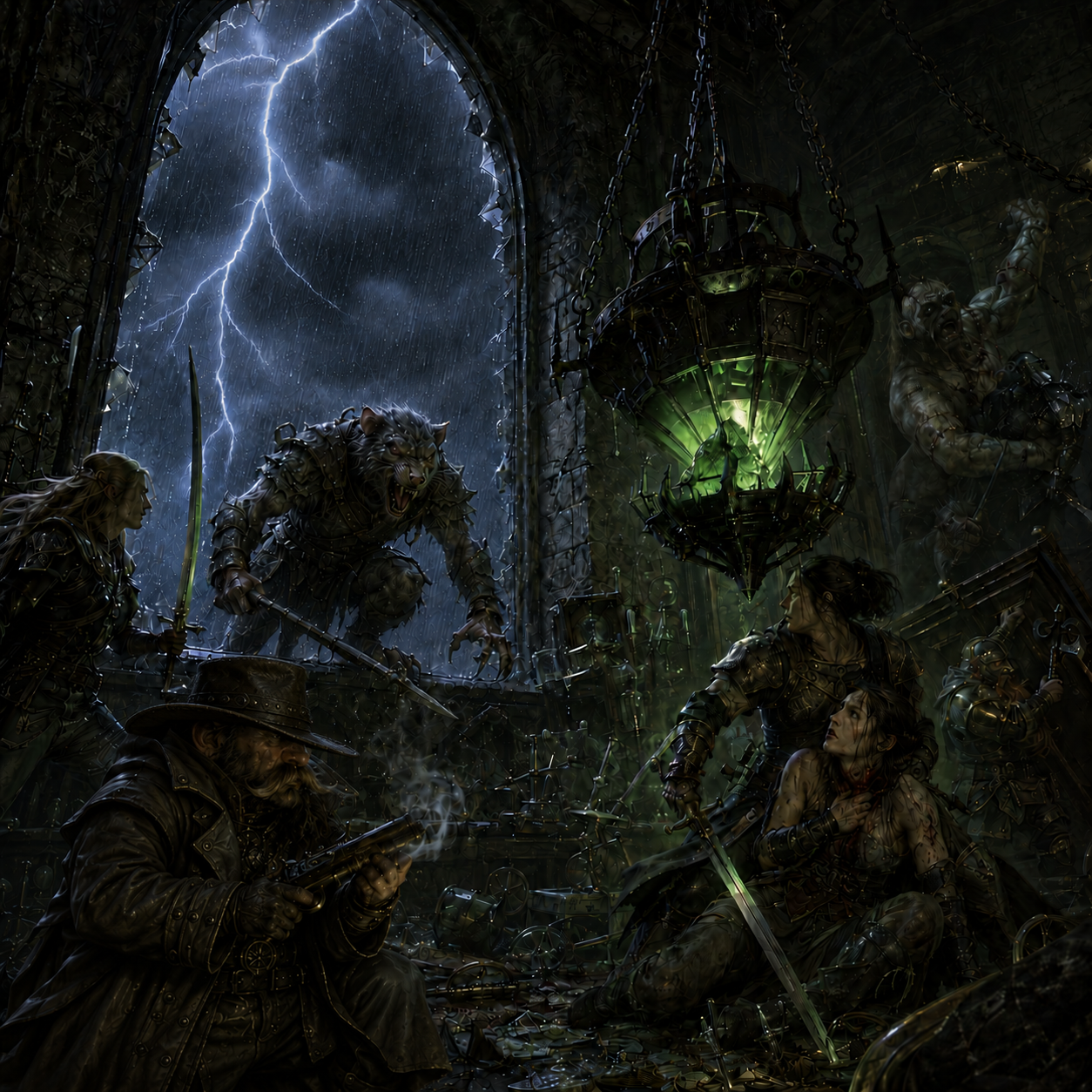
The minotaur’s corpse lay across the landing like something sacrificed to a cruel and inattentive god. Its flesh had been burned black, and smoke still curled from the cracks in its hide, an acrid stink that caught at the throat and mixed with the older smells of Castle Wittgenstein: mildew, lamp grease, old blood, and the sweet rot that seemed to breathe from the stones themselves. Beyond the tall windows the rain hammered down and thunder prowled the hills. Morrslieb’s green light came through the storm in sickly flashes, turning every puddle into a witch’s mirror.
Wanda’s boot struck one of the minotaur’s horns. Felrick, creeping beside her, collided with her shoulder, and the two of them went down together in a clatter of weapons, buckles, curses, and bruised dignity.
For a heartbeat the castle seemed to hold its breath. Then came the sound of iron-shod feet, slow and heavy and unhurried, and a door opened farther along the passage.
The man who emerged was nearly tall enough to scrape his helm on the rafters. He wore black plate from throat to heel, its overlapping surfaces scarred by blades and blackened by fire. A wolf’s pelt hung over his shoulders, the beast’s head perched above his helm like a grotesque second skull, and in one gauntleted hand he carried a saw-toothed zweihänder the way another man might carry a walking stick. His visor had a single narrow opening, and Felrick saw it.
He had already slipped into the dark beside the landing, little more than a shadow with a moustache and a loaded pistol. The others flattened against walls or crouched behind doorways while the armored warrior advanced on the minotaur’s corpse, wary but unhurried, certain that whatever had made the noise was less dangerous than he was. Felrick rested the pistol barrel against the edge of the wall. The eye slit was too narrow for any sensible shot, so he waited.
The warrior stopped beside the minotaur and lowered his head to examine the ruin of it. Felrick kept the pistol steady. The castle groaned around them, rain hissed against the glass, and somewhere below the river whispered beneath the foundations, carrying the freed villagers away from this place if the gods had not abandoned them entirely.
The warrior looked up, and Felrick fired.
The report cracked through the passage and vanished under a roll of thunder. The ball went in through the slit in the helm. For a moment the enormous figure simply stood there, and something wet struck the inside of the visor. Felrick was already reaching for powder and regretting every decision that had led him into this corridor when the warrior sank to one knee. His sword scraped along the floorboards. The other knee came down beside the first, and then he toppled forward onto his face next to the minotaur, hard enough to shake dust from the ceiling.
Nobody moved. Then Wanda went up and hit the fallen warrior with her morgenstern, and Qavitrae prodded him with a blade. He did not respond.
“Well done, Mayfly,” she said.
Felrick lowered the smoking pistol. “I am not a mayfly.”
“To me, you are.”
“I am more like a rat.”
Qavitrae regarded him with the patient expression of someone who had lived long enough to watch kingdoms become footnotes.
“A hamster, perhaps,” Felrick amended. “I have the beard for it.”
“Well done, Hamster.”
The others turned to the dead man’s weapon. The saw-toothed blade was hideous, oversized, and almost certainly worth a respectable sum to someone with more money than judgment. Qavitrae warned that it might be cursed. Wanda pulled on a pair of leather gloves and took it anyway. The castle had already stolen their cargo, their money, their weapons, and most of their patience, and nobody felt like leaving valuables lying about just because those valuables might whisper obscenities in their sleep.
They waited a while for guards, mutants, demons, or perhaps an offended piece of architecture to answer the gunshot. Nothing came, which was somehow worse.
Nora stood very still near the corner of the landing, head tilted. The wound to her throat had made speech impossible, but it had sharpened the silent language she shared with the others: a lifted finger for wait, a clenched fist for danger, a particular narrowing of the eyes for when somebody had said something especially stupid. Now she pointed at the wall. Something was moving inside it, a faint scraping too heavy for mice and too deliberate for settling wood.
Nora drew her claymore and, before anyone could object, drove the point between two panels. The blade punched through the outer layer with a sharp crack, but the heavy timber behind it held. She withdrew it, leaving a narrow wound in the wall, and whatever had been moving behind the paneling went quiet. The others stared at her. Nora pointed to her ear, then to the wall, then jabbed the claymore at the spot again.
Qavitrae opened the nearest door. Beyond it lay a guest chamber washed in Morrslieb’s green light. Blankets had been dragged across the floor and a porcelain plate lay shattered near the bed. A wardrobe stood against one wall beside a dressing table, and a pewter goblet rested on its side atop a nightstand. No one was in the room.
Qavitrae stepped into the doorway. The goblet rose into the air, hung there for a heartbeat, turning slowly, and then flew at her face.
She recoiled and loosed her crossbow at the place where an invisible hand might have thrown it. The bolt passed through empty air, struck the window, and vanished into the storm amid a spray of broken glass. Wanda raised her shield and the goblet bounced off it. Across the room, a drawer slid open.
“Witchcraft,” Wanda said.
Qavitrae drew her sword and charged. She slashed above the drawer, beneath it, and through the space in front of it, carving the air into increasingly narrow pieces and finding nothing. The drawer shot from the dresser and hit her squarely in the face. She staggered back with blood running from her nose, and a second drawer slid free below the first. Wanda stepped forward with her shield raised; the drawer struck the wood with a heavy thud and drove her back into the corridor. They slammed the door, and no one suggested reopening it. The furniture had now done them more harm than the armored champion had. They moved on.
Lady Wittgenstein’s chambers lay behind a pair of doors carved with the family heraldry. Wanda tested the latch, stepped back, and kicked both doors in.
The room beyond was vast, warm, and richly furnished. A fire had burned down to coals in the hearth. A canopied bed dominated the center, its curtains drawn open, gilded chairs surrounded small tables, and pots of cosmetics stood beside silver brushes and jeweled combs on the dressing table, where an open jewelry box glittered. Their stolen strongbox sat against the far wall. It should have been a reassuring sight, and it was not, because bodies occupied most of the chairs.
They had been arranged around the room like guests at a private gathering. Two sat before a game of cards. Another slumped beside a tea service. One had been dressed and positioned at the dressing table. Their flesh had swollen, split, and softened; flies crawled across peeling faces, and maggots worked in the folds of their clothing and under yellowed fingernails. Every corpse carried some mark of mutation. A hairless tail coiled around the leg of one chair, another body had no ears, and a third had fingers grown together into fleshy paddles. They wore the clothes of peasants and servants, not soldiers, and there were no obvious wounds on any of them. This was more than the castle’s usual rot. Lady Wittgenstein had gathered the dead and posed them around her bedchamber, whether as companions or ornaments nobody cared to guess.
Feet stuck out from under the bed. Nora took hold of the boots and pulled, slowly. The corpse came out with a damp dragging sound, leaving a dark trail across the floorboards, its legs still attached, which was about as close to mercy as the castle had come all night.
The bodies had not died together. Wanda studied their condition and judged that days, maybe weeks, separated some of them. They had been collected over time, and none of them showed violence enough to explain their deaths. Nora examined one, folded her arms, and nodded as though she had reached a conclusion. Demons. It was demons. As explanations went, it was at least as useful as any other on offer.
The dresses in the wardrobe were cut for an ordinary woman with an ordinary number of arms. The bed had recently been made and the fire tended. The room was in use; its mistress was simply elsewhere.
The strongbox still held all six hundred and eight of their gold coins. They dragged it nearer the entrance but did not try to haul it through the castle while danger still waited above and inside the walls. They had already imagined too many ways a man could die while carrying a chest of gold down a staircase.
A smaller door led into a dressing room half converted into a workshop, ladies’ garments hanging beside toolboxes, vices, grinding implements, and wooden crates. Inside the crates were blocks of extraordinarily clear glass and lenses in various stages of completion. Qavitrae lifted one of the wedges toward the light, and it barely distorted what lay beyond it. A master craftsman had made this, sparing neither labor nor expense, though the dust on the tools said the grinding work had been abandoned for some months.
They had seen work like this before. Dagmar von Wittgenstein had studied the heavens from his tower, hunting for the place where a piece of Morrslieb had fallen from the sky. He had come back to the castle a century ago with a lead-lined box and then, through a series of remarkably fortunate deaths, inherited the family title. Now his descendants were carrying his work on.
Beyond the workshop a stairway climbed higher into the tower. They closed the doors behind them and went up.
The next floor was a library. Shelves crowded the curved walls, their books swollen with damp or bound in materials none of them wished to examine closely. A writing desk stood beneath a window, and on it lay several of the books and papers that had been stolen from their own boat. Thindruk recovered the peculiar volume he had carried since Dagmar’s tower; it had apparently been set aside without anyone recognizing what it was.
Other books lay open on the desk, marked with silk ribbons. Qavitrae turned a few pages. Arcane diagrams sprawled across them, human figures rendered in precise anatomical detail and then altered into blasphemous geometries, the margins crowded with invocations, formulae, and the symbols of Chaos. These were grimoires, not the private eccentricities of an isolated noblewoman.
A letter rested on top of a stack of correspondence, recent, addressed to Lady Wittgenstein in the familiar hand of a brother. Qavitrae read it aloud. Goddard wrote from Middenheim, where he had thrown himself into scandalous gatherings and found castle life painfully provincial. Mutilating peasants had grown tedious, he explained; in the city he could let everything “hang out,” meet influential converts, and enjoy the favor of an inner circle devoted to Change. He had been entrusted with arranging something special for the coming Hexenstag celebrations and hoped to persuade his sister to attend. There was no cipher and no attempt at caution, just a letter from one monster to another complaining that rural atrocities lacked the excitement of urban ones.
Thindruk folded it and put it safely with the other evidence. The corruption of the Wittgensteins reached past the castle walls, into Middenheim, among wealthy and influential people who no longer felt any need to hide from one another.
Above them, hurried footsteps crossed the floor. A clap of thunder shook the tower, the air prickled, and ozone seeped down the stairwell. A deep moan followed, too resonant and too human to be the wind. Then came the crash of breaking glass, and a woman screamed.
They drew their weapons and climbed. Wanda led with her shield raised, Nora at her shoulder with the claymore ready despite the pain in her throat, the others crowding behind them on the narrow stairs, listening to the struggle above.
The chamber at the tower’s summit was half laboratory and half charnel house. A great hatch had been built into the roof, chains and pulleys descending from it. The tables were crowded with instruments, jars, cutting implements, metal frameworks, and containers lined with dull gray lead, and a tarp spread across one section of the floor held severed limbs and butchered organs awaiting use.
In the center of the room stood a man assembled from the bodies of others. He was enormous. Stitches crossed his flesh in black lines, straps and crude braces held pieces of him together, metal fittings had been driven into his neck and skull, and his skin had the pale, preserved look of meat soaked in brine.
Across the room, ratmen were pouring through a shattered window. Most were small hunched creatures armed with spears and knives; among them stood a larger warrior in proper armor, gripping a halberd. Rain blew in through the broken glass behind them. The creatures had climbed the outside of the tower in the middle of the storm, up stone no sane climber would have attempted, and now they were fighting the stitched giant.
Near them stood a young woman, staring at the intruders with shock, rage, and the particular indignation of someone whose private abominations had been interrupted by an entirely different variety of abomination.
Nora looked at her. She had endured the village beneath the castle, where starvation had been cultivated as policy. She had seen the prisoners, the mutations, the thing in the pit, and the bodies posed in the bedchamber below. She had been stabbed, maimed, and robbed of her voice, and now, after all of that, Lady Wittgenstein had crowned her sins by building a monster under a lightning hatch. Nora charged.
The lady had been watching the ratmen and turned too late. Nora struck her at full speed and hurled her to the floor, into the shards of broken glass. Lady Wittgenstein looked up and met Nora’s eyes, and whatever spell or command she meant to speak died unformed. Nora drove the claymore through her. The lady caught at the blade with both hands and the steel sheared through her fingers; Nora leaned her weight behind the weapon and forced it deeper until the body beneath her went slack. There were no last curses and no plea for mercy from a woman who had never shown any. The mistress of Castle Wittgenstein died on the floor of her own laboratory while her creation fought ratmen a few strides away.
Wanda came in behind Nora and planted herself at her side, shield raised against the chaos of the room. Qavitrae stepped from the stairwell and fired at one of the smaller ratmen, which saw the crossbow lift and skittered aside with unnatural speed; the bolt shattered against the wall. The large ratman barked orders in a chittering tongue, advanced on the stitched monster, and thrust with its halberd, but the point glanced off the giant’s patched flesh.
Thindruk moved into the chamber, keeping the stairway clear so Felrick could fire past him. The laboratory was a maze of tables and instruments, all of it arranged around a metal cradle suspended above the central workbench. One of the smaller ratmen climbed onto that table, seized the mechanism, and began forcing it open.
Green light appeared between the metal plates, and it was nothing like lamp flame or moonlight. Narrow beams stabbed out of the opening and painted the walls a poisonous color that seemed to cling to everything it touched. Inside the cradle sat a stone large enough to fill both hands. A fragment of Morrslieb, the thing Dagmar von Wittgenstein had sought out and carried home in his lead-lined box, the seed from which the castle’s century of corruption had grown.
Felrick reached the top of the stairs in time to see the ratman wrenching the cradle open and the green rays spilling across the room, with Thindruk shouting that the creature was taking the stone. He raised his pistol and fired. The ball took the ratman in the face, and it pitched backward, dead before it hit the table.
Its body caught the mechanism as it fell. The cradle tilted, and green light swept across the laboratory. Felrick ducked behind Qavitrae, Thindruk dropped beneath the workbench, and Wanda threw herself over Nora, covering them both with her body and shield. The stone stayed in the cradle, but only barely; the apparatus swung from its chains, scattering green beams across the ceiling before settling at an uneasy angle. The immediate danger passed. Nothing about the room felt any safer for it.
Nora pushed Wanda off and got up, blood from her throat wound staining her armor. One of the smaller ratmen charged her, emboldened by the lady’s death and the confusion around the stone. Its spear found the gap in her armor, the point striking the same ruined place in her throat that had already stolen her voice. Pain exploded through her neck and she went down clutching the wound, heels striking the floor, no scream possible, only a strangled rush of breath while the ratman squealed in triumph.
Then she forced herself upright, knocked the spear aside, and swung her claymore with both hands. The ratman tried to parry. Nora twisted her blade around its weapon and cut through its neck, and its head hit the floor and rolled. She tried to say something over the corpse, managed only a wet gurgle, and spat blood onto it instead.
Across the room, Qavitrae abandoned the crossbow, drew her pistol, aimed at the stitched giant, and fired. The shot tore a large hole through its body. No blood followed and no organs spilled from the wound; inside there was only darkness, dry and empty, as if the thing had been built around a hollow where a human soul should have been. It did not even turn toward her. It stayed intent on the armored ratman, swung one massive arm, and struck the creature across the face. The ratman staggered, recovered, and raised its halberd.
Wanda advanced with the stolen zweihänder. The immense blade encumbered her, but its reach let her cut at the armored ratman across the cluttered space between them. The creature turned her strike aside.
Thindruk surveyed the laboratory. Near the broken window stood a heavy metal chest, large enough to contain the green stone, with a covered lead-lined scoop resting on top of it, made for moving the fragment without touching it or bathing the handler in its light. The path to it ran through the ratmen, the monster, and the struggle around the center of the room. So Thindruk did what he had done in more than one crisis: he weaponized the furniture. He planted his feet against the central workbench and heaved, and the table went over toward the combatants in a crash of tools and glassware, a crude barrier between the stone and those fighting near the shattered window.
The armored ratman glanced away from the monster, its black eyes fixing on the companions.
“No! No!” it shrieked in broken Reikspiel. “Stone! Stone is ours! Go!”
The demand hung absurdly in the middle of the carnage. The creature seemed to genuinely believe that declaring ownership might persuade them to leave the source of Castle Wittgenstein’s corruption in its claws. Nobody lowered a weapon.
The stitched monster raised both fists and brought them down on the ratman. The first blow staggered it, the second drove it to one knee, and its halberd clattered to the floor as the monster hammered its armored body again and again, each impact sounding like a mallet striking wet timber.
Beyond the shattered window, claws scraped against stone. More ratmen were climbing into view. One hooked an arm over the sill and another appeared beneath it, their eyes reflecting the green light of the suspended stone, and behind them more shapes moved across the rain-slick face of the tower, clinging to the walls in numbers that could not yet be counted. The storm had hidden their ascent. Now the whole swarm was arriving at once.
Lady Wittgenstein lay dead beneath Nora’s blade. Her monster was battering an armored ratman a few paces away. The fragment of Morrslieb hung above the overturned workbench, spilling poisonous light through the laboratory, and the only safe container for it stood on the far side of the room, beside the window the enemy kept pouring through. Below them waited a library of forbidden knowledge, a bedchamber full of posed corpses, a room where the furniture hated elves, and a castle that produced a fresh horror every time they believed they had reached the last one.
Felrick reloaded his pistol. Qavitrae reached for another weapon. Wanda planted herself beside Nora. Thindruk looked from the fallen table to the tall gothic window and weighed the merits of using one to block the other, or simply hurling both table and ratmen out into the storm.
Outside, lightning split the sky, and for an instant the tower wall was lit from foundation to roof. It was covered in rats.
Then darkness returned, and the first of them came through the window.
Opening recap and the party’s position in Castle Wittgenstein The session opened with a recap of the party’s assault on Castle Wittgenstein and their actions immediately before reaching the castle’s upper floors. Felrick Flappan had executed Slagnar the Torturer by placing his firearm against the ogre’s head and firing. After killing Slagnar, the party took his keys and released the prisoners held in the castle dungeon. The first freed prisoner and the other captives pleaded with the party to rescue the villagers who had been imprisoned. The party agreed to bring the villagers down to the castle’s subterranean river port in the hope that they could escape by boat. While searching the cells, the party discovered loose stones concealing a tunnel behind one of the cells. The party had also been told about a creature in a pit beneath the castle. The party descended below the dungeon and reached the castle’s underground river port. The party recovered their own boat. They also seized the Wittgensteins’ neglected pleasure craft. The badly weakened Imperial tax collector was presumed to have accompanied the villagers. The party then returned to the castle’s upper floors to recover their stolen money and merchandise. Two surviving guards had been ordered to transport the party’s recovered provisions from the castle larder to the boat. The second-floor landing and the dead Minotaur As the party approached the second floor, they smelled an acrid chemical odor. At the top of the stairs, they discovered the scorched and badly burned corpse of a Minotaur. During the party’s earlier attempt to approach quietly, both Felrick and Wanda had critically failed their Stealth checks. The noise attracted the attention of a massive armored warrior occupying one of the nearby guest rooms. The warrior emerged into the hallway and began approaching the Minotaur’s body. The rest of the party attempted to remain concealed while Felrick prepared an ambush. Felrick’s called shot against the Chaos Warrior Felrick planned to use his opening automatic hit to fire directly through the warrior’s narrow visor. The GM ruled that: Felrick waited until the warrior approached the Minotaur’s corpse and looked downward. When the warrior raised his head again, Felrick adjusted his aim and fired through the eye slit. Because the warrior was surprised, Felrick received an additional Fury Die for damage. Felrick achieved a critical success on the called shot. The shot inflicted approximately 30 damage after Felrick corrected his initially omitted flat damage bonus. The projectile entered through the visor and ricocheted around inside the enclosed helmet. Blood and gore sprayed through the eye opening. The warrior staggered, dropped to his knees, and then collapsed face-first beside the Minotaur. The shot killed him before he could engage the party. The party remained alert for additional enemies, but no one immediately came to investigate the gunshot. The Chaos Warrior’s sword The dead warrior’s weapon was identified as a saw-toothed zweihänder. Qavitrae cautioned that weapons carried by powerful servants of Chaos could sometimes be cursed or imbued with chaotic power. The party decided not to leave the weapon behind. Wanda initially picked up the zweihänder. Carrying the sword heavily burdened Wanda and reduced her movement and initiative. Wanda observed that its practical damage was similar to that of her Morgenstern when the latter was wielded with two hands. The zweihänder was estimated to be worth approximately 12 gold coins. Movement inside the walls After the Chaos Warrior was killed, the party paused and listened for further threats. Felrick experienced a persistent feeling that someone or something was watching them. Nora also sensed that something was nearby. Nora heard a faint scraping or movement inside the wall near one corner of the hallway. Unable to speak because of her fractured larynx, Nora could not verbally warn the others. She attempted to communicate by acting directly. Nora pointed at the wall and then at her ear to indicate that she had heard something moving inside. The party heard no response after Nora struck the wall. Qavitrae began looking for a hidden door or passage connected to the area. The apparently haunted guest chamber Qavitrae opened the nearest door to investigate the area behind the wall. The chamber appeared to be a noble guest bedroom. No visible occupant was present. While Qavitrae and Wanda looked into the room, a pewter goblet rose from a nightstand without being touched. The goblet hurled itself across the chamber toward Qavitrae. Qavitrae reacted by firing her crossbow toward the area from which the goblet appeared to have been thrown. Wanda moved in front of Qavitrae and used her shield to deflect the flying goblet. A dresser drawer then began sliding open by itself. Believing that an invisible creature might be manipulating the furniture, Qavitrae charged into the room and swung her sword through the space around the dresser. The drawer launched itself at Qavitrae. Qavitrae withdrew behind Wanda’s shield. A second dresser drawer shot toward Wanda. The party closed the chamber door. They did not locate a secret passage. They concluded that the room contained some form of poltergeist or hostile supernatural force. Nora listened at the wall again but could no longer hear the movement she had detected earlier. Locating Lady Marguerite’s bedchamber The party recalled being told that Lady Marguerite’s room was on the right side of the landing at the top of the stairs. They proceeded cautiously in that direction. Wanda took responsibility for opening doors because she carried a shield. One nearby guest room was found empty. The party then reached a large set of double doors bearing the heraldry of the Wittgenstein family. The doors were not locked. Wanda kicked them open while the others prepared weapons behind her. Lady Marguerite’s bedchamber Beyond the double doors was a large and richly furnished bedchamber. The room contained: The chest was recognizable as the container holding the party’s missing gold. At first the room appeared empty, but further inspection revealed several corpses. The room was filled with the smell of advanced decay. The corpses showed differing degrees of decay. Every visible corpse showed some form of mutation. The corpses wore mostly rough peasant clothing. None wore armor or matched the description of Lady Marguerite. None resembled the desiccated captain of the guard the party had previously heard about. Nora approached the boots beneath the bed. The party searched the corpse and the others for visible causes of death. The wardrobe contained ordinary women’s clothing. The room otherwise appeared actively occupied. The adjoining dressing room and lens workshop Qavitrae opened the interior side door. A short hallway led to another heavy but unornamented wooden door. Beyond it was a room combining two distinct functions. One section was a lady’s dressing room. The other section was a workshop. Qavitrae opened one of the boxes. Examination of the tools indicated that the workshop was designed for grinding and shaping lenses. Additional boxes contained lenses in various stages of completion. The party recognized the possible connection to Dagmar von Wittgenstein. The workshop itself showed regular traffic through the room, but the lens-making tools appeared to have been unused for months or longer. The party considered the fine glass and unfinished lenses potentially valuable trade goods. Another door in the dressing room opened onto a staircase leading upward. Servants’ quarters near the balcony The tower library The party ascended the stairs discovered in the lens workshop. The next level was a library. The party could hear movement on the floor above. A small wooden crate held books and documents previously taken from the party. Examination of the books already on the desk revealed arcane symbols, heretical illustrations, and material associated with Chaos. Thindruk collected the most obviously significant correspondence and documents. Goddard von Wittgenstein’s letter The party found a recent letter addressed to Lady Marguerite from her brother, Goddard. Qavitrae read the letter aloud. Goddard wrote that: The letter openly implicated Goddard and Marguerite in chaotic activity. It provided evidence that the Wittgensteins’ corruption extended beyond the castle and into influential circles in Middenheim. The party estimated that Hexenstag was approximately half a year away. Thindruk placed the letter and related correspondence in his bag. Sounds from the laboratory above While the party examined the letter, a loud thunderclap sounded above the tower. The party detected the smell of ozone, suggesting that lightning had struck very close to the castle. A deep moan followed. The party then heard glass shatter. A woman screamed. The sounds confirmed that something violent was occurring on the uppermost floor. The party drew and checked their weapons. Wanda and Nora took the lead on the narrow stairs. The upper laboratory Wanda emerged into a large laboratory in a state of violent disorder. The room contained several distinct groups and threats: The stitched corpse-creature was moving toward the ratmen. The ratmen appeared to have entered through the shattered window. They and the cadaver creature were already engaged in a fight. The woman was watching the conflict and had not initially noticed the party. The broken window suggested that the ratmen had climbed the outside of the tower during the storm. Qavitrae recognized the ratmen from old accounts. The party initially considered allowing the ratmen and the stitched monster to fight each other. Nora instead chose to attack the woman immediately. Nora’s charge against the young woman Nora pushed past Wanda and sprinted across the laboratory toward the young woman. The distance required Nora to spend three Action Points on movement and her charge. Nora used her Soldier of Fortune ability and attempted a Takedown as part of the charge. The woman was distracted by the battle between the ratmen and the cadaver creature. Nora struck her from the side and knocked her to the floor. Nora spent her final Action Point to attack the prone woman with her sword. The woman attempted to defend herself. Nora wielded the sword in both hands and struck with an additional Fury Die. After exploding one of the damage dice, Nora inflicted approximately 25 damage. Nora drove the blade completely through the woman. The woman grabbed at the sword, and Nora cut through several of her fingers during the strike. The attack killed or mortally wounded the woman before she could use any magic or take another action. Nora attempted to deliver a remark but could produce no words because of her damaged larynx. Wanda enters the laboratory Qavitrae’s first attack on the ratmen Qavitrae moved far enough into the room to clear the stairway. She chose to attack one of the small ratmen near Nora rather than the stitched monster. Qavitrae spent one Action Point moving, one aiming, and one firing her crossbow. The ratman saw the attack and attempted to dodge. Qavitrae’s bolt struck the wall instead. Although the target evaded the attack, Qavitrae’s successful attack roll advanced her one position on the initiative ladder through Dance of War. Thindruk and Felrick enter the fight A small ratman attacks Nora One of the small ratmen charged Nora after witnessing her kill the young woman. The ratman attacked with its spear. Nora had spent all her Action Points on the charge, takedown, and killing blow. She therefore had no Action Points remaining to parry or dodge. Wanda could not defend Nora under the standard rules because she lacked the necessary protective talent. The spear attack succeeded and inflicted 12 damage. The spear found a gap in Nora’s armor. Nora’s condition worsened from Moderately Wounded to Seriously Wounded. The attack caused another injury. Overcome by the pain, Nora fell prone. She clutched her throat and kicked against the floor while the ratman appeared encouraged by its success. The stitched monster attacks the armored ratman The green stone is exposed Felrick kills the ratman at the apparatus Felrick moved to the top of the stairs and assessed the situation. He clearly saw the small ratman opening the apparatus and the bright green light spilling from it. Deciding that allowing the creature to remove or expose the object was too dangerous, Felrick aimed and fired. This was Felrick’s first attack of the combat, allowing him to use his automatic-hit ability. His initial damage roll was low, but he used a Fortune Point to improve the result. The final shot inflicted approximately 20 damage. The bullet passed through the ratman’s head and killed it instantly. In its death throes, the ratman disturbed the apparatus. The suspended container tilted. A band or beam of green light swept across the laboratory. The stone did not fall from its cradle. Party members reacted by seeking cover: The immediate sweep of light passed without an explicitly resolved mutation or corruption effect. Nora recovers and kills her attacker Qavitrae shoots the stitched monster Wanda attacks the armored ratman Thindruk examines the stone-handling equipment Thindruk used an Awareness check to inspect the machinery and surrounding laboratory. He succeeded. Near the window, he identified: The equipment appeared intended to allow the stone to be transferred without direct bodily contact. Thindruk also noticed: The glowing object remained suspended above the workbench by chains and a ceiling-mounted mechanism. Thindruk considered ways to prevent enemies from reaching it. He overturned the large workbench toward the central fighting area. Thindruk retained one Action Point after examining the room and moving the furniture. The armored ratman speaks The stitched monster critically wounds the armored ratman Additional ratmen arrive End-of-session tactical situation The session ended at the beginning of the next combat round. The young woman presumed to be Lady Marguerite had been run through by Nora and was down. Two small ratmen had been killed: The large armored ratman was still fighting the stitched monster. The stitched monster had suffered a large pistol wound but remained active. Additional ratmen were entering or preparing to enter through the broken window. The glowing green stone remained in the suspended apparatus. Its container had been disturbed and was emitting green light. The overturned workbench obstructed part of the room. A heavy metal storage box and lead-lined scoop remained near the window. Wanda stood near Nora and had attempted to shield her from the green light. Nora was Seriously Wounded and still suffering from the repeated fractured-larynx injury. Qavitrae had fired her pistol and retained a defensive Action Point. Felrick remained near the stairway with his firearm. Thindruk was positioned near the apparatus and overturned furniture. The party had not yet attempted to place the stone in the lead-lined container. Laboratory architecture and possible next actions The shattered window was tall and relatively narrow, consistent with a Gothic tower window. The overturned workbench was large enough to block the window if rotated and held in place. The table could also potentially be pushed through the window or used to strike enemies entering through it. The laboratory ceiling contained a large hatch. The laboratory therefore resembled the site of an attempted lightning-powered experiment involving the stitched cadaver creature and the fragment of Morslieb. Corruption and rewardsSession Notes