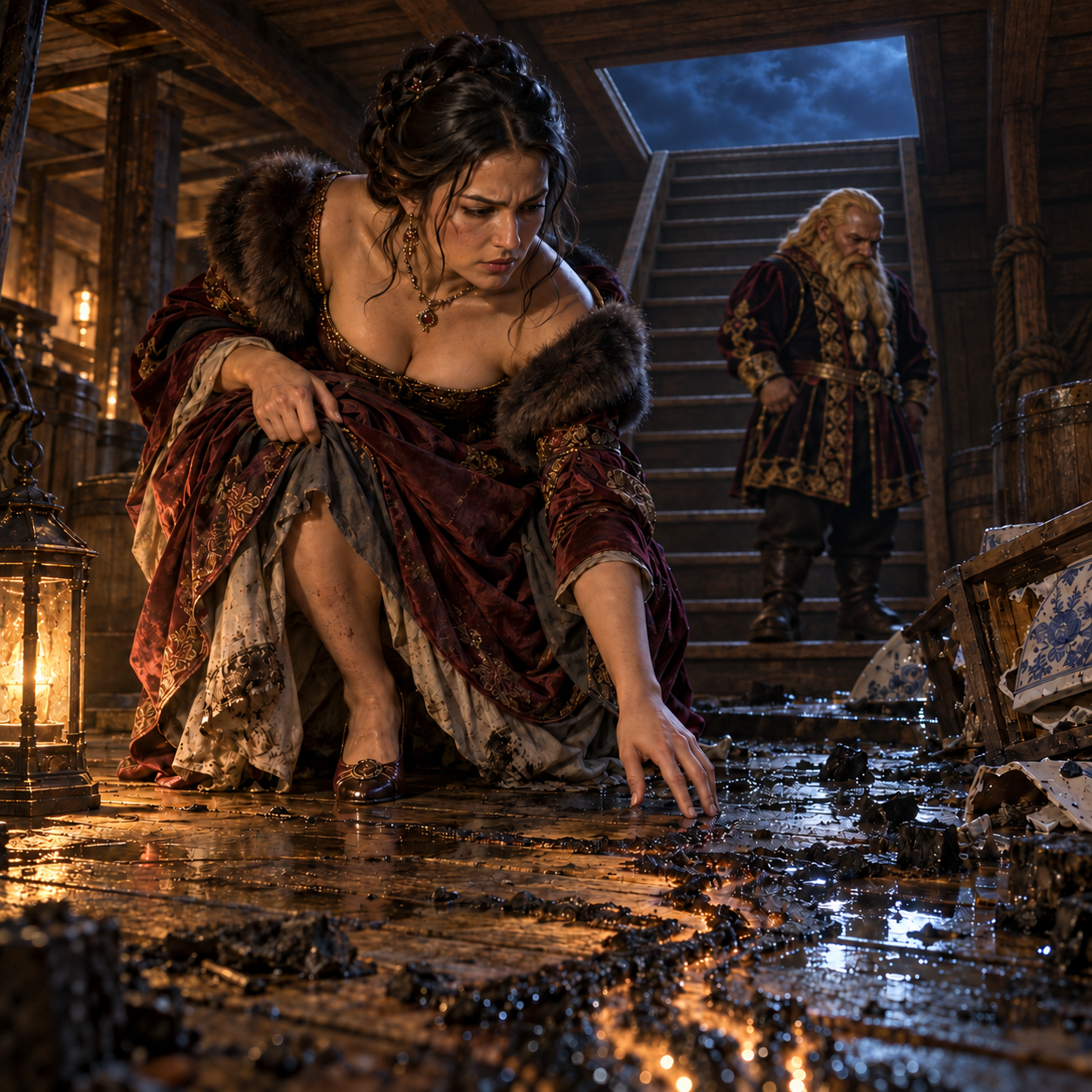
Kemperbad rose above the river on its cliffs, keeping its fine houses well clear of the mud that paid for them. Below, among the warehouses and moored barges, the Dandy Fräulein lay under repair, smelling of fresh timber, pitch, and the damp that seemed to have worked its way into everything they owned. Beyond her hull the Reik went about its business. Ropes creaked. Men shouted. Somewhere a heavy load settled with a crash and a burst of swearing. After Wittgenstein, the ordinary noises of people earning a living ought to have been comforting.
They had work, at least. Three hundred crowns for carrying Matthias Blücher’s porcelain to Marienburg, with a contract sufficiently worried over that even Thindruk had found little more to object to. The merchant’s men would load the fragile cargo in the morning. Until then, there was time to discover whether their new employer deserved the confidence his lawyer had so carefully encouraged.
There was also the lead casket aboard the boat.
Qavitrae stayed with it, and with Nora. Whatever Kemperbad offered by way of supper or entertainment, the elf showed little appetite for leaving their most troublesome possession unattended.
Wanda intended to ask the people who did the actual work. Thindruk preferred the people who ate well while discussing it.
Felrick considered the distinction.
“The fancy drinking comes with dinner?”
It did.
His decision required no further thought.
At the lift, the old operator prepared to collect his two pennies a head. This was the leg tax, and it stayed the same whether a traveller had one leg or two. Thindruk, however, had recently been seen in conversation with Master Blücher. A man in such company need hardly trouble himself with copper.
The operator knew that Blücher kept a tab.
Thindruk accepted this useful intelligence with the ease of someone discovering that the world had, for once, arranged itself properly. His companions belonged on the same account, naturally.
They ascended at the merchant’s expense.
Bruno’s Black Barge announced itself with an overturned boat on the roof. Inside, an accordion wheezed its way through a song whose principal interests became clear before Wanda had heard the end of a verse. Drums kept time beneath the singing. Smoke hung over broad shoulders and scarred faces; beer shone on tabletops marked by knives, mugs, and less easily identified violence.
Several people looked up when she entered.
Some looked away again. Others waited.
Wanda wore hide armour, with her morgenstern at one hip and her bullwhip at the other. She crossed to the bar without slowing, ordered a beer, and turned sufficiently to keep the room in view.
The bartender studied her.
“Do you know where you’re drinking, lady?”
“Black Barge. The lads down at the docks recommended it.”
He explained that although membership of the stevedores’ guild was not strictly required, it was customary.
“I might not be a stevedore,” Wanda said, “but I work on a boat. All I do is lift heavy things or hit things heavily.”
The bartender waited.
“I also drink heavily.”
He was willing to take her coin. He merely advised her that if anyone started giving her trouble, she would do best to let it pass and finish her evening elsewhere.
“Sound advice.” She gave him a wink. “Although I like hard men.”
He snorted and left her to her beer.
For a little while she drank alone. Then she raised her mug.
“To the working man and woman. May you get your coin paid promptly every day.”
That earned a low rumble of approval. Nothing extravagant, but sufficient. Wanda selected one of the approving faces and bought its owner a drink.
Griselda Dreyfus proved worth the investment.
“Most folk who don’t work the docks take one look at these ugly mugs and turn themselves round,” she said. “Commend you on your bravery.”
“I wouldn’t call them ugly.”
Griselda’s expression sharpened with interest.
“I like a rough exterior,” Wanda continued. “A man who knows how to work hard.”
An elbow found her ribs.
“Some of these men,” Griselda assured her, “can work extra hard.”
After that, the evening improved steadily.
Griselda introduced her to people. Wanda bought drinks without making a spectacle of her purse, reserving particular generosity for her new friend and anyone who impressed her. Suspicion gave way to talk, and the talk to laughter. She sang, joined the merriment, and discovered that the Black Barge possessed an extensive range of entertainments whose common feature was the possibility of minor injury.
There was arm wrestling. There were darts. There was a knife game played with an outspread hand, which appeared to have enjoyed a long and unfortunate history among the clientele.
A fistfight broke out. It was promptly interrupted so the combatants could be moved into the middle of the room, where everyone could see and the betting could be conducted properly.
The tavern had a man for that.
Wanda lost five silver and laughed hard enough to make it clear that the loss had not spoiled her night.
Between the drinks, she learned what she had come to learn. The Blüchers paid well. They paid promptly. Their generosity to the city was widely known, although the people at these tables placed greater importance on wages arriving when they should. Their boats were indeed away on business. Some were expected back in a few days, but there were none presently sitting idle in port.
Matthias’s explanation held up under beer.
With business attended to, Wanda devoted herself to Griselda’s prospects. Unwelcome men found themselves discouraged with admirable clarity; more promising candidates were ushered closer. By the end of the night, people who had watched her enter as though she were a possible disturbance were suggesting she give up the river altogether.
“Come down to the docks tomorrow, Wanda. We’ll find you work.”
She grinned over her drink. Tonight, the only prospects she meant to settle were Griselda’s.
At the Swan’s Neck, the smell of roasted duck reached Felrick before anyone could trouble him about appearances.
There were rich gravies, warm bread, carrots and wild onions, and potato dumplings concealing tender pork. Wine stood ready on the long communal tables. The serving staff wore matching clothes, the light was good, and the floor offered very little resistance to a boot.
Thindruk had moderated his own appearance. Tonight, Viscount Steelbone need not be visibly present. A less distinguished fellow would be better placed to repeat certain stories about a mysterious nobleman’s recent accomplishments.
Felrick, on the other hand, was about to become very distinguished indeed.
“You haven’t heard of him?” Thindruk asked their prospective dining companions. “The one-eyed gunslinger?”
Five merchants looked interested.
Thindruk spoke of remarkable marksmanship, of the champions of Chaos laid low, of a pistol whose report had sounded the end of a mighty enemy. Felrick provided the necessary presence. It was useful, in such circumstances, to look like a man whose modesty prevented him from interrupting.
Surely a fellow who had performed such services deserved a drink. A plate of something, perhaps.
The merchants went considerably further than Thindruk had expected. Before long, they were supplying details themselves. Someone had heard of an elite Imperial marksman. Someone else appeared quite certain that this must be the same man.
Felrick’s reputation grew while the duck was carved.
Alex Eisen, a merchant with a receding hairline and magnificent facial hair, leaned into the conversation with the expansive generosity of a man who had sold a cargo well that afternoon.
“Have you heard the news? That old castle on the river. Wittgenstein. Fallen straight in.”
Thindruk allowed that he had heard rumours. Beastmen, perhaps. An uprising. The household destroyed, the people driven to defend themselves.
A dark-skinned woman wearing a prominent Imperial cross confirmed that this was the account travelling downriver. Boats had stopped at Wittgendorf. People had asked where the castle had gone.
“This is the heart of the Empire,” she said. “Beastmen can drop a castle into a river?”
Alex dismissed the explanation. Wittgendorf was a plague hole. Everyone knew the villagers were sick and mad.
Perhaps they had grown hungry enough to do something about their lords.
“Don’t underestimate the poor,” he advised them. “They’re wily.”
Thindruk admitted to hearing a little more. Some wandering nobleman had apparently taken charge and led the people to victory. One could not put too much faith in peasant stories, of course. Still, if such a nobleman existed, he had rendered the Empire a considerable service.
“To the Empire!”
They drank.
Someone suggested the defenders could have used a marksman like Felrick. How many charging beastmen did he suppose he could shoot, given a certain distance?
“Before or after I’ve woken up?”
That went down almost as well as the wine.
The meal was paid for. So were the drinks. Thindruk could have regarded the evening as complete, but success encouraged industry, and he began drawing out news of the country ahead.
Most of the table preferred the fallen castle. Nevertheless, other concerns emerged.
There were rumours from Middenland: Sigmarites attacked, perhaps even temples burned. No one present had witnessed anything. Some blamed devout followers of Ulric, reaching for an old quarrel to explain a new fear. Nobody could vouch for the stories, which did not make them any more pleasant.
Alex offered a more attractive reason to look north.
The Middenheim Carnival was approaching.
Shows, spectacles, drinking, pleasures enough to make a man forget his own name. The whole city transformed, he assured them. It made the Schaffenfest at Bögenhafen look like a sideshow.
“I know what you’re thinking,” he continued, missing their accents entirely. “Middenlanders. Not a sense of humour among them.”
Thindruk watched him over his wine.
“But at carnival they let it all out. One mad week. Rest of the time they’re as solemn as a dwarf statue.”
Alex noticed his companion.
“No offence.”
Thindruk’s expression suggested the comparison was chiefly offensive to the statue.
Farther along the table, Ruari Radi had developed an explanation for Wittgenstein that he considered irresistible. He leaned close to Felrick, bringing a substantial quantity of wine breath with him.
“Dwarfs.”
Felrick listened.
“I was in those parts five years ago. Saw a little stumpy fellow with a shovel. Think about it.”
Felrick continued to listen. This encouraged him.
“Dwarfs dig tunnels. Dig a big enough hole under a castle…”
“What if they were beast dwarfs?” Felrick asked.
Ruari paused.
“Never heard of beast dwarfs.”
“Nasty underground. Dig five times faster than a regular dwarf. Cursed by moles.”
The merchant contemplated this enlargement of the world.
Mole men, once admitted, made room for other possibilities. Fishmen might have been nibbling away at the bank for years. The castle had fallen into the river, had it not? Exactly where fishmen would want its gold.
Thindruk mentioned ratmen.
The rest of the table displayed the weary discomfort of people who had already survived Ruari’s theory once that evening.
“Don’t encourage him.”
But Frieda Bismarck, the woman with the Imperial cross, finally brought them something more useful than subterranean speculation.
She had come back from Marienburg with a poor return on her cargo. Merchant factions were undercutting one another in a bitter price war. River traders had begun avoiding the city, unwilling to carry goods so far merely to accept miserable prices.
Thindruk asked how far the trouble extended.
Within the Empire, she thought they would be safe from it. Marienburg itself was the difficulty. Wait a month or two, and the market might improve.
Alex, whose commercial empire appeared to consist of two boats to Frieda’s one, suggested that sufficient experience and nerve could turn the situation to advantage.
Otto Gerber had been quiet until then. Pirates had taken both his cargo and his vessel, leaving him in Kemperbad to sell advice while he rebuilt the means to buy another barge.
Thindruk invited his opinion.
Certainly, Otto said, profit might be possible for someone capable of persuading one of the great merchant families to end the dispute. Such persuasion would require influence. Or leverage.
He looked at Alex.
“Do you perhaps have a nephew of one of these Marienburgers in your hold?”
Alex failed to appreciate the question.
Otto’s account of piracy led Thindruk to another practical matter. He wanted a small crossbow suitable for a gentleman travelling the river. His companions offered several places to try. Weapons were becoming easier to find because demand among river crews was increasing.
Once, they said, a boat might carry a bow and never use it.
Those days seemed to be passing.
“With Deadeye Felrick around, I scarcely expect to need anything,” Thindruk assured them. “But sometimes his admirers carry him off, and I have to fend for myself.”
Aboard the Fräulein, the evening passed more quietly.
Watchmen moved along the docks. Their lanterns came and went between warehouses, and even when no one stood immediately beside the boat, Qavitrae could generally see a light somewhere nearby. Blücher’s people appeared to be taking their duties seriously.
Nora lay within easy reach of her blitzball.
“I’ve never known a mayfly to be stabbed in the throat twice and survive,” Qavitrae observed. “That’s a first.”
Nora sat up slightly.
For a moment she considered speaking. Then she thought better of it and answered with a small, rough laugh.
She reached for the ball instead.
MOOD showed on its side as she held it up. A gesture told Qavitrae to move back. Another asked whether she was ready.
The elf caught the first throw without difficulty.
They began passing it between them. Nothing strenuous at first. Nora watched Qavitrae’s hands, testing what she could do, and then sent the ball wider, towards the edge of the boat.
Qavitrae moved quickly and caught it cleanly.
Nora’s answering nod carried a degree of respect that ordinary conversation might have taken much longer to earn.
For a little while they had the ball, the quiet water, and the pleasure of surprising one another. No one needed to explain what they had seen in the castle. No one needed to ask whether the other remembered.
They played longer than they should have.
Nora laughed at a particularly good catch. The laugh caught in her damaged throat. A cough followed it, and then blood.
Qavitrae stopped at once.
“Ah. Well, mayfly. That’s enough for tonight.”
Nora needed a moment before she could agree.
“Another few days in the hammock,” the elf said. “We’ll get you talking without coughing up blood. Then we’ll do this again.”
A thumb rose in assent. Nora settled back down.
Later, Thindruk and Felrick returned with wine in their bellies and useful information to share. Wanda arrived much nearer dawn, navigating the deck with the solemn concentration of a woman whose legs had become unreliable associates.
Three hours afterwards, she was eating an apple.
Thindruk and Felrick, whose own celebrations had been comparatively restrained, faced the morning with dry mouths.
Wanda crunched cheerfully.
“Felrick. I have to tell you about my night.”
The docks began stirring before sunrise. Once there was light enough for heavy work, a voice called for the Fräulein’s captain or owner.
Qavitrae answered.
The lead casket went temporarily into Thindruk’s cabin. He had agreed to tolerate it there during loading, provided that it returned to the hold afterwards, concealed among their other goods.
The foreman inspected the hatch and the space below. There were many crates, all of which required slow, careful handling. The crane could not be rushed. Loading would occupy the day.
Several of the stevedores recognised Wanda.
Some appeared rather more surprised to see her upright than she was to see them.
She asked how best to secure the cargo for the voyage.
They would secure it, she was told. The crew should leave it secured. The stevedores at Marienburg would attend to unloading.
Their advice, once stripped of professional courtesy, was to get out of the way.
While the work began, Max Wagner appeared on the dock in a dark velvet coat edged with fur. He caught Thindruk’s eye and beckoned him down the gangplank.
Young Master Blücher wished to extend an invitation. He and his wife were hosting a dinner that evening, and in gratitude for their willingness to undertake his commission, the entire crew would be welcome.
Appropriately dressed, naturally.
Thindruk explained that Nora was injured and might be unable to attend. Another of the crew might stay with her.
He watched the lawyer as he spoke.
Wagner’s face yielded nothing useful.
“Should you change your mind, the whole crew is welcome.”
The occasion was Matthias and Caroline’s first wedding anniversary. Festivities began at seven. There would be dinner and dancing. Wagner supplied directions, mentioned several establishments capable of providing suitable clothing at short notice, and moved with exquisite casualness to the question of gifts.
Caroline enjoyed embroidery.
Thindruk asked whether she possessed one of the slightly curved needles lately fashionable in Nuln.
The lawyer confessed that the viscount already appeared to know more about the subject than he did.
“I try to pick up a little knowledge wherever I can,” Thindruk said. “You never know what might prove useful.”
Nora, on learning that attendance need involve nothing more strenuous than eating and being agreeable, decided she could manage it.
The others considered the state of their wardrobes.
The boat had money. Presentable clothes were a business expense.
The coffers opened.
Kemperbad’s tradespeople spent the day making the crew suitable for polite company.
Tailors measured and pinned, promising hurried alterations for eight crowns an outfit. Baths followed. Hot water loosened the river dirt; attendants scrubbed, perfumed, powdered, and persuaded hair into arrangements that bore little resemblance to its recent habits.
Wanda submitted to cosmetics with considerable interest. She wanted something respectable, with a few touches that suggested the north. The young women attending her did not seem to have visited Middenland, but they did their best.
She wanted to look well. More than that, she wanted to avoid embarrassing Thindruk. He had taught her to read; the least she could do was learn how to stand beside him at a dinner.
Qavitrae’s instructions were simpler.
Accentuate the scar.
The branching mark of lightning was to be made conspicuous, its paths picked out so that they caught the light whenever she turned her head.
The attendant hesitated only briefly.
“As you wish.”
“If you’d been struck by chaotic lightning during a war a thousand years ago,” Qavitrae asked, “wouldn’t you want people to know?”
The young woman admitted that she could not rightly say.
Thindruk chose the local fashions with confidence. Felrick acquired a monocle to wear over his eyepatch, and a splendid version of his accustomed hat, finished with an iridescent peacock feather.
There were more practical purchases as well. Thindruk bought a light crossbow and ten clean bandages. Wanda visited a leatherworker about a carrying harness for the great sword taken from the Chaos knight.
The craftsman asked to see the blade.
His eyes widened.
“What in Sigmar’s name is that?”
“A trophy,” Wanda explained. “Won fighting the hordes of Chaos.”
He considered the weapon, then the available leather.
She would have liked a wolf motif. Something with claws, perhaps.
On such short notice, he could offer some fur.
She accepted.
It was consequently disappointing to learn that the sword could not accompany her to the party.
“Nor the whip,” Thindruk added.
Wanda considered alternatives.
“Manacles?”
“Probably not appropriate to an anniversary.”
The shoes were another grievance. They were polished and acceptable, but she could see no advantage in them over her boots.
“You’ll be able to dance with the gentlemen.”
“What if they step on my feet?”
“They’ll apologise.”
“And if they don’t?”
“Look at them with disapproval.”
That, at least, sounded manageable.
Qavitrae offered further encouragement. Wanda had seen the expressions she wore in battle. Something of that sort ought to cause a careless dancing partner to wither.
Thindruk would retain his gentleman’s rapier. A fine weapon worn by a titled man was acceptable. He also found room, less openly, for his dagger, lockpicks, and knuckle duster.
For Caroline’s gift, he spent five crowns of his own money.
The purchase was a modest quantity of Estalian thread, extraordinarily fine and strong, with a beautiful sheen. It was sufficiently unusual to please an enthusiast without suggesting a desperate attempt to buy the household’s favour.
Thindruk knew the difference mattered.
The Blücher mansion stood beyond the crowded heart of Kemperbad, where wealth had room to spread itself over several acres. Gardens surrounded the house in elaborate arrangements. Armed men watched the gates discreetly.
More guests were already making their way towards it. Directions had scarcely been necessary.
The guards examined the invitation. Thindruk’s rapier attracted no objection. The rest of the crew received closer scrutiny, but their efforts at respectability carried them through.
Wanda felt almost naked.
Felrick, buoyed by the previous night’s success, regretted only that the famous gun had been left behind.
A servant asked how Thindruk wished to be announced.
“Viscount Thindruk Steelbone of Middenland,” he replied. “And the crew of the Dandy Fräulein.”
They entered beneath the announcement into music, candlelight, and a concentration of wealth that made even the accustomed members of their party take notice.
More than a hundred guests would gather before the evening was well advanced. Servants passed with trays of wine and food. Musicians filled a gallery above the ballroom, playing dances whose rhythms suggested that everyone below had been taught precisely where to put their feet.
Wanda leaned towards Felrick.
“It’s so quiet.”
No one was shouting over the music. No one had overturned a table. There was, so far as she could discover, no bookie.
“The more money people have,” Felrick said, “the less they know how to spend it.”
There were compensations. The Bretonnian cheeses required investigation.
Wagner found them before long.
He welcomed Thindruk warmly, then looked across the group.
“And this is all your crew?”
“Indeed. Nora thought the occasion might prove restorative. I can hardly say she was wrong.”
Qavitrae studied the lawyer. His interest in their attendance merited attention, but his manner remained professionally pleasant and otherwise unreadable.
He turned to Nora, taking in the bandages at her throat, and expressed the hope that the festivities would improve both her spirits and her health.
Nora gave him a graceful curtsy.
Felrick nudged Wanda.
Wanda stared.
For an instant, the bending knees had looked like the beginning of something far more familiar and dangerous. Instead, Nora rose with composed delicacy.
“Thank you, my lord,” she said very quietly. “Very kind of you.”
The words cost her something. She kept that out of her expression.
Wagner offered introductions to people whose acquaintance might benefit river traders. There were Jacques and Henri, Bretonnian paper merchants; Roberto from Tilea; a promising young entrepreneur named Dirk; and Miguel, an Estalian looking for new opportunities. The Blüchers’ circle reached comfortably beyond Kemperbad.
The news about Marienburg remained discouraging. These merchants confirmed that the dispute would probably continue until one family felt sufficient pain in its purse to yield.
Wanda quietly told Thindruk what she knew of the city and its rival interests, and he drew on it as the conversations went along.
Such conversations had a way of ending.
A question about their business would lead to the discovery that they operated one small boat. Their new acquaintances would smile. Another guest would arrive, or someone across the room would become urgently interesting. Bodies shifted a little. A circle that had included them somehow ceased to do so.
Then they would be standing alone, holding wine.
Nora had expected as much. She knew this sort of gathering well enough to enjoy its food and music without demanding affection from its guests.
Wanda was less certain she was being insulted at all. No one had struck her or tipped a drink over her. Some of the expressions were unfriendly, but the buffet remained excellent.
She watched Nora and Thindruk for guidance, smiled when people spoke to her, and wondered how much more she could eat before the dress began to object.
Thindruk noticed more than she did.
His title afforded him room that the others lacked, and he used some of it on their behalf. When remarks about Wanda’s size or unfamiliarity with the occasion grew pointed, he answered in the same language of polished implication.
The Blüchers had invited her, after all. Surely no one meant to question their hosts’ taste?
A few people laughed.
The target of the remark discovered something else to discuss.
Wanda helped without surrendering her good humour. Her candid observations gave Thindruk openings, and he took them neatly. It was an unfamiliar kind of fighting for her, but she began to appreciate the way an opponent could lose while still holding an untouched glass.
Matthias and Caroline addressed the gathering from a raised platform and thanked their guests. Elsewhere in the evening, Thindruk saw their host speaking with a man whose lavish chain of office suggested the mayor himself.
Blücher’s prosperity had influential witnesses.
Eventually a servant approached the viscount. The couple wished to thank him personally for his gift.
Caroline held the thread with unmistakable delight.
“Wherever did you find this? It’s so fine, and strong with it. And the sheen!”
For all her interest in embroidery, she had never seen its like.
Thindruk received her astonishment with the composed pleasure of a man whose judgement had been vindicated. He was less forthcoming about the market stall that had supplied it.
He had known, he suggested, that eventually he would meet someone whose passion and skill could do justice to such material. In the proper hands, something truly beautiful might come of it.
Caroline looked at Matthias.
They really must become better acquainted with the viscount.
Matthias agreed.
Trade carried Thindruk hither and thither, he explained, but he would certainly return. Indeed, he pledged to take up their invitation.
Caroline seemed thoroughly pleased.
By the time the gathering began thinning towards midnight, the evening could reasonably be counted a success. They had eaten well, dressed well, learned useful things, and made an impression upon the people who had hired them.
No one announced that the party was over. Its guests simply recognised the moment and began leaving, as though they had all consulted the same discreet clock.
The crew went back through Kemperbad in their new clothes.
At the lift, there was no fare to pay.
The Blüchers, in their generosity, had covered everyone’s passage that evening.
Then the smell of smoke reached them.
At first it was only a trace in the night air. Nearer the cliff edge, it thickened.
Below, among the docks, an orange glow moved against the darkness.
Thindruk looked towards the Blücher warehouses.
“No.”
The lift began its descent.
There was nothing to do but stand within it while the view sharpened. A fire somewhere in that direction became a fire disturbingly close to their berth. As they descended farther, they could make out figures moving beside the water.
By the time they reached the bottom, hope had narrowed to the possibility that their eyes were wrong.
The Dandy Fräulein was burning.
The fire brigade had formed around her. Buckets came up from the river and emptied over the boat. Men shouted for water, room, more hands. Steam rose through the smoke.
Wanda hurried forward, fighting the restrictions of the dress and the uselessness of the shoes she had been persuaded to wear.
Thindruk called to anyone who might answer.
“Who saw it start? What happened?”
Most were too occupied to spare him a glance.
Eventually the same explanation began reaching him from different mouths.
A lamp, perhaps. An oil lamp knocked over in the hold.
The brigade was gaining control, they said. The boat probably would not sink at her moorings.
That was the best news available.
She was no longer fit for the river. Some of the cargo was ruined. Repair might be possible for someone with deep enough pockets.
They had only just repaired her.
The thought stayed with them as the flames diminished and the blackened shape of their vessel emerged.
When it was safe enough to go aboard, Qavitrae made for Thindruk’s cabin.
The fire had reached it.
The lead casket was hot.
It was also intact, its seal unbroken.
She left it closed.
Other discoveries offered smaller mercies. Her blades had survived. Felrick found his saddle aft, beyond the fire’s reach. Their personal effects appeared still to be there.
Someone asked about the gold.
They found the chest scorched. Inside, a few coins had warped in the heat, but most remained as they had been.
Gold was still gold.
Thindruk stood amid the damage with tears in his eyes and attributed them to the smoke.
Around him, water dripped through the boat. Qavitrae and Nora found it seeping through a damaged place in the hull. Burnt cargo filled the hold with a foul, sodden smell.
Felrick began counting.
He remembered where things had stood. He remembered the crates. Moving carefully through the wreckage, he checked one area against another and accounted for what remained.
Nothing important appeared to be missing.
Wanda confirmed that their belongings were still present.
Whatever had happened here, there was no obvious theft to explain it.
Together, she and Felrick turned their attention to the fire itself.
Beneath the cargo hatch, the damage drew them back repeatedly. The hatch had been open when they left, the stevedores still finishing their work. It should have been closed afterwards.
Here, they thought, was where the fire had begun.
They examined the way it had spread. There were signs consistent with oil splashing and running, carrying flame quickly across the hold.
A broken lamp could spill oil.
This looked like more than one lamp should have contained.
Wanda crouched to look again, the fine fabric of her dress perilously close to the wet char.
“I’ve seen insurance fraud before.”
That was a suspicion, and she kept it at that.
Thindruk found someone attached to the Blücher warehouses and demanded that a message be taken immediately. Master Blücher’s shipment had been of the greatest importance. His lawyer must be told what had happened.
Tonight.
Not tomorrow morning.
Wanda found Klaus, the foreman, with smoke blackening his face.
He looked at her with recognition, distress, and a momentary distraction that the dress did nothing to discourage.
“I’m sorry, Wanda. About your boat.”
He thought it had been a careless accident. Someone must have kicked over a lamp.
“Walk me through the end of the day.”
The sun had been getting low. It was dark below deck, so they had brought lamps down. They usually hung them. Perhaps someone had left one on the floor because there was nowhere suitable to put it. Perhaps another man, backing up, had knocked it over without noticing.
“I don’t know.”
Wanda let him speak.
He had asked his whole crew. Nobody said they had seen anything.
She could have pressed harder. Found somewhere quiet, taken control of the conversation, made it difficult for him to retreat into uncertainty. Instead, she stayed close and spoke as someone he knew from the Black Barge.
She wiped a little soot from his face.
His composure was already poor. The ruined boat, the possibility that his men were responsible, and Wanda herself between them gave him little room to hide.
What she saw was shock.
He was appalled that his crew might have caused this. He did not know that they had. His account was an attempt to assemble an accident from the pieces available to him.
She also heard, in the way he talked about his men, why a guilty stevedore might be reluctant to confess.
“Was there another company after this job?” she asked. “Someone who benefits if we fail?”
Klaus had heard nothing of the sort.
The trade wars in Marienburg meant little to his understanding of this particular cargo. He knew it was something grand for Bretonnia. A wedding. Important people. The porcelain had to arrive safely.
That was all.
Wanda questioned others. The answers remained confused, and the confusion appeared real.
She returned to her companions with what she had learned.
The boat had been under Blücher’s custody when the fire broke out. The contract placed responsibility accordingly. Thindruk knew the clause; they all remembered the care that had gone into discussing it. It was a useful thing to possess while standing in the remains of one’s livelihood.
It did not explain the oil.
Nor did it make the Fräulein capable of sailing.
They waited beside the blackened hold, their evening finery carrying the stink of burnt timber. Felrick’s peacock feather caught the light of the working lanterns. Glitter still marked the branches of Qavitrae’s scar. Nora kept her injured throat clear of the drifting smoke as best she could.
Above the cliffs, the anniversary celebration was ending. Below, water continued to drip from their boat.
Their money had survived. Their weapons had survived. In Thindruk’s cabin, the sealed casket remained among the wreckage, hot and undamaged.
A message was on its way to Matthias Blücher.
Until he came, they had a contract, a ruined vessel, and more oil than anyone could explain.
The session opened with a recap of the company’s escape from Wittgendorf after the destruction of Castle Wittgenstein. The battered Dandy Fräulein had required overnight work with planks and pitch to keep her leaking hull afloat. Imperial Exactor Willibald Krantz had emerged from the village after escaping the von Wittgensteins’ dungeons. Half-starved and weakened, he described drugged feasts, four-armed horrors, animated taxidermy, and the torments beneath the castle. Thindruk had offered the explanation that beastmen overran Castle Wittgenstein and used foul magic to cast it into the Reik. Krantz accepted that account. Fighters from the woodland camp had subsequently reported storming the outer bailey, killing its remaining defenders, and seeing the castle’s cliffs collapse into the river. The company and the fighters agreed to maintain the story that the von Wittgensteins fell to the beastmen they had harbored. The Fräulelein had departed downriver at dawn. By midday, Krantz had died in his hammock, apparently succumbing in his sleep to his weakened condition. Without his papers or a desire to invite official questions, the company commended him to Morr, weighted his feet, and buried him in the river. The company had then reached Kemperbad to obtain treatment for Nora, repair the boat, and decide what to do with the warpstone concealed aboard. Wealthy merchant Matthias Blücher had approached them with an offer of 300 gold crowns to transport fragile porcelain to Marienburg in time for a noble wedding. He said the boat and her crew were developing a favorable reputation along the river and that his own vessels were occupied elsewhere. The company had negotiated and signed the transport contract, taking particular care over the provisions assigning responsibility for the cargo and vessel. At the start of the session’s new events, the boat was under the supervision of Blücher’s stevedores and night watchmen. Qavitrae decided to remain aboard with the recuperating Nora and guard against anyone approaching or stealing the warpstone. Wanda proposed investigating Blücher through sailors and dockworkers while Thindruk spoke with merchants and captains. Max Wagner, the lawyer involved in the contract, had recommended the Swan’s Neck as a respectable place for dinner and conversation. Felrick chose to accompany Thindruk there, persuaded by the prospect of a good meal. Wanda asked dockworkers where they preferred to drink. Loading the porcelain had not yet begun; the stevedores were scheduled to start the following morning. Nora’s recuperation requirements were clarified: each day of bed rest removed an additional day from her recovery time. The GM allowed light activity, such as taking the air on deck, provided she avoided anything resembling adventuring. The dockworkers directed Wanda to Bruno’s Black Barge, a tavern near the top of the cliffs above the docks. Its identifying feature was an overturned boat mounted on its roof. The lifts between the docks and the upper town normally charged two pennies per person, described as the “leg tax.” Thindruk arranged for the lift fare to be put on Blücher’s account. The elderly operator had seen him speaking with the merchant and agreed to notify the lift master. Because Wanda and Felrick were riding with him, their fares were covered as well. Wanda entered Bruno’s Black Barge wearing hide armor rather than her brigandine, with her Morgenstern on one hip and bullwhip on the other. She had left the two-handed sword aboard the boat. Inside, musicians played accordion and drums while someone sang bawdy songs. The customers were muscular dockworkers, men and women whose hands sometimes showed missing fingers and other evidence of their trade. They smoked, drank, and laughed, although several gave Wanda suspicious looks. Wanda confidently approached the bar, surveyed the room, and ordered a beer. The bartender warned her that, although guild membership was not strictly required, the tavern customarily served members of the stevedores’ guild. Wanda replied that she worked on a boat and spent her time lifting heavy things or hitting things heavily—and that she drank heavily as well. The bartender accepted her custom but advised her to leave peacefully if anyone gave her trouble. Wanda responded flirtatiously that she liked hard men and winked at him. After her first drink, Wanda toasted working men and women and wished them prompt payment of their wages. Some nearby customers gave a restrained but approving response. Wanda selected someone who had responded favorably, bought another round, and began a conversation. Her new acquaintance was Griselda Dreyfus. Griselda remarked that most outsiders took one look at the customers and left. Wanda said she appreciated rough-looking men who knew how to work, and Griselda responded with an elbow, a wink, and an approving comment about the men’s other capacities. Griselda introduced Wanda to more people as the evening continued. Wanda socialized, drank, sang, and danced, buying drinks for Griselda and others who impressed her without ostentatiously displaying her money. Wanda committed two silver shillings to buying drinks, improving her Rumor test by 10%. The GM set the final difficulty at Challenging, and Wanda succeeded while using her Cosmopolitan ability to flip the result if needed. The dockworkers’ opinions of the Blüchers were consistently favorable. They considered the family good employers who paid well and paid promptly. They also knew the family gave generously to the city, although that philanthropy mattered less directly to the stevedores. Wanda specifically checked whether Blücher’s vessels really were away on other business. Her contacts confirmed that none were currently in port. Some were expected back within a few days, but the fleet was routinely moving along the river. Having obtained the information she wanted, Wanda turned to helping Griselda attract a man she liked. She encouraged welcome attention and discouraged unwanted approaches. The evening included arm wrestling, knife-hand games, darts, scuffles, and gambling. One fistfight was interrupted so the participants could be moved into the middle of the tavern for a proper boxing match. A dedicated bookmaker handled wagers. Wanda placed a five-shilling bet with the possibility of receiving a full crown. She failed the Gambling test and lost the stake, but laughed off the loss. To determine her lasting reception among the stevedores, Wanda made a Challenging Charm test with a bonus for being a happy drunk. Her result of 18 succeeded. By the end of the night, the dockworkers were encouraging Wanda to give up river travel, put down roots, and come to the docks for work. Wanda remained focused on helping Griselda enjoy herself, and the evening ended with flirtation and romantic activity. Meanwhile, Thindruk and Felrick arrived at the Swan’s Neck. The establishment was cleaner and better lit than many taverns they had visited, with serving staff dressed in similar clothing. The customers wore the colorful, ornate fashions of the Reikland, including ruffled collars and puffed shoulders. The atmosphere was lively and sociable, although the inn was not comparable to dining in a noble’s hall. The Swan’s Neck stood in a somewhat nicer market area near the lifts and catered to people arriving by boat. Two long communal tables occupied the middle of the room, while curtained private booths offered more secluded seating. Roasted meat, rich gravy, bread, melted cheese, and strong wine scented the room. Thindruk judged the communal tables suitable for joining conversations and making himself welcome. Thindruk began by praising Felrick’s marksmanship, introducing him as a one-eyed gunslinger capable of felling a mighty champion of Chaos with a single shot from his “blessed” pistol. Thindruk also wanted to spread a story about a mysterious nobleman who had helped the people defeat the beastmen at Castle Wittgenstein. To keep that story separate from his own identity, he disguised himself as someone of another social class. His Disguise test succeeded with a result of 83 against a 99% chance. He therefore did not appear at the inn as the recognizable Viscount Thindruk Steelbone, owner of the Dandy Fräulein. Five merchants were gathered at the table they joined. Their dinner included crisp-skinned duck, carrots, wild onions, and elaborate potato dumplings containing tender pork and a crisp interior. Thindruk used Felrick’s supposed celebrity to solicit food and drink, suggesting that such a notable Chaos Knight slayer deserved support. Felrick aided his Guile test. Thindruk achieved a critical success. The merchants began supplying their own supposed details about Felrick’s reputation, including suggestions that he had been an elite sniper in the Imperial army. These additions arose from the diners’ enthusiasm. One particularly talkative merchant was Alex Eisen, a middle-aged man with thinning hair and impressive facial hair extending from his mustache toward his hairline. He was already several glasses of wine into the evening. Alex asked whether they had heard the news from upriver: Castle Wittgenstein had fallen into the river and was gone. Thindruk responded that he had heard rumors of a beastman uprising that destroyed the household before the local people defeated it. A dark-skinned woman with short hair and a prominent Imperial cross confirmed that the beastman explanation was circulating. She had heard that travelers stopped at Wittgendorf, asked where the castle had gone, and received that account from the villagers. She found the idea of beastmen capable of dropping a castle into the river alarming, particularly in the heart of the Empire. Alex rejected the beastman story. He characterized Wittgendorf as a plague-ridden place full of sick and mad villagers, suggesting that the poor might somehow have caused the destruction themselves. Thindruk introduced his intended rumor: an itinerant, mysterious nobleman had taken command and led the people to victory. He carefully framed it as something he had heard rather than a claim to personal credit, then praised such a deed as a service to the Empire. The conversation returned to Felrick’s shooting, with the merchants imagining how many charging beastmen he could kill. Felrick responded by asking whether the hypothetical attack occurred before or after he had awakened. Their new acquaintances paid for Thindruk and Felrick’s meals and drinks, entertained by their personalities, stories, and apparent insight into the destruction of the castle. Thindruk next sought news concerning their route toward Marienburg. Felrick, now trained in Rumor, assisted him. The Routine test succeeded. The company at the inn remained more interested in Castle Wittgenstein than in ordinary river news, but Thindruk and Felrick heard reports of growing unrest in the north. These were vague, secondhand accounts from Middenland rather than eyewitness reports. They alleged that devout Sigmarites were being targeted and that temples might have been attacked and burned. Some people blamed zealous followers of Ulric because of the longstanding religious tension between Ulricans and Sigmarites. No responsibility for the reported attacks was established. The religious context was explained: Ulric, associated with war, wolves, and winter, was worshiped long before Sigmar. Hardline Ulricans regarded Sigmar as a great warrior and leader who was nevertheless only a man, while Sigmarite teaching held that Ulric elevated him to godhood. Wanda’s established devotion to Ulric was clarified. Her favorable experience at a previous Sigmarite church meant she was not antagonistic toward Sigmar: she accepted him as a god while considering Ulric greater. The traditional means of earning an Ulrican wolf mantle was discussed: entering the wilderness without equipment and killing a wolf using whatever could be found or fashioned there. Wanda possessed a wolf mantle, but the session did not establish whether she had obtained it through that ordeal. Alex Eisen continued boasting about his skill in trade and negotiation, apparently encouraged by having sold a cargo profitably that day. His good fortune also explained his generosity with the wine. Alex asked whether they intended to attend the carnival in Middenheim. The event was familiar to people from Middenland and drew visitors from far away. The carnival was described as occurring irregularly, generally every three or four years, and transforming the normally dour city through widespread celebrations and numerous events. Its origin was associated with the breaking of a great siege, during which the city’s Graf rode out and defeated the besieging enemy. The account was presented in broad terms rather than as a precise historical retelling. Alex described the carnival as a full week of shows, spectacles, strong drink, and other pleasures. He claimed it made Bögenhafen’s Schaffenfest look like a sideshow. Apparently overlooking his companions’ Middenland accents, Alex said Middenlanders ordinarily lacked humor but released all their pent-up impulses during the carnival. He compared their usual expressions to those of dwarf statues, then waved off the implied insult when looking toward Thindruk. Another diner, a robust man introduced as Ruari Radi, leaned close to Felrick and offered his own explanation for Castle Wittgenstein’s destruction. Ruari claimed dwarfs were responsible. His evidence was that he had seen a short fellow carrying a shovel in that area about five years earlier. Since dwarfs dug tunnels, he reasoned that they must have excavated an enormous hole beneath the castle. Felrick encouraged him by proposing “beast dwarfs,” supposedly cursed by moles and capable of tunneling five times faster than ordinary dwarfs. Felrick further suggested that his own small stature allowed him to pursue such creatures underground. Ruari took the new idea seriously enough to incorporate it into his speculation. Ruari then expanded his theory to fishmen, imagining them gradually nibbling away the riverbank until the castle collapsed where they could seize its gold. Felrick agreed that the castle’s fall into the river suited that explanation. Thindruk added ratmen to the discussion, suggesting that they could rival the supposed beast dwarfs at digging. Other diners were less interested and discouraged further encouragement of Ruari’s theories. The woman wearing the Imperial cross was identified as Frieda Bismarck. She had recently returned from Marienburg after delivering a cargo there. Frieda reported that merchant factions in Marienburg were engaged in a price war, continually undercutting one another. River traders were avoiding the city because they expected poor prices, reducing the flow of incoming goods. She was disappointed that her own trip had produced little profit. When Thindruk asked how far upriver the trouble extended, she said it should not affect trade conducted within the Empire’s borders. Frieda explained that there were no other significant trading ports in the Wasteland to serve as alternatives to Marienburg. The merchants were maintaining their positions for the moment, although she expected economic pressure eventually to force a change. She recommended postponing a journey to Marienburg for a month or two, when the market would probably be more favorable. Thindruk thanked her for potentially saving him considerable trouble and offered another glass of wine, pouring from wine someone else had purchased. Alex dismissed Frieda as a small operator with one boat and contrasted her experience with his own supposed commercial empire. His own fleet appeared to consist of two boats. Frieda was an independent carrier operating a twenty-foot barge, making her circumstances broadly similar to the company’s. Another merchant, Otto Gerber, initially said little. Eventually he explained that pirates had taken both his vessel and cargo. Otto had come to Kemperbad to rebuild his finances by offering advice as a trade consultant. He hoped his knowledge of river ports would earn enough money to acquire another barge. Thindruk asked Otto to assess Frieda and Alex’s opposing views: whether Marienburg was simply a bad market or a place where a sufficiently capable merchant could still profit. Otto suggested there might be an opportunity for someone capable of persuading or pressuring a major merchant family into ending the trade war. He considered that difficult for an ordinary river trader. Looking directly at Alex, Otto dryly asked whether he happened to have a nephew from one of the Marienburg families in his hold. Alex did not understand the remark. The company’s departure schedule was clarified. Loading the porcelain was expected to occupy the whole following day because the crates needed careful handling. Matthias did not expect the Dandy Fräulein to leave until the day after loading. The journey to Marienburg normally took about ten days, leaving a spare day or two before the onward captain’s scheduled departure; Matthias also expected that captain to wait at least a couple of days if necessary. Thindruk asked the merchants where he could buy a small crossbow suitable for carrying on the river. Otto’s experience with pirates gave him a reason to raise the subject. The merchants recommended outfitters and sellers who supplied weapons to travelers and riverboat crews. They explained that attacks on boats were becoming more common, creating a growing market for weapons. The river had once been considered safe enough that a bow kept aboard was rarely needed. Thindruk joked that Felrick’s marksmanship normally protected him, but that he might need to defend himself when Felrick was occupied with admirers. Thindruk also reviewed his lingering arrow wound and the requirements for treating a light wound. A bandage, approximately ten minutes, and a Healing test were identified as the relevant treatment requirements. He proposed replenishing the first-aid supplies and acquiring a grappling hook on a chain for boarding other vessels. No purchase of the grappling equipment was completed in the session. Thindruk and Felrick returned to the Dandy Fräulein later that evening, choosing to sleep aboard. Wanda returned much later, shortly before dawn, sufficiently drunk that she was barely steady on her feet. Wanda critically succeeded on a Challenging Toughness test. After only a few hours’ sleep, she was ready for breakfast and eating an apple, while Thindruk and Felrick felt the effects of the previous night’s strong wine. The transcript then returned to Qavitrae and Nora’s quieter evening aboard. Qavitrae remarked that she had never known a “mayfly” to survive being stabbed in the throat twice. Nora acknowledged the comment with a nod and a raspy laugh, initially thinking better of trying to speak. Nora retrieved her Blitzball, which had “MOOD” written on its side, and gestured for Qavitrae to move back and catch it. Qavitrae joined in, and the two tossed the ball back and forth. Qavitrae’s Athletics training was sufficient for her to handle it confidently. Nora tested her by throwing toward the edge of the boat. Qavitrae ran out and caught the ball, earning an approving nod from Nora. During their time on deck, they could see Blücher’s night watchmen moving along the docks and in and out of the warehouses. Even when no guard was close to their vessel, a patrol light was generally visible. The watchmen appeared to take their duties seriously. The game continued a little longer than was sensible for Nora’s condition. Amusement and laughter eventually gave way to coughing up blood, reminding both of them that she still needed rest. Qavitrae ended the activity and suggested a few more days in the hammock before another game, ideally when Nora could speak without coughing blood. Nora gave a thumbs-up and a nod before settling back into bed. The docks became active before dawn, with heavy labor beginning once there was sufficient sunlight. Soon a stevedore called for the Fräulein’s captain or owner. Qavitrae presented herself as captain and intended to supervise the loading closely, particularly to prevent anyone from getting a look at the locked warpstone container. The company discussed moving the casket into Thindruk’s cabin while the workers were aboard. Thindruk accepted this temporarily, intending afterward to conceal it beneath other goods rather than keep it in his cabin. Metal goods, cutlery, and canvas coverings were mentioned as possible concealment. The group agreed to use the cabin during loading. Some of the stevedores recognized Wanda from Bruno’s Black Barge and greeted her. Several were working despite having also spent the previous night drinking heavily. The foreman explained that the numerous crates required slow, careful handling and cautious crane work. Loading would take all day. Wanda asked how best to secure the cargo and minimize damage. The stevedores said they would handle the securing themselves, advised the crew not to undo their work, and told them to let the stevedores in Marienburg unload it. The workers primarily wanted the company to give them space. The foreman examined the cargo hatch, planned the lowering of the crates, and estimated that he would need about half a dozen men. Max Wagner arrived at the docks wearing a fine dark velvet coat with fur lining. He waved Thindruk down the gangplank for a conversation. Wagner conveyed an invitation from Matthias Blücher to a dinner that evening in gratitude for the company’s willingness to undertake the transport job. The invitation extended to the entire crew, provided everyone wore appropriate clothes. Thindruk initially declined on Nora’s behalf because of her injuries and suggested that another crew member might remain with her. Thindruk tried to judge whether the possibility of some crew members staying away troubled Wagner. He failed a Challenging Scrutinize test, spent a coin to try again, and failed to learn more from the second attempt. Wagner displayed no particular reaction Thindruk could interpret. He simply reiterated that the entire crew would be welcome if they changed their minds. Wagner explained that the occasion was Matthias and Caroline Blücher’s first wedding anniversary. Festivities would begin at seven, with dinner and dancing at their home. He supplied directions and emphasized the formal dress expected. He also casually mentioned establishments that could outfit the crew quickly and places where they could purchase a suitable gift. Thindruk asked about Caroline’s interests. Wagner said she enjoyed embroidery and made embroidered items such as pillows. Thindruk concluded that supplies or tools would be more thoughtful than finished embroidered goods. He discussed supposedly fashionable curved embroidery needles from Nuln, and Wagner admitted that Thindruk appeared to know more about the subject than he did. Obtaining clothes and a gift would occupy a substantial part of the morning, with a later visit to the tailor likely necessary to collect alterations. The company established that existing fine clothing was suitable for the occasion. Ordinary fashionable clothing would also be acceptable at a merchant’s party, although it would not make an especially strong impression. Fashionable clothes normally cost five crowns, but obtaining an outfit with rapid alterations raised the price to eight crowns. The price included basic, acceptable shoes. Felrick decided to obtain an outfit and attend. Nora considered joining as well, provided the occasion would still count as rest. The GM ruled that attending the party could count as a restful day if Nora kept her activity light and avoided pursuits, fights, or other exertion. Nora’s existing clothes were too rough for the event, and Wanda had only sturdy traveling clothes. The company agreed to use its shared funds for appropriate outfits as a business expense. After visiting the tailors, the group went to a bathhouse for bathing, scrubbing, perfume, and optional powder and makeup. The service cost two silver shillings. Wanda chose makeup, including coverage for her pimples. She asked for subtle features that emphasized her northern background while remaining respectable enough not to embarrass Thindruk. Qavitrae asked for her Lichtenberg scar to be accentuated with glittering highlights so that it would stand out and catch the light. She referred to having received it from chaotic lightning during a war a thousand years earlier. The attendants were not especially familiar with Middenland, but tried to follow Wanda’s directions. Thindruk requested the grooming and appearance currently fashionable among Kemperbad gentlemen. By the end of the preparations, the company looked and smelled respectable. Thindruk found time to purchase a light crossbow and ten clean, treated bandages. Qavitrae mentioned that she already carried four bandages, but Thindruk wanted a larger supply. The medical supplies were described as carefully packaged for use on wounds, with basic stitching equipment also discussed. Wanda sought a back scabbard or harness for the two-handed sword taken from the Chaos Knight. The leatherworker asked to see the blade so he could fit the equipment properly. The craftsman reacted with alarm when shown the weapon. Wanda explained that the company had defeated its former owner and taken it as a trophy from the fight against Chaos. Wanda asked for a wolf motif, such as claws holding the blade. Given the short notice, the leatherworker used available fur to provide a suitable decorative touch. Thindruk gave the others advice on conduct and equipment for the anniversary party. Arriving conspicuously armed would be inappropriate in this setting. A titled noble or officer could carry a suitable ceremonial or dress weapon, such as a rapier, but a two-handed sword would not fit the expectations of this Reikland gathering. Wanda asked about bringing her bullwhip and iron manacles. Thindruk discouraged both and said he could conceal his knuckle-duster and pass it to her if necessary. Felrick decided to buy a monocle and wear it over his eyepatch. Thindruk approved the accessory. Wanda objected to replacing her practical heavy boots with lighter shoes. Thindruk explained their suitability for dancing and advised her to respond to any unapologetic partner stepping on her feet with a disapproving look. Thindruk made an Easy Bargain test to select the anniversary gift and achieved a critical success. He judged two or three crowns to be a socially appropriate gift value for guests who did not know the couple well: enough to be respectable without ostentatiously displaying wealth or currying favor. The critical success offered two alternatives. He could spend six shillings on something that would appear to be worth three crowns, or spend five crowns on an understated but exceptionally well-chosen gift that Caroline would remember. Thindruk selected the five-crown option and paid from his personal funds. His light crossbow purchase was confirmed at the listed price, along with the ten bandages. Bolts recovered at the castle were accepted as suitable ammunition; the rules used the same bolts for all crossbows. Wanda recorded the new fashionable outfit and a two-handed weapon scabbard priced at two gold crowns. Felrick paid for an elaborate hat in a style resembling his usual headwear, embellished with an eye-catching, iridescent peacock feather from a distant land. The company traveled through Kemperbad toward the wealthier residential area on the slope beyond the town, away from the river cliffs. The Blüchers’ mansion stood on roughly four acres of land with elaborate ornamental gardens. The estate displayed wealth through its spacious grounds and grand house. Armed security watched the entrance discreetly. The company presented the invitation Wagner had supplied and was admitted. Nora elected to leave her swagger stick behind, considering it inappropriate for her carefully chosen appearance. Thindruk wore his fine rapier openly. Its decorative appearance and his noble status made it acceptable. He also used his Holdout ability to conceal a dagger, lockpicks, and knuckle-duster. The guards regarded him as a respectable noble and did not pat him down. Wanda carried no concealed weapons because her dress offered little room for them. Qavitrae likewise chose to arrive unarmed, deciding that bringing only a concealed throwing knife was not worthwhile. Qavitrae wore fine clothing above the minimum standard required for the occasion. Nora and Qavitrae had sufficient experience of burgher society that the event was not wholly unfamiliar. Wanda and Felrick were more obviously outside their usual social environment, although Felrick was excited by the prospect of building on the reputation established the previous evening. Thindruk asked to be introduced as Viscount Thindruk Steelbone of Middenland, accompanied by the crew of the Dandy Fräulein. The actual announcement identified him by title and name with his companions. The ballroom eventually held well over one hundred well-dressed guests. At least twenty servants circulated with food and wine, while a full band played courtly dances from a gallery. The scale of the entertainment impressed even those accustomed to prosperous company. Fine Bretonnian cheeses were among the refreshments. Wagner sought out Thindruk and warmly welcomed him. Noticing the others, he remarked that the entire crew appeared to be present. Thindruk explained that Nora hoped the festivities would benefit her spirits and health and praised the food and music. Qavitrae attempted to scrutinize Wagner’s apparent interest in having the whole crew at the party. Her Challenging test failed with a result of 89, leaving her unable to determine more than that he was practiced at politeness. Wagner noticed Nora’s neck bandages and expressed hope that the evening would improve her spirits and recovery. Nora’s injury still required a successful Scrutinize test before speaking. She managed a quiet, polite reply and a well-mannered curtsy. Felrick elbowed Wanda in surprise at Nora’s delicacy. Both were more accustomed to seeing her bend her knees before striking or tackling someone. Wagner offered to introduce the company to useful business contacts. Thindruk accepted while indicating some existing familiarity with Kemperbad’s successful merchants. The introductions included Jacques and Henri, Bretonnian paper merchants; Roberto from Tilea; Dirk, a promising young entrepreneur from Carroburg; and Miguel, an Estalian seeking new business opportunities. Thindruk again asked about Marienburg. The merchants confirmed the previous evening’s report: trade was restricted by the merchant families’ dispute, which they expected to continue until financial losses forced one side to change its position. Wanda’s regional knowledge of Marienburg was established as sufficient for her to know the relevant merchant families and their history of ruthless trade disputes without a roll. Their names were not supplied in the dialogue. Wanda quietly passed local information to Thindruk so he could draw on it during the conversations. Throughout the evening, some guests lost interest when they realized the company consisted of the crew of a single small trading boat rather than people with comparable wealth and commercial connections. The exclusions were usually indirect. A conversation would move away from them until they found themselves standing apart, although some guests added visible sneers or more obvious dismissals. Thindruk’s title protected him from some of this treatment. Even without landed wealth, a viscount remained interesting to people who valued noble connections. Wanda did not necessarily recognize the subtler insults. With no one striking her, spilling anything on her, or openly challenging her presence, she was inclined to regard the evening as friendly. She enjoyed the food and tried to follow Nora and Thindruk’s social cues. The abundance of refreshments tempted her despite the restrictions of her dress. Nora had expected some social exclusion and accepted it unless anyone became openly offensive. She enjoyed the food, drink, and atmosphere while maintaining the behavior expected in such company. Thindruk chose to defend the crew through socially appropriate verbal ripostes, turning the guests’ snobbery back on them without causing a scene. Wanda aided his Charm test by playing an amiable, unsophisticated conversational partner who provided openings for his remarks. Thindruk succeeded with a result of 26. His replies countered remarks about Wanda’s size and unfamiliarity with the setting, including the implication that criticizing an invited guest questioned the hosts’ own judgment. Several of his remarks landed well and drew restrained laughter. His wit improved his standing among the guests. Matthias and Caroline addressed the assembled company from a stage and thanked everyone for attending. Thindruk saw Matthias speaking with someone wearing an elaborate chain of office and assumed the man was Kemperbad’s mayor. Shortly before midnight, guests began making their farewells without any formal announcement that the party had ended. The reception of Thindruk’s gift was then described. Servants had labeled the gifts with the donors’ identities and, after the couple examined his present, invited Thindruk alone to receive their thanks. The exceptional gift proved to be fine Estalian embroidery thread. Thindruk had found enough for a worthwhile project without purchasing an extravagant quantity. Caroline was astonished by the thread’s combination of fineness, strength, and sheen. Despite her interest in embroidery, she had never seen this particular material before. She asked where Thindruk had found it. He responded with flattery about having anticipated the meeting of the right artist’s passion and skill with such fine materials, expressing confidence in what she would create. Caroline praised his appreciation of beauty and art and told Matthias that they should get to know the viscount better. Matthias agreed. Thindruk explained that trade carried him from place to place but pledged to return and accept their hospitality again. Caroline said she looked forward to it. The company departed and returned through Kemperbad toward the lifts. The Blüchers had paid for everyone’s lift rides that evening, making the descent free. As the party approached the lift, they smelled smoke and saw the glow of a fire below. The location appeared to be near the Dandy Fräulein. Descending and approaching the Blücher warehouses confirmed that their vessel was burning. A fire brigade was already hauling large buckets of river water aboard and fighting the flames. The fire was coming under control, but the boat had suffered considerable damage. Thindruk demanded to know who had seen what happened and how the fire began. Amid the firefighting and confusion, he initially received little attention. The leading explanation circulating at the docks was that an oil lamp had been knocked over in the cargo hold. At this stage, it was conjecture rather than an established account. The firefighters thought the boat would probably remain afloat at the dock, but she was no longer riverworthy. Some cargo was likely ruined, and repairs would require substantial funds. Once the flames were mostly extinguished, Qavitrae went to the cabin to check the warpstone casket. Fire had reached the cabin, but the lead container remained present, hot, intact, and sealed. The company did not open it. Qavitrae’s ancient elven blades had also survived. Felrick checked his saddle. A roll of 04 established that it had been stowed aft in an area the fire had not reached and was unharmed. The company checked its chest of gold. The chest bore scorch marks, and some coins had warped in the heat, but the money remained largely intact. The group recalled that the contract assigned responsibility to the Blüchers while the boat was in their custody. They noted that this provision had already existed before their negotiated amendments. Thindruk critically failed his Awareness test while inspecting the damage, with his reaction described as distress and smoke getting in his eyes. Nora and Qavitrae saw the burned cargo and general wreckage, including water seeping through a newly damaged part of the hull. Felrick performed a careful inventory, comparing the remaining crates and their positions with what he remembered. He did not believe anything important or valuable was missing. Wanda also succeeded in examining the boat. The crew’s personal effects appeared still to be present. Wanda and Felrick worked together to investigate the fire’s origin. The GM allowed a Standard Survival test for the physical evidence, with a Hard Folklore test as another possible approach. Felrick assisted Wanda, who succeeded on the Survival test. They identified the apparent starting point directly beneath the cargo hatch. The hatch had been open when the company left because loading was still being completed, although it should have been closed afterward. The fire appeared to have spread rapidly through spilled oil. The extent of that spread seemed greater than the contents of a single ordinary lantern would explain. Wanda connected the evidence with insurance fraud she had encountered as a bailiff. This raised suspicion but did not establish the fire’s cause or identify a culprit. Thindruk found someone within Blücher’s organization to carry an urgent message. He emphasized the shipment’s importance and insisted that the lawyer be informed that night rather than waiting until morning. Wanda sought out her stevedore acquaintances and found Klaus, the crew boss she had spoken with that morning. His face was blackened by smoke. Klaus apologized for the damage and said he believed someone had carelessly knocked over a lamp. Wanda asked him to recount the end of the workday. Klaus explained that lamps had been brought below because the setting sun left the hold dark. He said the workers ordinarily hung the lamps, but speculated that someone might have placed one on the floor when there was no convenient place to hang it. A person backing up could then have knocked it over. Klaus repeatedly acknowledged that he did not know what had actually happened. He had asked his crew, but no one claimed to have seen anything. Wanda pressed him about the ignition and whether anyone had been seen around the boat. She also wanted to question the workers themselves. Although trained in interrogation, Wanda chose to maintain a friendly approach rather than move Klaus into a controlled setting for formal questioning. She made a Routine Scrutinize test and critically succeeded with a roll of 11. Her existing acquaintance with Klaus, the stressful circumstances, and her striking appearance helped catch him off guard. Wanda concluded that Klaus was truly shocked and appalled by the damage, including the possibility that his own crew might have caused it. She also recognized that he lacked definite knowledge of how the fire began. If a crew member knew they were responsible, that person would be unlikely to admit it. Wanda asked whether another company had wanted the contract or might benefit from the shipment’s failure, referring to the trade conflict in Marienburg. Klaus knew of no such rival interest. His understanding was limited to a prestigious shipment connected with a wedding or other grand occasion in Bretonnia. Wanda shared her findings with the rest of the company. Further questions among the people on the docks encountered what appeared to be widespread, sincere confusion about the fire. The session ended with the damaged Dandy Fräulein unable to sail, an uncertain portion of the cargo ruined, and the apparent excess of spilled oil still unexplained. The next session was set to begin with Matthias Blücher arriving at the docks. Each character received 50 reward points. No corruption checks were required, and the GM instructed everyone to set their corruption to zero.Session Notes