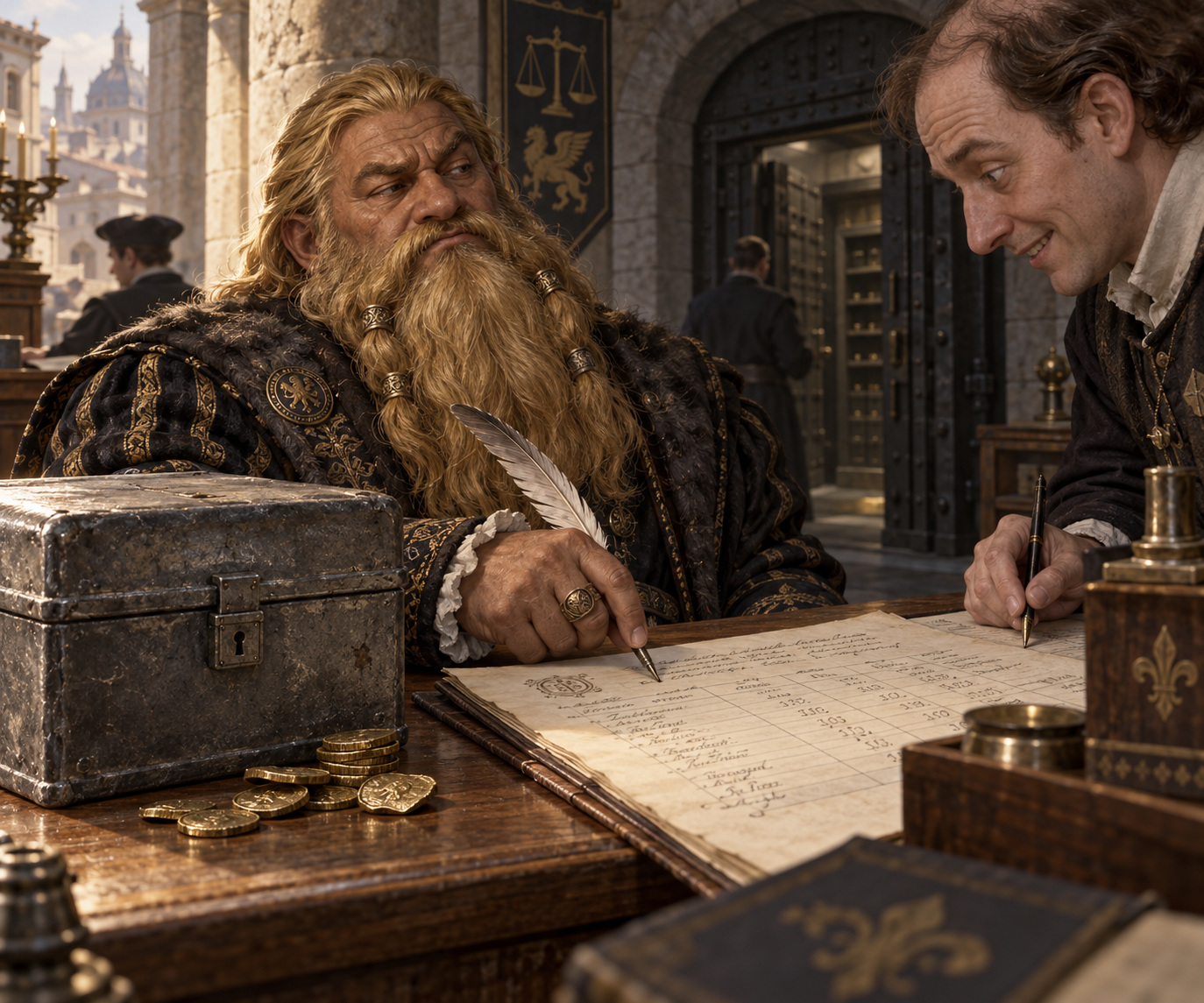
Water dripped from the Fraulein’s blackened timbers long after there was anything left worth saving from the fire. Each drop struck the river with a small, patient sound. Along the wharf, lanterns showed heaps of sodden belongings, the pale edges of shattered porcelain, and five people dressed for a celebration that had ended somewhere else. Wanda looked down at the smoke ingrained in her fine dress and thought of her boots. Good boots. Boots she had wanted to wear that evening, before anyone had persuaded her to be respectable.
One had burned. The other’s sole was coming away.
“I haven’t got any trousers,” she said.
Nora, whose surviving clothes now seemed an almost indecent extravagance, gave the dress a sympathetic inspection.
“It is a very nice dress.”
Wanda did not appear comforted.
The money had fared better. Their chest was damaged, and some of the crowns had acquired bends no mint would have approved, but six hundred crowns remained six hundred crowns. The cast iron had survived too. They could still sell it, provided they could find some means of moving it beyond the ruin of the boat that was supposed to carry it.
Felrick kept his hat on. Whatever else the night took from him, it would have to fight him for that.
They had sent for Max Wagner. Thindruk had been quite precise about this. Matthias Blücher could be informed when convenient. His lawyer could be inconvenienced immediately.
When lanterns finally approached through the darkness, Wagner came with an escort of town guards and the expression of a man who had been pulled out of bed to discover that his occupation had become unpleasantly literal.
“I understand there’s been some kind of accident.”
Qavitrae turned towards him.
There were several ways to make a tired man regret an opening remark. She chose Imperial law.
She began with custody. From custody she proceeded to liability, then to the wording of the contract, the circumstances under which the Fraulein had been left at the docks, and the obligations that followed from those circumstances. She remembered quantities and values, and she remembered exactly which clauses Wagner had helped put into writing.
Wanda stood beside her and supplied the facts that allowed no convenient misunderstanding. They had all been at Blücher’s anniversary celebration. Wagner had seen them there himself. The foreman had been distraught, and his account gave her no reason to think the crew had knowingly endangered the boat.
Wagner’s eyes moved from Qavitrae to the wet wreck behind her and back again.
“Yes. Yes, I know.”
She continued.
For Thindruk, watching a lawyer encounter the full weight of a contract he already understood was one of the few compensations the evening had offered. He allowed Qavitrae time to establish the foundations, then stepped into the conversation with a gentleness that gave Wagner somewhere to retreat.
“Of course we’ll be made whole. That isn’t the issue. The question is what can be done to protect the Blücher family name. And whether any of the cargo can still be delivered.”
There was little hope in the latter suggestion. The porcelain lay in scorched fragments. Still, Thindruk offered their assistance with the air of a man extending a courtesy between equals.
Wanda wanted a different question answered.
“Does he have enemies?”
Wagner tried the explanation he had been given. An oil lamp. Someone careless. An accident.
“Do you believe your stevedores are that incompetent?” Qavitrae asked.
There were stevedores within hearing. One of them held a substantial piece of dock equipment.
“Of course they’re very capable,” Wagner said.
Felrick sat nearby cleaning his gun.
At last the lawyer held up his hands. He knew they had been at the party. He did not believe the fire was their fault. He knew what the contract said. Nothing further could be settled until Matthias had heard the matter, but there was one immediate problem he could solve.
He would escort them to the Swan’s Neck. They would have the best available rooms at the Blüchers’ expense.
Then, if everyone could possibly bear it, they might go to sleep.
It was a reasonable proposal. It also left them with two chests and a collection of salvaged possessions to carry uphill.
Felrick asked Wanda to point out a few dockworkers she liked. Gold appeared. The men discovered that they were free to assist.
Some of the coins were bent.
The recipients did not object.
The Swan’s Neck had private rooms, clean bedding, and walls that did not smell as though they might collapse into the river. At that hour its public room was closed. Wagner arranged everything with the efficient misery of a man purchasing permission to leave.
Each of them received a room.
The lead casket went into Qavitrae’s.
No one suggested opening it. It had survived the fire, and when moved it still had the weight and sound of something solid inside. That was as much reassurance as anyone wished to obtain at close quarters.
Wanda was willing to sleep in the company of her sword. The stone was another matter.
Before Wagner escaped, Felrick caught him with one final question.
“Does the bank keep things for people? Actual things. In a vault.”
The lawyer saw no reason why it should not.
That possibility stayed with them after he had gone.
Their plans for disposing of the stone had depended on a boat. Beyond the river lay the sea, and beyond that, perhaps, people who knew what to do with such things. Now the Fraulein could barely be trusted to remain afloat at her mooring.
A bank had thick walls, guards, locks, and staff whose professional interest lay in preventing objects from changing ownership.
They could put a lock on the casket, too.
There was comfort to be found in these practical considerations if one kept one’s thoughts from wandering much further.
“It’s already a bank,” Qavitrae observed. “How much worse can it get?”
The casket sat quietly in the corner.
They slept.
By morning, sleep and washing had done something for their lesser hurts. The inn supplied eggs, sausages, and a pork cutlet under gravy. Felrick considered whether having their boat burned might be worth arranging more often.
Wanda ate in her smoke-stained party dress with growing resentment.
A message from Wagner instructed them to attend his offices at midday. Until then they had time to visit the bank and buy clothing suited to circumstances in which a person might need to run.
They dealt with the bank first.
Their existing account gave them standing. Four hundred and fifty-five crowns was sufficient to make a clerk attentive, although apparently insufficient to spare them questions.
What, precisely, did they wish to deposit?
The casket sat between them, heavy enough to make the question reasonable.
“Family heirlooms,” they explained.
Dwarven heirlooms.
Thindruk took possession of the explanation with admirable composure.
“An ancestral rock.”
The clerk considered this. Dwarfs had customs. Customers had money. Both deserved respect.
“Is there anything notable about the rock, my lord? Beyond its importance to your family?”
“It must be stored correctly.”
Thindruk explained that the staff should not open the casket. Its privacy mattered a great deal. They had fitted a simple lock to prevent accidents, but naturally they expected the bank’s own standards to provide the real protection.
The clerk understood perfectly.
Unfortunately, if they wanted insurance, someone would have to inspect the contents.
For a moment the conversation became very still.
They had no desire to show anyone the stone. An ancestral object ought not to produce green light and heat, at least not without provoking further questions. Further questions might attract people with an unhealthy interest in the answers.
“No amount of money could replace it,” Thindruk said.
In that case, the clerk explained, they could waive insurance.
If anything happened to the deposit, however, the bank would accept no financial obligation.
Thindruk disliked the shape of that arrangement. He wanted the institution to have a reason to care. The casket’s safety should be worth more to the bank than a sympathetic letter.
He began to explore the matter with the clerk, carefully, as one gentleman might enquire whether another gentleman’s scruples had a published rate.
Would an insured item receive particular attention?
Might a sufficiently generous payment allow them to dispense with an inspection?
The stone was priceless, certainly, but if one had to assign a figure to the distress of losing it, and the humiliation before other dwarven families, a thousand crowns might serve.
What would a hundred crowns paid in advance secure?
The clerk became helpful.
Qavitrae requested a contract.
This took some time. When the document arrived, she and Thindruk read it together while Felrick continued attending to his gun.
The fee was one crown and six shillings a month. Payment would come from an internal fund established for the purpose.
That fund contained forty crowns.
Thindruk rested the tip of his quill beside the figure.
The clerk looked innocently back at him.
“We’re happy to pay a premium for excellent service,” Thindruk said. “Perhaps twenty crowns rather than sixty.”
The clerk leaned over the document.
A clerical error. Most unfortunate.
He changed forty to eighty.
The remaining twenty, he volunteered, would cover administrative costs.
“Then let us make certain those costs result in the absolute safety and privacy of our property.”
“Absolutely, my lord.”
Qavitrae turned her head just enough for the light to catch her scar.
“And I appreciate your personal assurance.”
The clerk assured them again.
They paid him with a selection of their least conveniently shaped gold.
The casket stayed shut throughout, and no green light touched the bank’s respectable interior. Nobody behind the counter learned what had gone into the vault. Everyone involved came away satisfied, for their own reasons.
Outside, they could walk without carrying it.
The relief was immediate enough to discourage examination.
Wanda bought sturdy clothes and heavy boots. She had endured the dress for as long as circumstances required, and saw no virtue in extending the experience. Thindruk acquired travelling clothes of suitable quality. Qavitrae kept account of the expenses.
When they returned to the docks at midday, the Fraulein was still there.
Daylight had made her look worse.
In the dark she had been a boat that had caught fire. In the sun she was a list of timbers, each scorched gap an argument for how long the repairs would take.
Inside Wagner’s office, Matthias Blücher rose to greet them.
He had heard the story. His people were investigating. So far they had given him little beyond the suggestion that a stevedore had failed to watch where he was going.
The porcelain was gone. Replacing it was no simple matter. He had been the only merchant able to obtain Cathayware in the required quantity, and somewhere in Bretonnia there would be royalty learning that wealth could not make a ruined cargo arrive on time.
Blücher would have to repair that relationship himself.
First, they had their own business to settle.
Thindruk offered to return the seventy-five-crown advance. He also reminded Matthias that the ship had been in his custody.
There was a sigh.
“Our good friend Max’s… what did you call it?”
“A fairness clause,” Wagner said.
Blücher looked at his lawyer.
“There’s fairness,” he said, “and there’s fairness.”
But he did not dispute the contract. He might read future agreements more closely. He might alter their terms. This one had been signed, and it made his family responsible for their losses.
He would have the Fraulein repaired.
A month, the shipwrights estimated.
The figure settled unpleasantly over the room. A month paying for beds and meals. A month watching other boats leave.
Blücher had a proposal for that as well.
He had accepted a shipment on behalf of a family acquaintance. It needed to reach Middenheim in time for the carnival. Overland freight was outside his usual business, and he required people he could trust to see it delivered.
They could keep the original advance. On their return to Kemberbad, he would pay another hundred and fifty crowns. Passage, coaches, porters, and the necessary costs of transit would be covered up front.
By the time they returned, their own boat should be ready.
“What is the cargo?” Thindruk asked.
A soldier’s personal effects. Captain Arum Charlock’s. Sealed in a crate.
Blücher did not know more than that.
Nora cleared her throat.
Speech still cost her effort, which gave her few words a certain authority.
“What happens if the carriage catches fire?”
Blücher said he hoped they would behave professionally and attempt to save the captain’s belongings.
Qavitrae pointed out that anyone trying to ruin his reputation might find a second failed delivery useful.
He seemed unconvinced. If someone wished to attack his business, he owned a fleet of barges. There were larger targets than a soldier’s luggage.
“Perhaps you have enemies,” he said. “I only have rivals.”
“We’re river traders,” Qavitrae replied.
Felrick could think of at least one man who might have phrased that differently. Shooting someone’s horse tended to leave an impression, especially when the horse was subsequently sold for meat.
Still, a job was a job, and this one would pay them to travel while someone else repaired their boat.
They accepted.
Thindruk asked for an additional provision. Their agent should be permitted to collect the vessel and payment if necessary.
Uncle Joe.
Wagner consulted his records and established the name under which the Empire was more likely to recognise him. Josef Korting, owner and captain of the Berebeli.
Yes, that could be included.
Blücher seemed mildly surprised by the intimacy of the connection.
“A distant relation,” Thindruk said.
Family acquired on the river did not always submit easily to genealogical enquiry.
The crate waited in a warehouse office.
It measured roughly two feet on each side and weighed enough to make two carriers advisable. Wax seals promised to betray any attempt to open it. Someone had painted FRAGILE on the wood, along with instructions about which side belonged uppermost and a warning against tipping it.
They looked at it.
Thindruk, who had spent part of the morning preventing a banker from inspecting a suspicious container, found himself asking whether anyone had inspected this one.
Blücher repeated that it held the captain’s personal effects. A favour for a family friend.
That was the extent of the reassurance available.
They left the seals intact.
Passage was arranged aboard the Blue Salmon, departing the next morning. The Blüchers would pay for another night at the Swan’s Neck. They would take custody of the crate when they boarded.
That left time to settle their affairs.
They would carry two hundred crowns for the journey and put the rest of their available shipboard money into the bank. There was little point hauling a fortune along the Middenheim road when transport was already paid for. They had no vessel waiting at the far end to fill with goods.
Felrick wanted a horse. He still had a saddle, salvaged from the animal whose former owner might or might not have burned their boat.
The purchase could wait until Altdorf.
For now, they needed something to hold the possessions that had previously lived aboard the Fraulein. Qavitrae bought a serviceable trunk for six shillings. Between them, they could fit what they needed inside.
The iron goods stayed behind.
It was a modest and rather insulting reduction in their domestic circumstances. A boat had become a trunk.
Before leaving, Qavitrae wanted another look at the wreck.
The men had started clearing damaged material out of the Fraulein to make room for repairs. This was necessary work, but every load carried ashore removed another portion of whatever the fire had left to tell them.
Qavitrae examined where it had started.
Oil had fed the flames in the hold. Its distribution suggested that it had come from above, through the cargo opening.
That much could be made to fit the explanation of a fallen lamp.
The rest fitted poorly.
There had been too much oil. Wanda had noticed that when the damage was fresh. And where was the lamp?
Qavitrae could find no broken glass. The cleanup might have removed it, but Wanda had not found the remains of a lamp on the night of the fire either.
Someone appeared to have made sure there was fuel enough for the work.
Identifying that person was another matter.
The warehouses were guarded, but guards were men with eyes that faced only one direction at a time. The docks had passages and shadows. Someone determined could have got through. They knew from experience how little reassurance the word secured provided when applied to a warehouse.
Among the stevedores, questions met a wall.
The guild had closed ranks.
No one had done anything wrong. No one had anything to say.
Wanda went to the Black Barge.
Griselda was there with a tankard, and Wanda approached her as someone who remembered an evening’s friendship rather than a name on a list of witnesses.
“I know you’ve been told to keep quiet,” she said. “But I don’t think your people did it.”
She had been there. She had spoken to them. Someone else had set the fire, and the men with offices and contracts would find it easiest to blame the people who carried the boxes.
“If someone’s made you look bad, we’re quite willing to put the pain on them.”
Griselda listened.
The guildmasters had been clear. Whenever a crane fell or a fire started, people wanted a culprit, and dockworkers were conveniently close at hand.
But the crew had been inside the warehouse, warming themselves, when the trouble began.
One of them had seen someone.
Oscar.
A figure moving away from the boat shortly before the flames spread. He had caught a glimpse from behind, in the darkness, and assumed one of the crew had gone off to relieve himself.
Now he wondered.
Wanda found him and pressed for what details he could give. There were few. A cloak. An ordinary enough build. Darkness where a face should have been.
She gathered the timing and what little description survived, then brought it back.
Thindruk meanwhile enquired among merchants.
He wanted a grievance. A rivalry bitter enough to reach for a torch. Perhaps someone with sufficient influence to silence the guild.
The answers gave him little satisfaction.
The stevedores habitually kept quiet when accidents attracted blame. They needed no secret patron to advise it. And a story about an unknown man disappearing into the dark would sound very convenient coming from someone accused of starting a fire.
As for merchants burning one another’s boats, that was a dangerous way to conduct business. Such things happened, but they could start a war. It was not the usual response to losing a contract.
Insurance, someone suggested.
People burned things for insurance.
That thought came back with Thindruk.
So did all the other possibilities.
The porcelain had been independently insured. They had seen its ruined fragments, but none of them had inspected it before the fire. Had it arrived intact? Had it ever been worth what they had been told? The invitation to the anniversary party had removed them from the boat at a useful hour.
Yet Blücher had honoured the contract. He was repairing their vessel. Felrick reminded Thindruk that a noble passenger might reasonably receive an invitation without first being selected as the victim of an elaborate fraud.
They had questions enough to accuse half the town and evidence insufficient to accuse anyone.
Wanda wondered whether magic had played a part.
Qavitrae examined the dockside, away from where the stone itself had lain. The winds were present, as they were everywhere, but sluggish. There was no unusual concentration, no lingering force to point towards a powerful working.
A lesser spell might already have faded.
The search gave them nothing they could pursue.
Felrick considered the man whose horse he had shot.
“He lost his transport,” he said. “Now I’ve lost mine.”
That had a certain symmetry.
Nora observed that true symmetry would require someone to eat the boat.
“It was already cooked,” Felrick said.
The laughter was brief, but they needed it.
There were other possibilities. The Skaven had found the stone before. The destruction at the castle might have left someone alive with a grievance. They could keep naming enemies until morning.
At the end of it, they knew that the fire looked deliberate, and that a man might have been seen leaving.
They went back to the Swan’s Neck for dinner.
The Blue Salmon was larger than the Fraulein, with passenger cabins and a crew whose work they were under no obligation to share.
That morning, the crate came aboard with its seals intact. Their trunk followed. Kemberbad remained behind them with their damaged boat, their iron goods, and a bank clerk who had charged twenty crowns to be particularly discreet about a rock.
Then Alex Eisen came up the gangplank.
He recognised them at once.
“Friendly faces! I thought we’d be parting ways after the Swan.”
Wanda watched him approach with an expression that offered very little encouragement.
He supplied his own.
Was it his description of the carnival that had persuaded them to travel? He was going all the way to Middenheim himself. An experience of that quality deserved to be repeated.
Qavitrae said they would have to see how it compared with Schaffenfest.
Eisen dismissed Schaffenfest as an entertainment for goatherds and shit-shovellers.
Felrick wanted to know how many legs the goblins had at the Middenheim Carnival.
Eisen recalled drinking wormwood liquor and seeing something that might have been a goblin, although he could not confidently vouch for its anatomy or existence.
At Schaffenfest, Felrick explained, they had hunted a three-legged goblin through the sewers. The carnival had much to live up to.
Eisen recovered sufficiently to offer advice.
They should bring extra money.
For the elf and dwarf taxes.
Wanda’s attention sharpened. She had been comparing his build with Oscar’s unsatisfactory description. He was ordinary enough to fit it. So were a great many men. She had gained another suspicion without gaining evidence, and now he was talking again.
The taxes, Eisen explained, would make Middenheim a better city. Public works required funds. And if the expense encouraged certain elves and dwarfs to move elsewhere, the ones who were not really contributing, then two purposes would be served at once.
Felrick looked towards the river.
“That’s how I feel about people falling off boats. Two birds, one stone.”
“You’d need more than one stone,” Wanda said, “to keep them under.”
Eisen discovered a distinction he had neglected to make.
Not them, of course. They worked hard. They earned their money. He meant the other dwarfs.
Water moved past the hull.
No one helped him further.
Qavitrae eventually asked whether he would be travelling to Middenheim in a private carriage.
He preferred company. Castle Rock was his favoured coaching firm.
They retained that information for purposes other than recommendation.
Wanda also remembered the Four Seasons coachmen, whose drunkenness had required threats before they would proceed. Their choice of onward transport was beginning to consist chiefly of exclusions.
Behind them, Kemberbad dwindled.
Ahead lay five days on the river.
Nora rested.
For once, no one required them to work the vessel, chase anything, or negotiate while standing in the wreckage of their belongings. The cabins below decks were small and shared, but they were cabins. There was time to sleep, and her injured throat had days in which to mend without being called upon to shout.
Thindruk had a larger cabin above deck, with a window.
The distinction was pleasant. He intended to enjoy it.
He also intended to catch up on his reading.
The papers taken from Lady Marguerite’s desk had travelled with them through enough upheaval. He laid them out and returned to the letter from her brother Gotthard.
The affection in it was almost worse than the rest.
He wrote about cruelty with the ease of someone describing agreeable company and excellent food. Torture and murder belonged among life’s pleasures. His sister ought to visit. There were better amusements to be had than tormenting pathetic peasants.
Outside the window, the river passed in daylight.
Thindruk read the letter again.
The books offered no improvement.
The mysterious volume from the Obsidian Signal Tower was written in the language Qavitrae recognised as belonging to magic. Recognition did not mean understanding. Neither of them could read it.
Other volumes from Lady Marguerite’s library mixed similar writing with passages of older Reikspiel.
Those he could decipher.
They concerned the restoration of a semblance of life to dead bodies.
He spent enough time with the text to establish what it was, then found himself considerably less eager to continue.
Another book appeared to concern the magic of life and death. A wizard would be needed to confirm precisely what they had acquired.
Until then, they possessed books they could not use and would have difficulty explaining.
There might be someone willing to pay for them.
That thought was followed by the less comfortable question of what such a buyer would do with the purchase.
They discussed the Grey Wizard they knew in Altdorf. Perhaps he could take charge of the books. Perhaps he ought to be told about the stone in Kemberbad.
Their acquaintance with one wizard did not make them welcome among all his colleagues. Delivering incriminating material into unfamiliar hands could become an awkward way to demonstrate good intentions.
The river offered a simpler disposal method.
So did a disreputable bookseller, if simplicity were measured only in the number of crowns changing hands.
No decision became an action. The books stayed with them.
They passed the tower on their journey. Work had resumed there. Figures moved about their business, and for a little while Thindruk could watch people repairing something without being personally responsible for the cost.
“Good lads,” he said.
Then the river carried them on.
Middenheim waited at the end of the next stretch of travel. They had been pointed towards it before. Thindruk remembered the Purple Hand and the inheritance they had expected him to bring, money he did not possess and an affair whose surviving documents had already met the fire.
There had been good reasons to prefer a voyage towards the sea.
For the moment, those reasons had to share space with a sealed crate and a contract.
They reached Altdorf at midday on the first day of summer.
The docks were busy. Cargo moved between shoulders and carts. Crews called across the water. Somewhere beyond the waterfront waited the Blücher offices and arrangements for the road to Middenheim.
First they looked for their faces.
The last time, the city had wanted them in connection with the dead nobles. The portraits had been poor, but poor likenesses could still put a rope around a neck. None of them had forgotten why they had been glad to leave.
Wanted notices remained plentiful.
They inspected the fresh sheets, then looked among the older ones.
Other faces stared back.
Theirs appeared to have gone.
It was possible the city had found more recent crimes worth its attention. More than two months had passed since the spring journey that had brought them into so much trouble. Summer had arrived while they were occupied elsewhere.
Felrick regarded the notices with professional confidence.
“If they don’t catch you in the first month, they give up.”
No one asked him to put that assurance in writing.
Wanda wanted a short stay. Find the company offices, arrange the next stage, move on. Her new boots were sound. Nora’s throat had benefited from the quiet voyage. They had money enough, and the crate had reached Altdorf unopened.
Behind them, there was still a boat to reclaim, and that mattered. The Fraulein had survived. She would be repaired, and Josef Korting had authority to collect her if they could not. Their iron goods were waiting to be sold. Their life on the river had not ended merely because someone had poured oil into it.
For now, they stood on the wharf with everything they were taking packed into one trunk.
The porters had the captain’s crate ready. Its painted instructions faced upwards. The wax seals showed no sign of disturbance.
Thindruk gave the notices one last look, then turned to follow the others towards the city.
They were expected in Middenheim before the carnival.
The session opened with a recap of the party’s arrival in Kemperbad aboard the Dandy Fräulein. They had accepted a contract from Matthias Blücher to carry fragile Cathayware porcelain to Marienburg for a royal wedding in Bretonnia. The delivery was urgent, and the agreed payment was 300 crowns. The party had scrutinized the shipping contract before signing it. They had also invested the 75-crown advance in cast-iron goods to sell along the route, hoping to earn additional money alongside the porcelain delivery. During their earlier stay in Kemperbad, Nora had received medical treatment for her injured throat, and Thindruk had purchased a crossbow. Inquiries about the Blücher family had established a reputation for shrewd business dealings and difficult negotiations, but had uncovered no particular accusations of villainy. The recap recalled the merchants the party had met at the Swan’s Neck, including Alex Eisen, Otto Berger, Frida Bismarck, and Rory Roddy. A merchant recently returned from Marienburg had described a trade war in which local merchant families were restricting foreign commerce while competing with one another. The party also recalled spreading and encouraging rumors about underground Beastmen. Felrick had contributed to the discussion of dwarf Beastmen or molemen, and Qavitrae had suggested underground Beastmen. Their conspiracy-minded acquaintance had responded with stories about fishmen. Matthias and Caroline Blücher had invited the party to their first wedding-anniversary celebration. The characters attended in suitable clothing, and Thindruk’s gift had made a favorable impression on Caroline. Returning to the docks near midnight, the party had found the Dandy Fräulein burning. The people fighting the fire prevented the barge from sinking, but the vessel was no longer riverworthy. The heat destroyed the porcelain and damaged many of the party’s belongings. The cast-iron cargo survived. The fire had not become hot enough to melt it, although the goods would need attention before being sold. Wanda had already spoken with the stevedore foreman and members of his crew. The foreman appeared genuinely distressed and worried that one of his workers had accidentally caused the fire. At that point, he had offered no evidence of deliberate sabotage. Thindruk clarified that he had demanded the immediate presence of Max Wagner, the Blüchers’ lawyer. Matthias could be informed when convenient, given that it was his anniversary night, but Thindruk wanted Wagner at the docks as soon as possible. The party checked which ordinary clothes had survived. Rolls of 50 or lower were required to preserve clothing left aboard the barge. Wanda lost her sturdy traveling clothes and heavy boots, leaving her with the formal dress she had worn to the celebration. Nora still had ordinary clothing, described as something like a jersey. Felrick retained the hat and formal outfit he had worn to the party. Thindruk and Qavitrae discussed which clothes they had owned and which had been left aboard, with Thindruk explaining that his usual clothing was already fashionable enough for the occasion. The surviving money was clarified before any new losses were applied. The party had previously established that all 600 crowns in the shipboard chest remained usable, although some coins were bent or damaged. That earlier result stood. Max Wagner eventually arrived with an escort resembling a group of town guards carrying lanterns. He looked tired and asked about the accident. Qavitrae confronted Wagner with her experience of Imperial bureaucracy and the legal obligations arising from the barge being in the Blücher company’s custody. Her purpose was to establish that the company bore responsibility for making the party’s losses good. Wanda assisted Qavitrae by corroborating the foreman’s account and reminding Wagner that the party had been attending the Blüchers’ anniversary celebration when the fire occurred. Qavitrae’s argument used a challenging Education test. Her numeration ability applied because she could cite cargo values, schedules, the value of the boat, and other relevant figures. Her proposed use of Lament of the Ages was not allowed in this situation. Qavitrae rolled 55, exactly meeting her target and obtaining a critical success. She cited Imperial legal precedents and the terms of the contract concerning responsibility for the vessel while it was at the docks. Wagner acknowledged the argument but maintained that Matthias would have to be involved before a settlement could be reached. He was familiar with the contract and had personally seen the party at the anniversary celebration. Thindruk adopted a more conciliatory approach. He treated compensation as an established obligation and emphasized the party’s willingness to help protect the Blücher family’s reputation, salvage the delivery if possible, or otherwise assist their employer. Wanda asked whether the Blüchers had enemies or competitors who might have wanted to sabotage the porcelain contract. Thindruk suggested that the party could help deal with anyone responsible for deliberate wrongdoing. Felrick sat nearby cleaning his gun. Wagner said he had been told that an oil lamp had been knocked over and that the fire was an accident. Qavitrae challenged the implication that the stevedores were incompetent, citing Wanda’s familiarity with them. With stevedores standing nearby, Wagner affirmed that they were capable workers. Wagner explicitly said he did not believe the party was at fault. For the immediate night, he offered accommodation at the Swan’s Neck at the Blüchers’ expense, with negotiations to follow after Matthias had been informed. The party took their surviving valuables with them, including their money chest and the lead casket containing the Chaos stone. Wanda refused to have the stone in her room, although she acknowledged that she was already carrying an evil sword. Felrick asked Wanda to identify stevedores she trusted, then paid the selected workers a gold crown each to carry the chests and other belongings to the inn. The payment attracted willing porters, but also prompted remarks about the party having kept a chest of gold aboard their boat. The party reviewed its holdings. Before the night’s expenses, it had 600 crowns aboard the barge, 455 crowns in a Kemperbad bank, and 375 crowns already sent to Altdorf for Uncle Joe. The porcelain was destroyed, while the cast-iron investment remained intact. Qavitrae explained that they had withdrawn a substantial amount of cash because they had not known when they would return to Kemperbad. Consequently, more than half their readily discussed cash had been aboard the vessel. At the Swan’s Neck, Wagner arranged the best available private rooms, one for each character. The inn did not have a communal sleeping room. Wanda chose to sleep without her dress rather than spend the night in formal clothing. Qavitrae kept the Chaos casket in her room. It remained closed and caused no confirmed disturbance during the night. Felrick asked Wagner whether the bank would accept valuable objects for secure storage. Wagner saw no reason that it would not, and the party began considering leaving the casket in a vault while their own transportation was unavailable. The party discussed bank storage as an alternative to continuing to carry the stone while unable to take it to the ocean or to the elves. They also considered the idea of putting the existing lead casket inside a second lead container, but did not establish that they purchased one. The night passed without incident. The characters recovered stress through sleep. For minor injuries, the GM allowed the final lightly wounded box to clear after a good night’s rest and cleaning the injury, without requiring the expenditure of a bandage. The following morning, the inn served a substantial breakfast of eggs, sausages, and pork with gravy. Several characters were still wearing formal clothing marked by smoke and the previous night’s work around the fire. Wagner sent word that the party should come to his offices at midday to meet Matthias Blücher. The morning therefore remained available for banking and replacing damaged clothing. Before depositing the casket, Felrick asked whether it could be secured with a padlock. The party decided to add one to prevent the container from being opened casually. At the First Bank of Kemperbad, the party relied on its existing account and 455-crown balance to establish that it was already a customer. The bank offered vault storage for a recurring fee deducted from funds held there, but wanted to know what the party was depositing. The party described the contents as dwarven family heirlooms associated with Thindruk’s family. Thindruk characterized the stone as an important ancestral object. The weight was consistent with a heavy rock inside a lead casket. When the bank representative asked whether anything else was notable about the object, Thindruk stressed proper storage and privacy. He said the staff should not open it, and explained that the lock was intended to prevent accidents. The representative said the bank would need to inspect the contents before offering insurance. Alternatively, the party could waive insurance and leave the sealed casket in the vault, accepting that loss or theft would bring no compensation. Thindruk asked whether purchasing insurance would give the bank a financial reason to take particular care of the deposit. He wanted to determine whether insurance would improve security, rather than merely provide money after the heirloom was lost. With Qavitrae’s assistance, Thindruk succeeded on an Education test to assess the arrangement. He concluded that the representative was initially discussing an ordinary banking and insurance service, rather than covertly asking for a bribe. The bank’s wish to inspect the object was explained as a way to establish an appropriate insured value and prevent fraudulent claims. The discussion also established that an expensive insured deposit would receive additional care, although the vault was intended to be secure for all customers. The party considered the consequences of allowing an inspection. The stone visibly emitted green light and heat, so opening the casket would reveal more than an ordinary ancestral rock. Qavitrae also pointed out that showing it to anyone would spread knowledge of its location. Felrick suggested offering a sufficiently generous payment to make accepting the sealed container attractive. Thindruk proposed roughly 1,000 crowns as compensation for the heirloom’s loss, including its family significance, and asked what a 100-crown payment would secure. The representative accepted a 100-crown payment for placing the item in the vault and prepared a written contract. The party intended to use damaged but still valid coins from the recovered shipboard money. Thindruk and Qavitrae scrutinized the contract together. Thindruk made the Education test with Qavitrae assisting and successfully identified the relevant terms. The contract specified an insurance charge of one crown and six shillings per month, paid from an internal fund. Despite the proposed 100-crown payment, the first draft credited only 40 crowns to that fund. Thindruk drew the representative’s attention to the 40-crown figure. He said the party was willing to pay a premium for excellent service, but suggested that 20 crowns would be more appropriate than 60. The representative called the discrepancy a clerical error and amended the credited fund to 80 crowns. He described the remaining 20 crowns as administrative costs. Thindruk insisted that those administrative costs should secure the absolute safety and privacy of the party’s property. Qavitrae reinforced the demand by turning so that the light caught her scar and requesting the representative’s personal assurance. The party paid 100 crowns in total. Of that sum, 80 crowns went toward the account funding the recurring charges, while 20 crowns covered the administrative premium. The casket was stored without being opened. After finishing at the bank, the party turned to replacement clothing. Wanda confirmed the loss of her heavy boots. One had been destroyed, while the other was badly damaged, with its sole partly detached. Thindruk advised recording expenses caused by the fire so they could seek compensation. Qavitrae confirmed that she was maintaining a ledger of those costs. Clothing prices were reviewed during shopping. The prices ultimately used were six shillings for ordinary clothing and one crown for good heavy boots. Well-made, stylish traveling clothes were priced at two crowns. Wanda obtained sturdy traveling clothes and replacement heavy boots so she could stop wearing her formal dress. Thindruk also picked up traveling clothes and boots in preparation for possible overland travel, while retaining his existing fashionable outfit. The party discussed the repairs it expected the Blüchers to fund. Thindruk suggested that rebuilding the barge might offer an opportunity for the above-deck cabin he had wanted, and Wanda mentioned a cooking galley. These improvements were discussed, but were not established as agreed additions. At midday, the party returned to the Blücher offices by the docks. The damaged Dandy Fräulein was still visible outside. They were shown into Wagner’s office, where Matthias was waiting. Matthias said he had heard what happened and had assigned people to investigate. The explanation available to him was still that a stevedore had caused an accident, but he wanted to know whether there was more to it. Wanda again asked whether another merchant might have wanted to sabotage the contract. Matthias said he had been the only person able to obtain the required Cathayware in the requested quantity. The loss would disappoint Bretonnian royalty, and he would have to repair that business relationship. Matthias canceled the porcelain-delivery contract because the cargo no longer existed. Thindruk offered to return the 75-crown advance under its terms, while also making clear that the party expected compensation for the damage suffered while its vessel was in Blücher custody. Thindruk repeated that the party remained willing to help Matthias, despite its reduced circumstances. Matthias referred to Wagner’s contractual provision as a fairness clause and admitted that he should have read it more carefully. Although he might change future contracts, he accepted that this one made the Blücher family responsible for the party’s costs arising from the fire. Matthias offered to arrange repairs through shipwrights already contracted to his family. Restoring a vessel with this level of damage would take approximately one month. To provide work during the repair period, Matthias offered a delivery to Middenheim in time for the Carnival. The shipment had come to him through a friend of a friend, and overland delivery was outside his normal river-shipping business. The proposed payment was 225 crowns in total. The party would retain the original 75-crown advance and receive another 150 crowns after delivering the shipment and returning to Kemperbad. Matthias also agreed to pay transportation expenses in advance, including coaches and porters. He expected the party to accompany the freight and ensure its safe delivery. The route would begin with passage by river to Altdorf. The party would then visit the Blücher company offices there, which would help arrange a coach journey along the Middenheim Road. Matthias described the cargo as the sealed personal effects of Captain Arum Sherlock. He did not know the precise contents. The container was large enough to require two people to lift comfortably. Wanda asked how difficult it would be to move the shipment if a wagon broke down. The answer was that two people could carry it, although it would be awkward. Nora successfully made the Scrutinize check required by her throat injury before speaking. She asked what would happen if the carriage caught fire. Matthias replied that the captain’s belongings would be lost and that he expected the party to make a professional effort to save them. Qavitrae raised the possibility that someone targeting his business might attack this shipment as well. Matthias doubted that a rival would choose a soldier’s personal effects as a target when the Blücher company owned an entire fleet of river barges. He suggested that the party might have enemies of its own, while describing his own business opponents as rivals. Nora’s throat injury was still healing despite treatment. The discussion put the treated recovery period at approximately eight days, with some time already elapsed. The party reviewed the timing of the job. A journey to Middenheim, attendance at the Carnival, and a return trip should occupy roughly the month needed to repair the barge. Thindruk requested that Uncle Joe be authorized to collect the repaired vessel and payment on the party’s behalf if necessary. The discussion also considered ensuring that he could take custody if the party did not return. Wagner consulted the company’s records and identified Uncle Joe as Captain Josef, owner and captain of the Berebeli. He agreed that the authorization could be included in the new agreement. Thindruk did not push for a higher delivery fee. He wanted to maintain Matthias’s goodwill and ensure the barge was repaired. Qavitrae shared that view, and the party accepted the job. Felrick recalled that he had a personal enemy whose horse he had shot. The horse’s owner had been following the party, making retaliation one possible explanation for the fire, although no evidence linked him to it. The prospect of overland travel prompted discussion of buying Felrick a horse so he could act as an outrider. He still had the saddle taken from the horse he had previously shot and sold for meat. No horse purchase occurred during the session. The full journey from Kemperbad to Middenheim was initially estimated at roughly ten to twelve days, including both river and coach travel. Thindruk reminded the party that wanted posters had been displayed for them on their previous visit to Altdorf. They recalled the altercation with nobles who were subsequently murdered, and distinguished their own involvement in the fight from the killings. The party also recalled that Middenheim was connected to the Purple Hand and the earlier inheritance affair. The supposed inheritance was remembered as approximately 20,000 crowns, and the documents connected to Robert’s assumed identity had been burned after the trap at the legal offices and the demon attack. With the agreement settled and a new contract signed, Matthias took the party to the warehouse to see the shipment. The crate was approximately two feet on each side and weighed about 100 pounds. Wax seals covered it so that opening or tampering with it would be obvious. Its faces were marked “Fragile,” and one side carried instructions identifying the top and warning against tipping it. Thindruk asked whether anyone in the Blücher company had seen the contents, citing the inspection normally associated with insurance. Matthias repeated that this was a favor for a family friend and that he had been told it contained Captain Sherlock’s personal effects. The party expressed concern that it might be taking responsibility for dangerous or illicit goods without knowing what was inside. Nevertheless, the crate remained sealed, and they continued with the agreed delivery. The party confirmed that the Chaos casket would remain in the Kemperbad bank. It was not part of the shipment to Middenheim. They discussed putting most of their remaining shipboard money back in the bank, since they would not be buying a return cargo for a vessel waiting in Middenheim. A proposal was made to carry 200 crowns and deposit 400. Qavitrae then reminded the others that the 100-crown payment for the casket’s storage and insurance had already come out of their cash. The discussion did not establish a final reconciled total for the proposed deposit and travel money. Buying a cart and horse was briefly considered, but the party realized that none of them was trained in Drive. Felrick’s Pilot skill applied to boats rather than road vehicles. Because they could no longer leave their traveling equipment aboard their own barge, the party arranged to pack its surviving belongings into a trunk. Wanda noted that she could not carry all her equipment personally, much of it being weapons. Thindruk listed documents and books he could study during the journey, including correspondence taken from Lady von Wittgenstein’s desk and a mysterious tome recovered from the earlier tower. Qavitrae also mentioned possessing an evil grimoire. A serviceable trunk cost six shillings, and the GM ruled that one would hold the party’s collective belongings. Qavitrae paid from her personal funds rather than introducing shillings into the shared money chest. The party considered whether anyone should be informed about the Chaos stone’s location. Wanda suggested trying to find their Grey Wizard acquaintance in Altdorf and telling him about the casket in the bank. No warning was delivered during this session. Matthias booked passage aboard the Blue Salmon, which was due to leave the following morning. The Blüchers would pay for another night at the Swan’s Neck. The party would take custody of the crate when boarding. With time remaining before departure, Qavitrae decided to investigate the barge fire herself. She wanted to inspect the physical evidence rather than rely entirely on Matthias’s inquiry. Qavitrae used Education to analyze the scene and succeeded with a roll of 31. The available evidence placed the fire’s source in the cargo hold, where spilled fuel oil had fed the flames. The pattern was broadly consistent with the explanation involving oil and an open flame, but Qavitrae found no shards from a broken lamp. The stevedores had begun clearing the vessel for repairs, so some evidence could already have been removed. Wanda recalled that she had found no lamp during her earlier inspection either. She also remembered finding more oil than one lamp should have contained. The position of the fuel suggested that oil, or a lamp containing it, had been introduced from the deck through the open cargo doors into the hold. It was not established that the cargo doors had been closed before the incident. The stevedores’ guild had closed ranks and was refusing to discuss responsibility. Although the warehouses had security, an intruder could have entered the area, particularly late at night. Qavitrae’s investigation made an accident seem unlikely. The amount of fuel suggested that someone had ensured the fire would spread, but the physical evidence did not identify the culprit. Wanda went to the Black Barge to ask among her stevedore acquaintances. She sought out Griselda, a drinking companion she had helped during their earlier socializing. The Rumor test was hard, with a penalty of 20, because the guild had instructed its members not to discuss the incident. Wanda used Cosmopolitan to flip the result to succeed. Wanda told Griselda that she did not believe the stevedores had caused the fire. She argued that someone had set them up, that their superiors would look for someone to blame, and that the party was willing to act against whoever had made the workers look responsible. Griselda confirmed that the guildmasters had ordered silence. She said she had spoken to the crew involved and believed that none of them had started the fire. According to Griselda, the crew had gone into the warehouse to warm up and had not been around the barge when the fire began. One worker, Oscar, thought he had seen someone moving away from the vessel shortly before the flames spread. Oscar had initially assumed the person was another worker going off to relieve himself. After the fire, he reconsidered whether he had seen the person responsible. Wanda sought out Oscar and requested the best description and timing he could provide. He had seen the person only briefly, from behind and in darkness, and could not identify them. Wanda intended to pass what she learned to Thindruk. Thindruk pursued rumors among merchants and tradespeople, looking for relevant grudges against Matthias, himself, or the party. He also questioned whether anyone had enough influence to make the stevedores’ guild suppress evidence of an arsonist. Wanda suggested that the guild might simply be afraid of being implicated. Thindruk remained concerned that silence left the accidental-fire story, and therefore blame on the stevedores, unchallenged. The party asked about access to the docks. Blücher security normally knew who belonged there and could challenge strangers, but darkness and the late hour would have given an intruder an opportunity to avoid notice. At Wanda’s suggestion, Qavitrae checked the dock area for unusual magical traces. She focused on the surroundings rather than the barge itself, since the Chaos stone had previously been aboard. Qavitrae’s Incantation check revealed ordinary, stagnant Winds of Magic without any special concentration of magical energy. There was no positive evidence that a spell had started the fire, although a weak spell might already have dissipated. Thindruk’s inquiries established that the guild’s silence was a familiar response to accidents involving its members. A claim that an unidentified person had been seen nearby might sound like an excuse rather than clear the workers. The merchants discounted ordinary commercial rivalry as a likely explanation. Burning a competitor’s vessel was regarded as the sort of act that could start or accompany a larger conflict, rather than routine business competition. Someone mentioned insurance fraud as a reason a vessel might be burned. The party considered whether the valuable porcelain shipment and its independent insurance could have provided a motive. The party confirmed that charred porcelain fragments had been present after the fire. However, they had not inspected the contents of the sealed crates beforehand, so they could not establish from personal observation what condition the porcelain had been in before loading. Thindruk questioned whether the anniversary invitation had conveniently ensured that the party was away from its vessel. Felrick pointed out that Thindruk’s noble status also provided an ordinary reason for inviting him. No evidence established that Matthias had arranged the fire. Other possible explanations discussed included a demon, a doppelganger, surviving enemies connected to the destroyed castle, and Skaven following the Chaos stone. These remained suspicions. Felrick observed that destroying the party’s boat would be a fitting form of revenge for someone whose horse he had killed. The investigation nevertheless ended without identifying the person Oscar had seen. The party returned to the Swan’s Neck for another substantial dinner and wine. The following morning, they met the Blue Salmon’s captain, took custody of the sealed crate, and boarded for Altdorf. Alex Eisen boarded the same vessel. The party recognized him as the boastful merchant from the Swan’s Neck, known for taking considerable pride in his commercial success and his elaborate facial hair. Alex greeted them as familiar faces and said he was also traveling to Middenheim for the Carnival. He asked whether his earlier description had persuaded them to attend. Qavitrae said they would need to experience the Carnival before comparing it with Schaffenfest. Alex dismissed Schaffenfest as an entertainment for goat herders and laborers and promised that Middenheim would provide an experience they would remember for the rest of their lives. Felrick asked how many legs the Carnival’s goblins had, recalling their pursuit of a three-legged goblin through the sewers during Schaffenfest. Alex remembered drinking wormwood liquor and possibly seeing a goblin, but could not say how many legs it had or whether it had been real. Felrick maintained that their earlier goblin hunt set a high standard for the next festival. As the Blue Salmon departed, Alex advised the party to have extra money available because Middenheim imposed taxes on elves and dwarves. Felrick noted that he was neither. Wanda compared Alex’s general height and build with the limited description of the person seen near their burning vessel. The sighting had been of an average figure seen from behind, with a cloak covering the shoulders. Alex could fit that vague description, but it did not distinguish him from many other people. Alex defended the taxes as a way to fund public works while encouraging elves and dwarves who were supposedly not contributing to move elsewhere. Felrick responded with a pointed remark about people falling from boats in the middle of rivers. Alex hastily said he did not mean hardworking river traders such as the party, but other dwarves. Qavitrae asked whether Alex would be taking a private carriage to Middenheim. He said he liked company and planned to travel with Castle Rock, his preferred coaching company. The party recalled its poor experience with Four Seasons coaches, including coachmen who had become so drunk that the characters had needed to threaten them into departing. They expressed interest in avoiding that company. The river journey from Kemperbad to Altdorf was confirmed as five days. Since the characters were passengers and did not have to work the vessel, those days counted as ten days of healing. The Blue Salmon was larger than either the Dandy Fräulein or the Berebeli and had several passenger cabins. Most of the party shared small cabins below deck. Thindruk received a larger private cabin above deck with a window, in recognition of his station. Thindruk used the journey to examine the correspondence taken from Lady von Wittgenstein’s library. The party revisited the recent letter from her brother Gotthard that had been near the top of those papers. They recalled the letter’s descriptions of cruelty, murder, and torture, along with Gotthard’s invitation for his sister to join him. No newly decoded message or additional discovery was established from the letter during this session. Thindruk then considered the mysterious book taken from the Obsidian Signal Tower. The group initially discussed whether it might have been Dagmar von Wittgenstein’s research journal, but Thindruk’s inventory described it only as a mysterious tome. During the voyage, the Blue Salmon passed the tower. Workers were visibly back at work there. The party did not stop to inspect their progress. After reviewing what had been found in the tower, the GM established that Thindruk had kept the volume written in the language of magic. Qavitrae recognized the script but could not read it, and Thindruk could not interpret it either. Thindruk also examined books taken from Lady von Wittgenstein’s library. A roll of 04 was used to establish the nature of the material he had collected. One book contained magical script interspersed with passages in older Reikspiel that Thindruk could understand. Those passages described restoring a semblance of life to dead bodies. Another volume appeared to be a grimoire concerning the magic of life and death. A wizard would be needed to confirm its precise nature. Thindruk concluded that these books offered him little immediate practical use, might be incriminating to possess, and could nevertheless be valuable to someone interested in their contents. The party discussed handing the books over to their Grey Wizard acquaintance as evidence of good intentions. They also expressed concern about approaching other wizards who might be hostile to them. Other proposals included throwing the books into the river or finding a discreet buyer in Altdorf or Middenheim. No disposal, sale, or handover took place. The Blue Salmon reached Altdorf around midday on the first day of summer. The party looked for wanted posters as it disembarked. Wanted notices were still displayed, but the party’s faces no longer appeared among the current posters they examined. They took this as a sign that they were no longer prominently sought in the city. Reviewing the campaign calendar established that more than two months had passed since the original coach journey, when members of the party had become ill after exposure to the rain. Their recollection of that visit being only a few weeks earlier was corrected. The session ended with the party in Altdorf, intending to make a brief stop before continuing overland to Middenheim. No corruption was awarded for the session. The Chaos casket had never been opened for the bank staff or insurance inspection. Each character received 100 reward points as the campaign moved into its third chapter. In the closing discussion, the party noted that it had not visually checked whether the Chaos stone was still inside the casket after the fire. The GM confirmed that something had rattled inside when it was moved, but the contents had not been inspected. The cast-iron trade goods had remained with the damaged barge in Kemperbad. The party had not brought them aboard the Blue Salmon to sell in Altdorf. The shared luggage arrangement was clarified again. Qavitrae’s six-shilling purchase covered one trunk for everyone’s belongings, so Wanda did not need to pay separately for a second trunk and reversed that duplicate expense.Session Notes