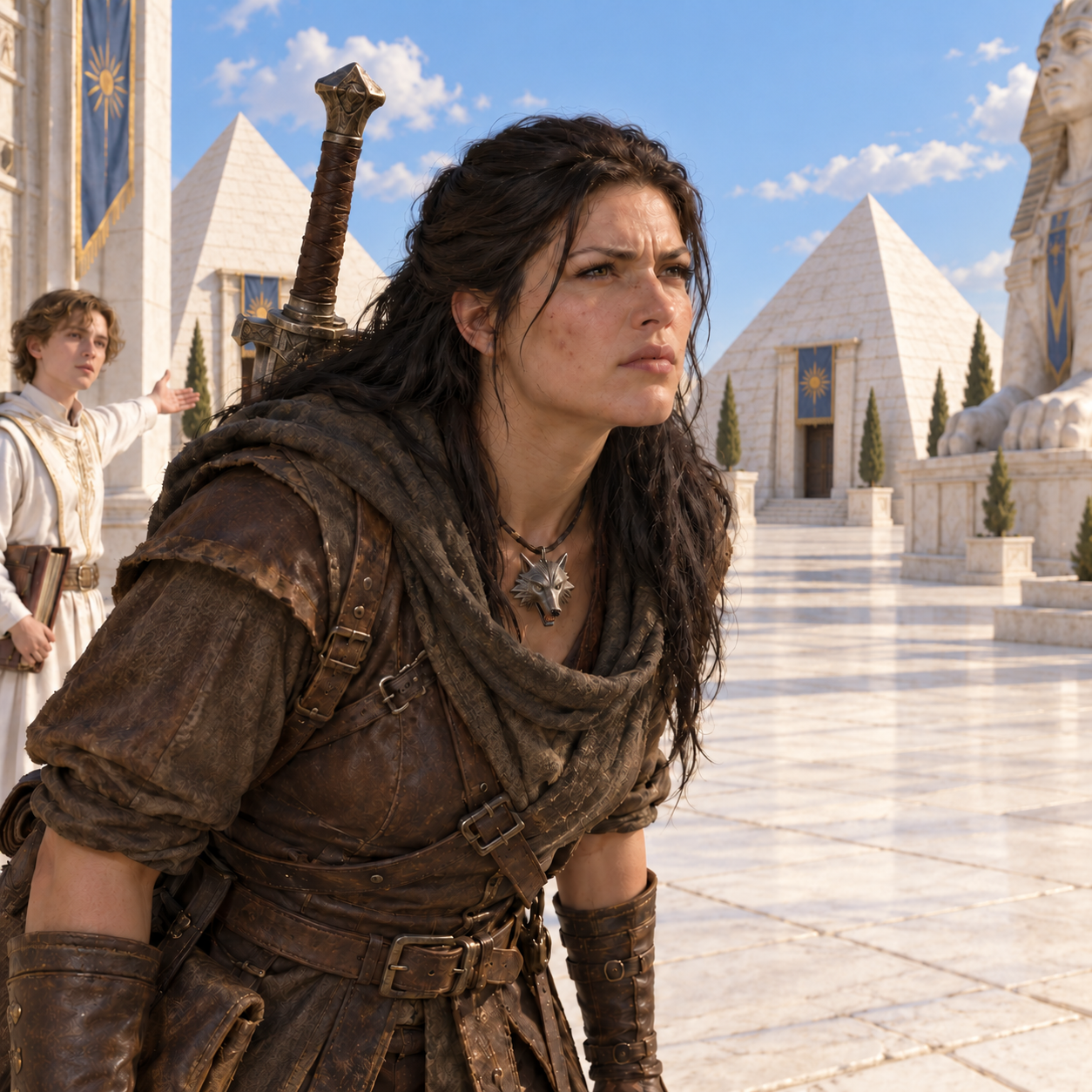
Altdorf smelled of river mud, horse dung, and other people’s money. Somewhere beyond its roofs stood the Colleges of Magic; somewhere beyond its northern gate lay the road to Middenheim. For the moment, the company had a sealed crate to deliver, a damaged boat being repaired at someone else’s expense, and the unfamiliar pleasure of walking past a wanted board without finding their own faces on it. Nora still had a likeness of Felrick tucked away. There seemed no reason to waste a perfectly serviceable portrait merely because the authorities had lost interest.
Their arrangements with Matthias Blücher had survived the journey downriver. The crate was bound for Captain Garlock in Middenheim, its contents protected from curiosity by numerous wax seals and the understanding that trusted agents did not pry. It took two people to move comfortably. Nobody had offered them extra money to discover why.
Behind them, in a bank in Kemperbad, another box sat under arrangements that were rather more elaborate. Its contents were evil, its declared value modest, and its loss insured. There were few matters in their affairs that could be described as settled, but they had done their best with that one.
The boat would take about a month to repair. Blücher had accepted the responsibility after studying the relevant clause in their contract, an experience that had apparently diminished his affection for his lawyer. In the meantime, he was paying their passage north. Felrick regarded this as a considerable improvement in their circumstances.
“Having our boat burnt down might be the best thing that’s ever happened to us.”
“Getting the boat was the best thing that ever happened to us,” Wanda said. “Now losing it is the best thing that’s ever happened to us.”
Both observations appeared sound.
Middenheim promised Carnival, which occupied a large and agreeable portion of Nora’s thoughts. It also promised Gotthard von Wittgenstein, whose letter had described intentions considerably less wholesome than drinking and public entertainment. His continued existence complicated Thindruk’s cheerful view of the ownership of what remained of Castle Wittgenstein. There was, admittedly, less castle than there had been.
“The parts we didn’t like are gone,” Wanda observed.
Thindruk saw no reason to dispute that assessment. Nor did he see any reason to neglect their travel arrangements while discussing the disposition of his prospective property.
They went to the Blücher offices, where the clerk examined Matthias’s letter, accepted its seal, and treated their arrival as ordinary business. This was unsettling. They had grown accustomed to people whose ordinary business involved deceiving them, arresting them, or turning out to be somebody else. He inspected the seals on the crate and agreed to store it overnight.
“You are responsible for it until we get back,” Wanda told him.
The clerk indicated where they should sign. She watched his face for some sign that he understood the weight of that sentence. He appeared to understand the weight of paperwork. Beyond that, she could establish nothing.
He would book them onto the next available Castle Rock coach to Middenheim, probably departing the following morning. They should return at the end of the day for the precise arrangements. The coaching house stood across the plaza, close enough for him to point it out without rising. Then he went into the back office and returned with two gold crowns. Blücher had provided an allowance for their lodging.
The coins landed in Thindruk’s palm with a small, persuasive sound. Whatever doubts they retained about the clerk, the company, or the wisdom of carrying mysterious boxes across the Empire, none applied to the immediate usefulness of gold. They left with an evening to spend.
Wanda had been thinking about demons. They kept appearing in the course of business. A person could accept a certain amount of misfortune as the ordinary cost of travelling, but repeated encounters with Chaos suggested that she ought to acquire some means of dealing with it beyond hitting it harder.
“Qavitrae. These different colours of magic.”
The elf looked at her.
“We’ve met a brown one, a yellow one, a grey one. Is there a school that specialises in taking down demons?”
Qavitrae explained that the colours belonged to the winds the colleges studied. For Wanda’s purposes, the Lore of Light seemed the most promising. The Arcana of Luminescence enjoyed the approval of the Church of Sigmar and concerned itself, among other things, with powers capable of resisting and banishing daemonic forces.
“I don’t want to worship Sigmar.”
Studying a wind of magic and worshipping a god were different matters, though Wanda’s preference for Ulric remained firm. What interested her was the practical question of how one learned to fight something that could crawl into a person and wear them.
Qavitrae considered her with an expression Wanda had come to recognise. It generally preceded an estimate of time that made human lives seem poorly planned. Learning to wield the winds effectively against such enemies, she warned, might require more years than Wanda had left.
“We could die any day,” Wanda said. “We have to seize the moment.”
There was no useful answer to that. Their recent travels had furnished ample evidence, and Qavitrae conceded the point with affectionate condescension.
“Well, mayfly, I appreciate your gumption.”
Thindruk offered necromancy as an alternative. They already had the books, which would reduce the initial expense.
Wanda declined. The books themselves raised an awkward question. Altdorf surely contained someone willing to buy horrible knowledge. It also contained authorities who might reward the surrender of such knowledge, provided they did not decide to burn the people carrying it. Neither prospect invited haste. Wanda preferred to begin by finding the College of Light.
The directions she received were less reassuring than she had hoped. People knew the quarter where the colleges stood. They also knew she ought to avoid it. The streets were strange, and people got lost in them. Getting lost, one informant implied, was among the happier possible outcomes.
She went anyway. At one hedge she paused long enough to prod the greenery. Their previous experience had demonstrated that wizards could emerge from such places, though none obliged her now.
Eventually the streets brought her towards the northern end of the wizards’ district, near the city wall. The buildings there made little concession to the rest of Altdorf. White stone rose in broad, severe masses. Pyramids stood above a plaza marked with unfamiliar carvings. Huge creatures with cats’ bodies and human heads watched without blinking. Other symbols resembled crosses fitted with loops, though what use anyone had for such a thing Wanda could not guess. At least the colour suggested she had come to the right place.
She intercepted a young man in a white jerkin. His clothing was so clean that it seemed almost a professional qualification. He stopped when she stepped into his path and looked up at her with the apprehension she often inspired in people from whom she merely wanted information.
“Who does one speak to about entering the school?”
The young man explained that the great masters sought out those who had demonstrated talent.
“And how does one demonstrate talent?”
An innate knack, he said. An ability. Something already present. He looked at her again.
“What is your business here?”
“Information.”
He hesitated, then gestured towards the plaza.
“Can you see the third pyramid?”
Wanda counted two.
She looked again, more carefully this time. There was an open space large enough to accommodate another pyramid. That might be where it stood. It might equally be where someone wanted a hopeful fool to point while the real building lurked somewhere else.
For a moment she considered watching his eyes. People gave things away, and she had found enough truth in nervous glances to know the value of them. But she had come to discover whether she could learn this. Guessing the answer would tell her nothing.
She stood still and tried to look beyond the white stone and empty air. She waited for some unfamiliar sense to stir, some pressure behind the eyes, some recognition that would explain how other people saw a building that she could not. The plaza remained a plaza. There were still two pyramids.
“It’s probably there,” she said at last. “But no. I cannot see it.”
The admission disappointed her more than she had expected. The apprentice accepted it without mockery. Seeing the college was the first test, he explained. If she could find its door and knock, someone might speak with her. He was only an apprentice. There was little he could do.
Wanda let her gaze rest on the empty space a moment longer before asking what the college actually taught. This, at least, he knew how to answer. He straightened slightly, and the words came with the rhythm of something learned from a lecturer and repeated often enough to feel like personal wisdom.
Hysh, the white wind, was thinly spread through the world. Its power had to be gathered with care. The discipline was difficult, among the most difficult, but concentrated light could form a mighty defence against the forces that corrupted and destroyed.
“You mean Chaos.”
“Do not speak its name.”
“I travel with an elf who speaks its name all the time. She was in the wars. She’s always telling us we have to fight it.”
The apprentice’s alarm acquired a touch of authority. Those who had fought the enemy and tasted victory could underestimate it, he warned. Defeat did not prevent it from seeking an advantage. A person could believe the danger ended while carrying some part of it away.
The hilt of Wanda’s great sword stood above her shoulder. The blade had belonged to a Chaos knight. She listened.
“Well. Thank you, young lad. You’ve given me something to think about. Perhaps one day I’ll see the door.”
Her earnestness seemed to loosen something in him. Before she left, he offered advice. In the evening she should meditate. Quiet herself. Remember goodness and purity wherever she had encountered them. Attend to sensations beyond those she ordinarily trusted. Perhaps there would be a sound nobody else could hear, or warmth from a person that no one else felt. If she learned to extend her senses, perhaps the college would be visible when she returned.
Wanda thanked him and walked away beneath the gaze of the stone creatures. Behind her, the apprentice watched the sword hilt recede and began to look as though he was reviewing how much he ought to have said.
Their rooms that night were comfortable enough to justify the clerk’s allowance. Wanda attempted the meditation. By morning she had a report.
“It hurts your legs,” she told Qavitrae. “And I think I fell asleep.”
“Another couple of dozen years. I’m sure you’ll get there.”
The Castle Rock coaching house was already busy. Porters carried trunks across the yard while horses stamped and harness rattled. The coach itself was a considerable vehicle, built to carry a small society northward, with finer seats inside and a broad railed roof for everyone whose purse or standing failed to secure shelter.
Their names were on the booking. So was Alex Eichen’s.
He arrived with the confidence of a man who had never suspected that anyone might find him tedious. On seeing them, he grinned.
“So you are going to Carnival.”
“Of course,” Qavitrae said. “We have to see how it compares to Schaffenfest. Despite your boasts, it sounds like something one must judge for oneself.”
Nora remained unimpressed by the lack of anticipation in Altdorf. For a celebration supposedly so grand, remarkably few people seemed to be talking about it. Alex had an explanation readily available. Altdorfers had their heads up their rumps.
Several nearby Altdorfers looked round.
He continued undeterred. They lacked the common sense of river folk. The failings of the capital appeared to be a subject upon which he could speak at any length required. Other passengers assembled while he did so.
Ulrike and Bertha Jung introduced themselves politely. The sisters wore fine clothes and travelled beneath the protection of a large man in a leather jerkin whose axe seemed excessive until one looked at the rest of him. His heavy brow sloped over a flattened, twisted nose. His jaw projected beyond it with the stubbornness of a fortification.
Wanda took an interest. Meditation had so far failed to disclose any mysterious warmth. There were other varieties, though she doubted the apprentice had meant those.
Sister Adelaide Kruger greeted them quietly. They knew enough of Shallyan temples to recognise her calling before she named it. She was middle-aged, composed, and prepared to climb onto the roof without complaint.
Captain Matthias Voss introduced himself as recently retired from the Reikland army. Another young woman arrived with several leather satchels and a trunk. Her good clothing and the care given to her baggage suggested a passenger who expected to sit inside.
A plainly dressed man kept apart from the finer company. Qavitrae noticed him. His clothes made the fare seem an extravagance, which was no proof of anything but offered a place to begin.
“It’s good to see another working person on such a fancy coach,” she said. “I’m Qavitrae.”
His attention went first to her ears. He had not known there were elves in Altdorf.
“It is the capital.”
“My name is Conrad.” He hesitated. “You’re a labourer?”
She indicated her swords, which required him to adjust his understanding once more.
“I’ve never met an elf before,” he admitted. “I don’t know what I’m supposed to say.”
“You introduced yourself. That’s a good start.”
He was making a pilgrimage to Shining Rock. Did she know it?
She did. Both Sigmarites and Ulricans revered the place, each claiming it for their own god. The stories differed in particulars while agreeing upon the useful parts. A god rested after battle, deprived of his weapon. Enemies attacked. He seized a strange stone to fend off their blows, and when it shattered, a long sharp fragment remained in his hand. With it he killed five hundred attackers before the survivors fled. There was a shrine around the rock now. Men travelled great distances to pray beside it, and disagreed about whose prayers it ought to hear.
“Are you a warrior?” Qavitrae asked.
Conrad was not. He lowered his voice.
“Ulric’s strength gives me strength.”
She directed him towards Wanda. The prospect of another follower of the Wolf brightened him at once.
“You’re not like I thought you’d be,” he told the elf.
“Have you met any elves?”
He conceded that he had not. There were even elves who had served the Empire, she added. He looked as though she had complicated his morning considerably. Whether that complication concealed anything more dangerous than ignorance, she could not tell.
The luggage was almost secured when the shouting began.
“Wait! You can’t leave without me. I’ve already paid!”
Qavitrae turned towards a familiar voice. Count Otto Bormann hurried into the coaching yard, followed by men dragging his trunks. She opened the coach door.
“Count Bormann. Of course we’ll wait for you.”
Surprise crossed his face. Then he saw the rest of them, and his expression darkened.
“What are you doing here?”
His eyes searched until they found Thindruk. The count approached him while the porters dealt with the luggage. His jowls trembled, but he kept his voice low.
“I know you did it. I don’t know how.”
Thindruk received this with injured courtesy.
“Surely you’re not upset that we had to leave your company early. We were called away on urgent business. How did the remainder of your visit turn out?”
Poorly. The records of Kemperbad’s obligations to the Emperor had gone missing or failed to agree with the imperial records. Confusion had followed. Anticipated revenue had not arrived.
“Scandalous,” Thindruk said. “Wasn’t verifying those records the purpose of your visit?”
The count answered through his teeth. It had been. His failure had earned him less desirable duties. He was now travelling to Middenheim, where he would have the pleasure of their company.
“Oh, Middenheim,” Qavitrae said. “You can visit Carnival. I’ve heard middling things about it.”
“I’ll be working.”
Wanda jumped down to help with his luggage. A porter objected that she did not belong to the guild.
“I’m not after your tips. Don’t strain yourself.”
Thindruk had not finished with the count. An accusation was an accusation, however delicately delivered, and Bormann’s position hardly justified making enemies. The dwarf advised him to consider the value of his remaining friends before insulting them with speculation.
He had noticed something else. The men carrying Bormann’s luggage were leaving once their work was done. The retinue that had once surrounded the count was absent. Thindruk’s companions were all still present. The distinction required no explicit explanation.
Wanda supplied a gentler version.
“All we did was show you things you wanted to see. We’re on your side.”
Bormann climbed into the coach and took the last seat, which Qavitrae had intended to occupy before opening the door for him. She stepped towards it, discovered the consequences of her courtesy, and stopped.
“Enjoy your lovely carriage ride.”
Then she climbed onto the roof. Sister Adelaide was preparing to follow when Felrick addressed Captain Voss.
“Surely, sir, your honour would allow such a woman a more comfortable seat. You can come up with us and have a grand time.”
The captain’s jaw tightened, but only for a moment.
“I was just thinking it would be good to trade stories with you folk,” he said. “Sister, please take my seat.”
Adelaide thanked him and entered the coach. Voss joined the company above. Felrick suggested that he speak with Qavitrae about military affairs, which turned out to be an agreeable enough compensation. The captain liked discussing campaigns, and the elf knew what she was talking about.
Wanda settled her great sword between her legs and brought out her bow. Felrick had a clear view from the roof. Nora had the road to Carnival at last. The coach rolled out of the yard, joined the main street, and passed through the northern gate. By midmorning, Altdorf was behind them.
The horses worked hard. Castle Rock maintained its pace by changing teams along the route, leaving the passengers to admire the efficiency with which one set of exhausted animals could be exchanged for another. The roof jolted beneath them. High summer offered less rain than their earlier travels, though the growing heat made the shaded interior increasingly attractive. Below, the finest passengers enjoyed softer seats and exactly the same holes in the road.
Conrad found Wanda’s wolf medallion reassuring. His family came from the north, he told her, although he had grown up in the Reikland. They had kept the old faith. There was a small community of them in his home town, devout people who received news from Middenheim.
He began cautiously. Sigmar had been a great warrior. Nobody disputed that. But a god? Were they obliged to go so far?
Wanda listened. There were disagreements within a faith, and there were disagreements between faiths. She was interested in discovering which sort Conrad meant to have.
“Have you got your own wolfskin yet?”
He had not, though he had thought about it. He would be travelling through the Middenland forests. Had she? She had. That encouraged him.
The Ulrican church was beginning to stand up for itself, he said. No longer would it permit the Sigmarites to place Ulric beneath their own god. Middenland belonged to Ulric. People who worshipped other gods ought to think seriously about that.
Wanda remembered reports of Ulricans attacking Sigmarites in the north. Conrad spoke with the satisfaction of someone receiving welcome news.
As he continued, his earlier awkwardness fell away. Dwarfs, for example. Their ancestor worship. They did not even worship proper gods, only other dwarfs. And elves had their own strange beliefs. Things were going to change.
Wanda looked at him with closer attention. He carried no weapon. He was not strongly built and had none of the easy balance of a practised fighter. The man spoke eagerly of a faith of wolves and battle while sitting among people who had actually fought beside the folk he despised. Below them, Thindruk rode in the coach. Qavitrae was close enough to hear the wheels grind over loose stones.
“What do you mean to do at Shining Rock?” Wanda asked.
Pray. Feel the presence of his god. Perhaps meet others who thought as he did. That last prospect seemed to please him.
Wanda looked across at Felrick. The gnome met her eyes, and a hand drifted towards his pistol. Nothing more passed between them. Conrad remained on the coach, and the road continued north.
Wanda let her fingers rest against the wolf at her throat. She had sought advice about fighting corruption and found a young apprentice afraid to name it. Now she had found a fellow worshipper quite willing to name his enemies, and some of them were her friends. She had not expected the second conversation to leave her colder than the first.
Farther along the roof, Captain Voss spoke with Qavitrae. His retirement would begin with Carnival. Afterwards he intended to join a mercenary company and seek employment in the east. Talabecland and Ostland had been testing one another along their borders. He expected the disagreement to become profitable.
Qavitrae mentioned the rumours concerning Ostland’s ruler.
“The prince,” Voss corrected. “It was the prince I heard about.”
They had nearly entered his service, she said, but never quite caught up with him. Perhaps that had been fortunate.
“They say he went up into the mountains and vanished with the mist.”
So they did. The captain spoke of the coming conflict with professional interest. Whatever had happened to the prince, there would be men willing to pay other men to fight. He meant to enjoy himself in Middenheim before reporting for work. Qavitrae understood the calculation. She had heard versions of it before.
Inside the coach, Thindruk discovered that the woman with the leather satchels was Bella Kurz, an appointed imperial cartographer. She was educated, well informed, and pleased to find someone who could offer news from farther south. On learning that he had recently passed through Kemperbad and Nuln, she asked after matters there.
Thindruk suggested that her maps might require an alteration around Castle Wittgenstein.
“Has it moved?”
“Mostly downwards.”
She frowned, then remembered the cliff. The inner bailey, he explained, had stood upon a spire that collapsed during a mysterious calamity. An unknown noble and his rowdy companions had performed acts of heroism. The details were naturally difficult to establish.
Bella seemed more interested in the foundations. The location had never been secure. Much of the surrounding cliff had already fallen away, and the bridges between the surviving portions hardly inspired confidence.
“An irresponsible place to hold power,” Thindruk agreed.
He asked whether she was travelling on imperial business. She was. A geographical discrepancy had troubled maps of the Reikland for roughly twenty years. Her task was to establish the truth.
“There is a town called Delbers,” she said. “Nobody can agree where it is.”
Thindruk looked at her. He was familiar with Delbers. He had lived there for decades. It stood on the road they were presently travelling. Their coach was scheduled to stop there.
Bella opened a satchel and drew out maps. The coach rocked as she unfolded them. Roads crossed her lap. Rivers creased at the folds. She showed him where one authority had placed the town, then where another disagreed.
Thindruk attempted a careful approach. He could point to Delbers himself, he said, but he was curious about the source of the controversy. The coachman had visited it many times. Of course, going to a place and placing it accurately on a map were not necessarily the same thing.
“Precisely.”
She tapped a river. Delbers ought to stand beside the Delb. That was the difficulty.
Thindruk studied the map. The river under her finger was not the Delb. He explained this. He was a river trader when circumstances did not compel him to travel by coach. Rivers could change their courses, certainly, but the watercourse she indicated bore another name. The Delb ran here, beside Delbers.
Bella disagreed. She had seen several maps.
For a while, Thindruk examined her as carefully as he had examined the count. There were many reasons for a person to insist upon something plainly wrong, and some of those reasons had recently tried to kill him. But Bella appeared sincere. Her certainty rested upon the documents in her hands. His account of having lived in the town carried less authority than the ink that placed it somewhere else. A mistake on a map ought to have been a small thing. He found her determination to correct the town more troubling.
“Well, Imperial Mapmaker, if my home suddenly moves somewhere nicer, I’ll know whom to thank.”
She thought the settlement might more accurately be called Talbers.
“Sounds as though you’re doing the Emperor’s work.”
Bella searched her baggage and produced an imperial seal. She intended to speak with the mayor. Surely that would settle matters. Thindruk offered his assistance. He was, after all, a person of some influence.
She asked whether he was known in Delbers. He was very well known. There had been a time when that fact made departure attractive. Thindruk saw no reason to burden a promising new acquaintance with such qualifications. Any past unpleasantness was water under the bridge, whatever river Bella ultimately decided ran beneath it. He expected they would welcome him back.
The coach was approaching Frederheim when Sister Adelaide saw a figure beside the road. At first the traveller looked like a beggar, another worn person moving slowly through the dust. The coach might have passed without anyone giving them further thought.
Adelaide asked the driver to stop. Wanda felt the change in pace and turned. The horses pulled up. Conversation dwindled as the nun got down to investigate.
The traveller had been attacked by bandits. There were wounds beneath the dirt and the poor clothing. Adelaide attended to them there beside the road, then arranged for the injured traveller to accompany them to the Great Hospice. Her destination had become theirs.
They made room. The delay was small, and soon the wheels were turning again, carrying one more person towards help. Wanda watched the roadside for a while after that. Somewhere out there were the people who had done it. They did not appear, and the coach went on without a fight.
Frederheim offered little to detain a traveller who had no business with the hospice. The Dove coaching inn served the road, and a handful of shops supplied what passing people needed. By midday they had arrived, and Sister Adelaide saw that the wounded traveller received care.
The others ate while fresh horses replaced the team in the yard. After the jolting roof, even an ordinary seat at an ordinary table was welcome. Nora still had Carnival ahead of her. Thindruk had a cartographer to assist and a count to endure. Felrick would return to his place above, where he could see what approached. Wanda’s legs ached less from the journey than they had from trying to meditate.
She remembered the apprentice’s advice about goodness. He had made it sound difficult to find, something she must coax from memory in a quiet room. Adelaide had found work for hers at the edge of the road.
Outside, a coachman called the passengers. They gathered their things and went back into the sunlight. The crate still had to reach Middenheim. Bormann was already making for the interior, and Conrad was waiting near the roof ladder.
Wanda took hold of the rail and climbed up.
The session opened with a review of the party’s current delivery assignment. They had taken custody of a crate bound for Middenheim, where it was to be delivered to Captain Garlock. The crate was large enough that two people could move it reasonably easily; one person might manage it, but would not move quickly. Matthias Blücher had arranged and paid for the party’s passage aboard the riverboat Blue Salmon to Altdorf. His company would also arrange the next stage of their journey by coach. The party remained responsible for making sure the crate reached its destination. The party reviewed the dangerous stone they had deposited in a bank in Kemperbad. It remained inside its box, and they had paid for additional care and insured it. The insurance covered the monetary value they had declared, which was relatively low. They had not reopened the box to inspect the stone since putting it inside. Thindruk’s collection of dangerous books included a volume concerning the reanimation of corpses and a grimoire dealing with the magic of life and death. Qavitrae also still possessed a grimoire associated with a daemon or daemon worshipper, which she had been trying to find a suitable way to dispose of. The party was now in Altdorf. They had checked the wanted notices and found that their likenesses were no longer prominently displayed. Nora still had a wanted poster bearing Felrick’s likeness. Wanda raised the possibility of visiting the Colleges of Magic. The party recalled an earlier proposal to warn the Grey College about what they had encountered, along with their concern that presenting themselves and their knowledge might cause the wizards to treat them as dangerous or corrupted. Matthias Blücher had provided a sealed letter for the Blücher company’s Altdorf office. The letter instructed the office to arrange the party’s onward passage. The delivery crate itself bore numerous wax seals, which were to remain intact. Blücher had described the shipment as a favor for a friend of a friend. He was sending the crate with agents he trusted, rather than treating it as an ordinary unattended shipment. The party also reviewed the agreement to repair their boat. Their contract made the Blücher company responsible for the vessel while it was in the company’s docks. After seeing that clause, Matthias had accepted responsibility, although he appeared unhappy with the lawyer who had prepared the contract. Repairs to the boat were expected to take approximately a month. The party noted that it had already needed some repairs before the incident, but they had not brought those preexisting problems to Blücher’s attention. An additional cabin had also been raised in their earlier negotiations, although no completed alteration was established. Wanda wanted to gather news about Middenheim and its approaching Carnival. Altdorf and Middenheim were connected by one of the Empire’s major roads, making Altdorf a plausible place to hear information from travelers and traders. The party recalled a letter from Gotthard von Wittgenstein describing the atrocities he intended to commit at Carnival. After some uncertainty about the writer’s identity and family connections, he was explicitly identified as Gotthard von Wittgenstein. They also recalled the cult that had mistaken one of them for someone else and sent conflicting instructions about traveling to Middenheim and bringing money. Their discussion revisited earlier confrontations with those people, including an interrogation interrupted by crossbow fire, but did not establish any new information about the cult’s current activities. Discussion of Gotthard led back to Castle Wittgenstein. Part of the castle remained standing, and Thindruk referred to it as Steelbone Castle. The party discussed the surviving Wittgenstein heir in connection with Thindruk’s claim, without establishing any new legal recognition of that claim. The party decided to visit the Blücher office and confirm their travel arrangements. They wanted to know when the coach would depart and make sure that the next stage of the journey had actually been organized. At the office, a clerk accepted Matthias Blücher’s letter and examined it. Its wax seal satisfied him that it was genuine, and he treated the requested arrangements as routine company business. The onward journey would use Castle Rock Coaches, rather than the Four Seasons company associated with the party’s earlier coach journey. The Blücher office agreed to store the crate overnight. The clerk inspected its seals to confirm that they remained intact. Wanda emphasized that the company would be responsible for the crate while it was in its custody, and the clerk directed the party through the paperwork. The clerk expected to book them onto the next available coach to Middenheim, probably leaving the following morning. He asked them to return at the end of the day to learn the exact departure time. The Castle Rock coach house stood across the same plaza, and he pointed it out. Wanda tried to scrutinize the clerk, but her check failed. She could not determine anything beyond his apparent attitude of simply doing his job. Blücher’s arrangements also included money for accommodation. The clerk retrieved two gold crowns as a stipend for the party’s overnight stay. He appeared to recognize Thindruk as a person of standing and treated him accordingly. Wanda asked Qavitrae about the different colors associated with the Colleges of Magic. Qavitrae explained that the colors represented the Winds of Magic, rather than merely distinguishing the schools. Wanda specifically wanted to know which magical discipline was best suited to fighting daemons and Chaos. Qavitrae identified the Arcana of Luminescence, associated with the white wind and the Lore of Light, as the closest match. She also noted its favorable relationship with the Church of Sigmar. Wanda made clear that she did not want to become a worshipper of Sigmar; her religious interest lay with Ulric. Nevertheless, the College of Light’s ability to oppose daemonic forces interested her. Banishment and other magic directed against daemons were discussed as examples of its relevance. Qavitrae warned Wanda that learning to wield the Winds of Magic effectively against daemons could require more years of study than Wanda had left to live. Wanda answered that they might die at any time and should seize the opportunity, particularly since they kept encountering Chaos in the places they visited. Thindruk offered necromancy as another possible direction, pointing to the books already in their possession. Wanda rejected that suggestion. Thindruk then considered whether Altdorf might contain a buyer for the books, while the party again discussed whether surrendering them to authorities would be helpful or simply attract dangerous scrutiny. No sale or surrender took place. Wanda decided to seek information about the College of Light: what its members did, how someone became an apprentice, and what prospective students needed to learn. It was established that practicing magic outside the Colleges’ tutelage was strictly prohibited. Wanda succeeded on a Rumor check with a roll of 47 and obtained directions toward the Colleges’ district. More than one person warned her against going there, describing the area as strange and suggesting that getting lost was among the better possible outcomes. The directions eventually led Wanda to the northern end of the Hexerbezirk, near the city wall. She was told to look for unusually shaped buildings and would recognize the location when she saw it. The College of Light’s surroundings featured a plaza with grand but simply shaped buildings, including blocklike structures and pyramids. The stone was white, and unfamiliar symbols and shapes were carved into the walls. The plaza also contained statues with feline bodies and human heads, along with ankh symbols. These were described as sphinxes and ankhs, although Wanda herself did not recognize them by those names. Wanda approached a young man in simple, remarkably clean white clothing. He appeared startled and somewhat frightened when she stopped him to ask whom she should speak to about entering the school. The young man explained that the College of Light’s great masters sought out people who demonstrated talent. When Wanda asked how someone demonstrated that talent, he described an innate knack for magic. The apprentice then asked whether Wanda could see the third pyramid. She could see only two. There was an apparently empty area large enough to accommodate another pyramid, but she could not see a building occupying it. Wanda considered looking for clues in the apprentice’s gaze or deducing the pyramid’s location from the open space. She was offered the possibility of using Guile, a challenging Awareness check, or an untrained Incantation check subject to flipping to fail. Wanda chose Incantation because she sincerely wanted to find out whether she could perceive the pyramid. She did not want to obtain a misleading result by tricking the apprentice into revealing its location. Her initial attempt failed. She spent a coin to try again, but the second result, 48, also failed. She admitted that although she could guess where the pyramid might stand, she could not actually see it. The apprentice explained that seeing the hidden pyramid was the first test for attending the College of Light. If Wanda could come to its door and knock, someone might speak with her. As an apprentice, he could not offer her admission himself. Wanda asked him to explain the College’s purpose and the nature of its magic. He described Hysh, the white wind, in terms that sounded like a recitation of his lessons. According to the apprentice, Hysh was thinly diffused throughout the world. Students had to gather its energy carefully within themselves, making it one of the most difficult magical disciplines to learn. Once concentrated, however, it formed a powerful barrier against forces that sought to destroy and corrupt. When Wanda explicitly named Chaos, the apprentice told her not to speak its name. Wanda replied that she traveled with an elf who had fought in wars and regularly spoke about the need to confront and destroy it. The apprentice warned that those who had faced the enemy and experienced some success could underestimate its insidious nature. Even when apparently defeated, it continued seeking a way to achieve victory. Before Wanda left, the apprentice advised her to meditate in the evening, center herself, and concentrate on goodness and purity she had experienced. He suggested reaching beyond her ordinary senses, perhaps listening for something others could not hear or detecting a warmth that others could not feel. He told her that developing those senses might allow her to see the College on a future visit. Wanda thanked him and departed, still carrying the zweihänder taken from a Chaos knight. The apprentice appeared uncertain afterward about how much he should have told her. The party obtained rooms in Altdorf’s tavern district. The following morning, they went to the Castle Rock coach house on the Königsplatz, gave their names, and found preparations underway for a coach expected to leave within the hour. Wanda told Qavitrae that she had tried meditating, but her legs hurt and she thought she had fallen asleep. Qavitrae suggested that another couple of dozen years of practice might bring progress. Alex, whom the party had met previously, was also traveling on the coach. He greeted them with pleasure and observed that they were going to Carnival after all. Qavitrae said they needed to see for themselves whether Carnival compared favorably with Schaffenfest. Nora remarked that she had expected to hear more about such a supposedly impressive celebration. Alex blamed the lack of enthusiasm on Altdorf’s inhabitants, loudly criticizing their self-importance and contrasting them with river folk. Nearby people reacted to his remarks, but he remained willing to explain his poor opinion of the city. Other passengers arrived, including two well-dressed sisters, Ulrike and Bertha Young. They politely introduced themselves. They appeared to be approximately sixteen and nineteen years old. The sisters were accompanied by a large, heavily built bodyguard whom they did not introduce. He wore a leather jerkin and carried an unusually large axe. His features included a heavy, sloping brow, a massive projecting jaw, and a flattened, twisted nose. Wanda took an interest in him. A middle-aged nun quietly introduced herself as Sister Adelaide Kruger. The party recognized her as a follower of Shallya from their previous experiences in Shallyan temples. Another passenger introduced himself as Captain Matthias Voss, recently retired from the Reikland army. A young woman, apparently in her early to middle twenties, arrived in good clothing with several leather packs and a trunk carried by a porter. She did not initially explain her business. A modestly dressed man also joined the travelers. His clothes were plain enough to make the party wonder how he could afford the coach. Qavitrae approached him, intending to talk and get a better sense of him. Qavitrae introduced herself and commented that it was good to see another working person among the coach’s prosperous passengers. The man stared at her ears and admitted that he had not realized there were elves in Altdorf. Introducing himself as Conrad, he asked whether she was a laborer. Qavitrae gestured toward her swords to clarify the kind of work she did. Conrad admitted that he had never met an elf and did not know what he ought to say. Conrad explained that he was making a pilgrimage to the Place of Shining Rock. Qavitrae succeeded on a Folklore check and recalled that the site was sacred to both Sigmarites and Ulricans. Both faiths associated the site with a similar account of their god resting after a battle against Chaos. In the story, the god was without a weapon when enemies attacked and used an unusual rock to ward off their blows. A blow shattered the rock, leaving a long, sharp shard. The god then used that shard to kill five hundred enemies before the survivors fled. A shrine had subsequently been built around the rock, and pilgrims continued to visit it. Qavitrae asked whether Conrad was a warrior. He said he was not, then lowered his voice and explained that Ulric’s strength gave him strength. Qavitrae directed him toward Wanda as a fellow follower of Ulric. She initially mentioned Wanda’s recent blessing, but Wanda clarified that the blessing had come from a woodland deity, not Ulric. Conrad expressed surprise that Qavitrae was unlike what he had expected an elf to be. She pointed out that he had never met one and explained that some elves served the Empire. Qavitrae attempted to scrutinize him after the conversation. The exchange earned her a routine check with a bonus, but she rolled 81 and failed. She did not establish whether he was concealing anything. The party worked out seating as luggage was secured to the coach. The vehicle was large, with an enclosed compartment for passengers paying for better accommodation and additional seating on the roof. The sisters and their bodyguard had inside seats, as did Alex and the young woman with the leather bags. Thindruk’s place inside was taken for granted, and Captain Voss also initially had an interior seat. Qavitrae claimed the remaining place. Felrick was content to ride on the roof, where he would have a wider field of view and better opportunities to use his weapons if necessary. Before the coach departed, another traveler called out for it to wait, insisting that he had already paid. The newcomer was Count Otto Bormann, whom the party knew from Kemperbad. The party recalled their earlier dealings with Bormann, including showing him historical battle sites and entertaining his interests. They also remembered the scheme involving drugs, clarifying that they had supplied those to someone else rather than administering them to him directly. Qavitrae opened the coach door and welcomed Bormann, assuring him that they would wait. His initial surprise at seeing the party quickly became displeasure, and he focused his attention on Thindruk. Bormann approached Thindruk and quietly said, “I know you did it. I don’t know how.” He did not present any evidence or explain precisely how he believed Thindruk had interfered with his affairs. Thindruk responded as though Bormann were merely upset that they had left his company early. He apologized for their departure, attributed it to urgent business, and asked how the rest of Bormann’s visit to Kemperbad had gone. Bormann explained that records of Kemperbad’s obligations to the Emperor had either disappeared or failed to match the imperial records. The resulting confusion had prevented him from delivering the revenue the Emperor expected. Thindruk expressed apparent shock and pointed out that checking those records had been the purpose of Bormann’s visit. Bormann confirmed this through clenched teeth. As a consequence of his failure, Bormann had been assigned less desirable duties. He was traveling to Middenheim in connection with that work. When Qavitrae suggested that he could enjoy Carnival, he sharply replied that he would be working. Wanda helped with Bormann’s luggage. The porters objected that she was not a guild member, but she reassured them that she was not trying to take their tips. Thindruk objected to Bormann’s accusations and attempted to make clear that he should not alienate the friends he still had while his standing in the Empire was declining. Wanda supported the assertion that they had merely shown him places he wanted to see and were not the people he should blame. Bormann climbed into the coach and occupied the seat Qavitrae had intended to use. Having opened the door and invited him in, she found herself displaced and climbed onto the roof instead. Thindruk noted that the servants who had brought Bormann’s luggage did not accompany him. Unlike his earlier arrival with a substantial retinue, Bormann was now traveling alone. The party did not establish whether Bormann had proof of their involvement in his difficulties or was merely assigning blame. His accusation particularly offended Thindruk, who remained conscious of the difference between the count’s isolation and his own group of companions. The roof had a broad, flat seating area with rails. Its passengers would experience the same rough suspension as those inside, although the interior seats were more comfortable. The high-summer weather was less rainy than on the party’s earlier coach journey, but exposed passengers would have to contend with the sun. Wanda arranged her zweihänder and readied her bow while taking her place outside. The coach left the coach house, passed through Altdorf’s northern gate, and set out along the Altdorf–Middenheim road in midmorning. The coaches maintained a good pace by driving their teams hard and changing horses several times a day. The first scheduled stop was Frederheim. Frederheim was described as little more than a roadside settlement. Its principal features were the Dove coaching inn, a handful of shops serving travelers, and the Great Hospice of Shallya. Sister Adelaide was traveling to the hospice. As the seating arrangements were revisited, it was established that she had initially intended to climb onto the roof with the other outside passengers. Felrick appealed to Captain Voss’s honor, suggesting that the sister should have a more comfortable seat and that the captain could enjoy their company on the roof instead. Voss briefly clenched his jaw, then said he had been thinking that exchanging stories with the passengers above would be pleasant. He offered Sister Adelaide his seat, and she thanked him. Voss joined the roof passengers and proved willing to discuss military campaigns. Felrick suggested that he speak with Qavitrae, who was happy to exchange knowledge and stories about warfare. During the journey, Wanda approached Conrad as a fellow follower of Ulric. She wore her wolf medallion openly and succeeded strongly on a Rumor check to encourage him to talk. Conrad explained that he had grown up in the Reikland, although his family originally came from the north and maintained the old faith. As he spoke, he began expressing a more militant interpretation of Ulrican belief. Conrad questioned whether Sigmar, though clearly a powerful warrior, should truly be regarded as a god. He appeared to be testing how closely Wanda shared his views. Wanda asked whether he had obtained his own wolfskin. Conrad had not, although he had considered doing so once he reached the Middenland forests. Wanda said that she had obtained hers. Wanda failed a Scrutinize check, leaving her without a reliable assessment of his deeper motives. Conrad nevertheless appeared to become more confident and forthcoming with her. Conrad described belonging to a small, devout Ulrican community in Carroburg. News from the north had encouraged him, particularly reports that the Ulrican church based in Middenheim was asserting itself against the Sigmarites. He approved of efforts to prevent Ulric from being placed below Sigmar and argued that Ulric was the god of Middenland. In his view, people there who worshipped another deity should reconsider their allegiance. The party connected his remarks with earlier rumors of Ulricans attacking Sigmarites in the north. Conrad’s conversation appeared consistent with that hostility and extended beyond rivalry between the two human religions. Conrad also criticized dwarven ancestor worship, saying that dwarves worshipped other dwarves rather than gods. He expressed hostility toward the beliefs of both dwarves and elves and suggested that those differences would be corrected. Despite his forceful religious opinions, Conrad did not appear to be an experienced combatant. He carried no weapon, was not in particularly strong physical condition, and did not hold himself with a fighter’s confidence. His stated purpose at the Place of Shining Rock was to pray, experience its holiness, and meet other like-minded Ulricans. He did not describe a more specific plan. Wanda reacted badly to his views, particularly his hostility toward peoples represented among her companions. She exchanged a look with Felrick. The possibility of Conrad falling from the coach was discussed, but no attack or attempt to throw him off occurred. Qavitrae spoke with Captain Voss during the journey. Her Rumor check failed to produce particularly useful news, but she learned more about his plans. Voss intended to enjoy Carnival as a holiday before joining a mercenary company. He expected to find profitable work fighting in the east, where Talabecland and Ostland had been jostling along their border and further conflict was anticipated. Qavitrae mentioned reports that an Ostland noble had met an untimely end. Voss clarified that the person he had heard about was the prince. The party recalled that they had nearly entered the prince’s service but had been unable to catch up with him. Voss suggested that missing the opportunity might have been fortunate. He had heard that the prince went into the mountains and vanished in the mist. Inside the coach, Thindruk struck up a conversation with the young woman carrying the leather bags and achieved a critical success on his Rumor check. She introduced herself as Bella Kurz, an appointed imperial cartographer. She appeared educated and well informed, was willing to discuss Altdorf news, and asked about places farther south after learning that Thindruk had recently visited Kemperbad and Nuln. Thindruk suggested that her maps might need updating around Castle Wittgenstein. When Bella asked whether the castle had moved, he replied that it had mostly moved downward. He explained that the spire supporting the inner bailey had collapsed during a mysterious calamity. He also referred to the heroism of an unnamed noble and his unruly companions. Bella remembered the castle’s precarious position above the Reik, including cliffs that had eroded around it and bridges connecting its sections. She regarded its structural vulnerability as a plausible explanation for the collapse. When Thindruk asked about her own journey, Bella explained that she had been assigned to resolve discrepancies among maps of the Reikland produced over approximately twenty years. The particular problem concerned Delberz: the maps did not agree about where the town was located. Bella began taking maps from her satchel to illustrate the conflicting accounts. Thindruk knew Delberz personally and succeeded on an Education check. To him, its location was straightforward: it stood on the Altdorf–Middenheim road, and the coach itself would stop there. Rather than immediately dismissing Bella’s assignment, Thindruk asked how the controversy had arisen. He observed that regularly visiting a place and accurately placing it on a map were not necessarily the same skill. Bella explained that Delberz should stand on the River Delb. However, when she indicated that river on one of her maps, she pointed to a different watercourse from the one Thindruk knew by that name. Thindruk explained that, in his experience as a river trader, the river she indicated had another name. He showed her the river he understood to be the Delb and its relationship to the town. Bella remained unconvinced. She acknowledged the existence of a settlement called Delberz but treated the maps as more authoritative than the local identification of the river and town. Thindruk attempted to scrutinize her to determine whether she was simply mistaken or concealing another purpose. His initial roll of 95 failed, but he spent a coin and succeeded on the second attempt. He concluded that Bella sincerely believed what she was saying. Her maps were her source of truth, and the discrepancy appeared to him to be a labeling error rather than evidence that she was knowingly lying. Thindruk remarked that if his hometown unexpectedly moved to a nicer location, he would know whom to thank. Bella instead suggested that the town might more accurately be called “Talbers.” Bella produced an imperial seal and explained that she intended to speak with the mayor to resolve the issue. Her proposed solution involved using her official authority to settle the disagreement. Thindruk offered his assistance as someone of influence who was willing to advance the Empire’s interests. Bella asked about his connection to Delberz and whether he would remain on the coach through the town. It was clarified that Thindruk had lived in Delberz for a substantial period before the campaign began. His difficult relationships with people of influence there were recalled, although he remained confident that the town would welcome him back. On the road to Frederheim, the coach passed someone who initially appeared to be a wandering beggar. Sister Adelaide asked the coachman to stop so that she could check on the person. The person proved to be a traveler who had been attacked by bandits and wounded. Adelaide treated the traveler’s injuries and arranged for the coach to carry them to Frederheim. Adelaide intended to ensure that the wounded traveler received further care at the Great Hospice of Shallya. The coach reached Frederheim and the hospice around midday. While the horses were changed, the passengers stopped for lunch. After lunch, the travelers were directed to reboard for the remainder of the day’s journey. The session ended at that point, with the party still traveling toward Middenheim. The party received 100 reward points for the session.Session Notes