The river flashed between the buildings beyond the Wheel and Anchor, carrying other people’s boats north.
Nora paused with her hand on the inn’s door. They could have come home that way. That had been the plan once: sail as far as Delbers, leave their boat somewhere safe, among people who knew them. Now they had a midday stop, a coach waiting, and just enough time to visit her aunt without making the omission a family grievance.
Wanda looked towards the water too. “We could have sailed here.”
“Yes,” Nora said. There seemed little use elaborating.
Josef was away aboard the Barabelli, making what he could of the summer’s trading. They left word with his family about collecting the payment for the boat at the bank. Greetings had to be hurried, explanations shorter than anyone at home would have liked. Nora was conscious of the coach’s departure all through the visit. Home had become a place she could pass through on business.
Bella Kurz would have more time. The imperial cartographer was staying behind to settle her disagreement with the town’s location, or the river’s name, or both. Her maps and the town could not both be right.
“She can’t move the river,” Qavitrae observed as they prepared to leave.
“Then she’ll have to move the town,” Felrick said.
Perhaps the mayor could negotiate his way down to a new name. Nora wished him luck.
The coach took them north beneath the trees. Talk turned to the smaller towns ahead, their Blitzball players, the business of spotting talent among farmhands.
“It is a sacred tradition,” Nora explained. “You throw rocks at the children. The fast ones get scouted.”
“And the ones who don’t fall down,” Qavitrae said.
“They can play too.”
It was comfortable nonsense, and for a while the road asked nothing more of them.
Then smoke came on the wind.
Qavitrae shifted forward along the coach’s roof towards the driver. The trees stood too close for Nora to see much beyond their branches, but the smell had reached her: wood burning somewhere ahead, with more persistence than a cooking fire.
“Trouble on the left, mayfly.”
The coachman glanced back. “How do you know?”
“You don’t smell the smoke?”
“Could be a campfire.”
“Certainly.” She began cranking her crossbow.
A break in the trees gave Felrick a view westward. He pointed out the smoke above the canopy. It was no great black column, but there was enough of it.
“A campfire for giants,” Qavitrae said.
The guard beside the driver checked his blunderbuss. Nora knew there were farming settlements off the road in that direction. She watched for a roof, a field, something that would tell them what had burned. Before she saw any of those, the coach rounded a bend and slowed.
Wagons blocked the road. Horses stood among them, and banners bearing Sigmar’s hammer rose above the timber. Armed men and women were moving forward from the barricade. Behind them waited a man in a tall, broad-brimmed hat.
The coachmen exchanged a look. Nora stopped thinking about the smoke.
Thindruk had found that an agreeable manner often achieved what threats made unnecessarily difficult. The man in the hat looked in need of an agreeable manner.
The coach halted well short of the wagons. Fifteen followers, perhaps, besides their leader; leather armour where they wore any, weapons enough to make the road impassable. Hammers backed by painted flames marked some of their equipment. The driver called out, asking the meaning of the blockade.
“By the rights granted by Emperor Magnus the Pious to the Order of Righteous Fury,” the man answered, “you are commanded to stop for inspection and search. If you are devout and free of heresy, you have nothing to fear.”
Thindruk went forward to speak with him. “My good man. It is a pleasure to encounter another devout and pious gentleman. But an inquisitor of your calibre need hardly concern himself with people like us. We are merely passing through. Not a whiff of heresy.”
“My lord, it is my duty to ascertain that for myself.” The witch hunter considered him. “You are willing to vouch for your companions?”
“Of course.”
“Sigmar had a special relationship with the dwarves. Great allies.”
“We both certainly love hammers.”
The man’s manner remained civil. Thindruk allowed himself a little optimism. They had come from Altdorf, he explained. Yes, they had travelled together for some time. Yes, he knew his companions well.
“Might any of them be Ulricans?”
There it was. Wanda was back at the coach. Thindruk did not turn to look at her.
“Ulricans?” He spat. “We encountered one. A dwarf-hater on top of everything else.”
“One of those Sons of Ulric, I expect. Troublemakers.”
“Bastards of Ulric, more like.”
Nora gave a smothered chuckle. Thindruk heard it and hoped the witch hunter heard precisely the same thing: shared contempt, uncomplicated fellowship. Behind him, Wanda leaned out to contribute her opinion of their former travelling companion. For a moment her wolf medallion showed. The witch hunter’s eyes narrowed, and Thindruk kept smiling. It was becoming work.
“I would be remiss in my responsibilities if I did not speak with every member of your party,” the man said. “I promise not to hold you long, my lord. Why don’t you rejoin them?”
“Of course. All above board.” He returned to the coach feeling that he had left something fragile behind him.
The witch hunter drew one of his followers aside. They spoke too quietly to hear. Wanda tried to catch their words; nothing useful came of it. Then the follower went to a saddlebag and brought out a folded paper. Felrick watched from above.
“He’s looking at the paper,” the gnome said softly. “Now he’s looking at you.”
Thindruk knew that particular exercise. Kazrik Lackerson’s dead face had continued to cause trouble long after the rest of the dwarf had ceased to do anything. The witch hunter folded the sheet, returned it without looking at his follower, and adjusted the pistol at his belt.
“My fine compatriots,” Thindruk said, “things may be going south in a hurry. What do you think of taking the man with the large hat as a hostage?”
Nora gave him a small nod. She climbed down quietly, her weapon undrawn, with an air of admirable compliance. Thindruk noticed how carefully she chose her footing, and the clear line she left between herself and the witch hunter. Wanda joined her, tucking the medallion well into her clothing. Felrick stayed above with his bow.
“The man travelling with you under the name Thindruk Steelbone,” the witch hunter announced, “is a heretic and a criminal.”
“Oh, I get that all the time,” Thindruk said. “You’re thinking of the other fellow.”
“Are you saying all dwarves look alike?” Wanda demanded.
Nora spoke before the question could take them anywhere worse. “You’ve got the wrong man. We’ve done this already. He’s a viscount. We saved a town. We burned down a castle.” She made a brief, practical gesture towards their banners. “You like burning things, don’t you?”
“Heretics,” Wanda added. “It was full of heretics.”
Thindruk appreciated the effort. He would have appreciated it still more if the witch hunter had looked impressed.
“We will ascertain Steelbone’s guilt or innocence at the chapter house.”
There were institutions from which innocence was not necessarily sufficient to secure release. Thindruk had no wish to investigate this one’s practices from within. The coachmen sat rigidly on their box. Inside the coach, the other passengers had fallen silent. The witch hunter looked from Nora and Wanda to the figures above them, then along the whole length of the vehicle.
“We shall need to establish which of these people are his allies.” His followers began to spread. “Take them all. You on the coach—stand down.”
Felrick brought up his bow.
The pistol cleared the witch hunter’s belt before the string had reached full draw. There was a flat, violent report. Pain struck Felrick under his coat, hot enough to make his breath catch. Smoke sprang between them.
He loosed.
The arrow went through the witch hunter’s chest. Its bloody head came out through the back of his leather coat. For an instant the man remained upright. He looked down, apparently unable to account for the shaft in him. Then his legs gave way and he collapsed in the road.
Felrick reached for another arrow. Everything beyond the fallen man seemed to be moving at once: hands went to weapons, crossbows rose. The coach guard had his blunderbuss ready, and behind Felrick the passengers were making small, frightened sounds. He could feel the wound now. He could attend to it later.
“Anyone else?”
Qavitrae stood with her loaded crossbow. “There are no heretics here.”
Wanda stepped into the pause their weapons had made. “We are on official business of the Emperor.” Her voice carried across the road. Felrick had heard that voice take possession of rooms. It took possession of this stretch of dust and wagon-ruts just as thoroughly. “This man betrayed the Emperor by waylaying Lord Steelbone on false charges. Anyone who interferes with our passage will answer for it.”
A follower shifted his aim. Another looked down at the corpse. Wanda did not give them time to arrange those facts into a more dangerous conclusion.
“Stand aside.”
“Hold,” someone among the zealots called. “Hold.” The crossbows wavered. Felrick kept his arrow ready.
“Let them pass.” The man who had spoken looked from Wanda to Thindruk. “Apologies, Lord Steelbone. Move the wagons.”
A horse backed reluctantly. Wheels began to creak.
“As you were, citizens,” Thindruk said. “You’re welcome for the disposal of this ne’er-do-well.”
Felrick climbed down and walked to the body with his bow still in his hand. The followers gave him room. He rolled the witch hunter over and took the pistol, then the bag of powder and shot. One bullet remained. He looked towards the trees, where the smoke still hung somewhere beyond sight. There was no time to learn what had happened there, and no certainty that the dead man’s ammunition told them anything about it. Felrick took what remained and went back to the coach.
Wanda walked beside the vehicle while it passed through the opening, keeping the zealots under her eye. Only when the wagons were behind them did she climb aboard. The wheels gathered speed, but Felrick waited until the barricade was out of earshot before speaking.
“Gods damn it. Those things hurt.”
“I have laudanum,” Wanda said.
“And we have bandages,” Qavitrae observed.
Nora looked back down the road. “You know we can never come back here. Ever.”
“Oh, I’m sure Lord Steelbone’s reputation will improve after this,” Qavitrae said.
“The list of places we can go back to,” Wanda said, “is getting very small.”
Felrick settled himself as comfortably as the wound allowed. They were still moving north. For the moment, that was enough.
Inside the coach, Count Bormann waited until the noise outside had subsided. “Why,” he asked Thindruk, “would a witch hunter take such an interest in you, Viscount?”
The two young sisters watched from their seats. Thindruk found himself wishing they would resume whatever conversation had occupied them before the roadblock.
“Only yesterday,” the count continued, “other imperial representatives appeared to have gone to considerable trouble to find you.”
There was a perfectly serviceable tale available. Enemies of the Empire, false accusations, agents pursuing an innocent nobleman. Lady Nacht’s intervention could be made to fit. A conspiracy had the advantage of accommodating almost anything.
Thindruk began. He had told better stories over worse roads. He knew how to place a pause, how to let a listener supply the detail that would persuade him. But the dead witch hunter kept intruding. How many members did the Order of Righteous Fury have? How readily would they accept the account of the people who had moved the wagons? How many copies of that damned likeness were travelling ahead of him?
A sentence ran too long. The next explanation repaired something the count had not questioned. Bormann did not challenge him. Somehow that made it worse. The sisters exchanged a glance, and Thindruk brought his account to an end and watched the passing trees.
Outside, Wanda informed the coach guard that this was how one negotiated. “Only one bullet fired.” He seemed chiefly relieved to have escaped the need to fire his own weapon.
They reached Sauterm in the evening. There were hours of summer light left, and several hours of road to the next town. Wanda wanted those hours behind them before they slept.
The coachmen objected. Bandits. Beastmen. Darkness. All the ordinary dangers of the road, which had lately begun to sound almost reassuring.
“We have an elf and a gnome to watch for you,” Wanda said. “You saw that shot.”
The men were unconvinced. They had contracted to drive a coach, and their passengers’ difficulties with witch hunters did not make the horses less tired.
Money did what confidence had failed to do. Wanda negotiated with Qavitrae’s help. Thindruk supplied the crowns: one for each coachman, laid on the table. They studied the coins, then one another. Finally the money disappeared.
At the coach, a porter had already begun taking down the luggage when one of the coachmen stopped him. “No, no. Put that back.”
An announcement followed. Owing to the irregularities of the journey, and to recover time lost earlier, they would press on to Malstedt that night. Thindruk had the impression that the supposed lost time had already been recovered. No one seemed inclined to trouble the announcement with this detail.
Gunder, the sisters’ bodyguard, refused to take his charges onto the road after dark. Their cousin’s wedding was not so soon that it justified the risk. Bormann promptly requested his belongings too.
“We’ll see you at Carnival,” Qavitrae said.
Nora helped unload the count’s luggage, then claimed his seat inside. The captain remained with them. So did Alex Eisen, who declared that he would not miss a minute of the Carnival.
Within twenty minutes the coach was moving again. Supper had been bundled for them: shaved roast lamb and bread, eaten while the wheels knocked over the road. Above, Qavitrae and Felrick kept watch. Wanda sat with them, her shield ready.
Thindruk had more room inside now. He was not sure the journey had improved.
By the time the forest opened before Malstedt, Wanda’s back ached from the coach’s jolting. The horses were tired, but the road behind them had offered no further trouble. The coaching-house gates were shut. A slit opened, and someone wanted to know why they were arriving at such an hour.
“Important personages,” one of the coachmen explained. “Need to make good time.”
“Let’s see this important person.”
Thindruk appeared at the coach door. Wanda held her breath; the viscount had already talked them into enough attention for one day. He began pleasantly, met the gatekeeper’s first reluctance with patient assurance, and then seemed to find the precise voice in which an important person ought to regret inconveniencing someone. Even in the failing light, his clothes, his bearing, the accustomed ease of rank all supported him. The gates opened.
“Give these horses your famous hay,” he said, and Wanda let out her breath.
Inside the yard hung a sign painted with a golden crown, bright with sapphires and rubies. Someone had daubed a white wolf’s head across it. Wanda drew her medallion out of her clothing. For a moment she felt better. She even patted the sign as she passed beneath it. “Ulric has brought us to a good place. Let’s get some rest.”
They were the only guests. The staff, surprised by the late arrival, set about finding food. There had been supper on the road, but no one objected to a second. Wanda asked the innkeeper about the sign.
“The Imperial Crown,” he said. He was balding, with a large nose and the tired manner of a man who had already discussed his sign more than he wished. “You’ve come from the south?”
She nodded.
“There are people talking openly of leaving the Empire. Some of them came through here. Started fights with the patrons. Brought a paint pot with them.”
“So they came prepared.”
“They went north again. I think they come and go from Middenheim.”
He had no names. Their leader had been a big fair-haired man, with a thick beard and moustache. They had announced that the Sons of Ulric would free the land from the Emperor’s oppressive rule. Wanda looked towards the door, beyond which she had so publicly approved their handiwork. Then she took the innkeeper’s hand.
“Not everyone who follows Ulric is so crass. We’re people of one nation. All of us trying to live. We ought to be able to coexist.” She pressed his hand once. “You’ve been good enough to take us in tonight. Thank you.”
He accepted the thanks. Neither he nor his staff encouraged the conversation to continue, and Wanda let it end.
In the morning, the coach and horses were still in the yard, but the coachmen were absent from breakfast. Alex Eisen joined the table to complain about them. “They pushed the horses hard, they said. Going to rest them until midday. Sounds like laziness to me. On my boat we rise with the sun.”
Qavitrae remarked that this was hardly the first time they had found coachmen reluctant to rise. On a previous occasion, water had helped.
“Did it work?”
“They got moving. They were unhappy. We did stand by them when we had to defend the coach against mutants. Citizens of the Empire, I beg their pardon.”
“Call a mutant a mutant.”
For a brief instant, agreement existed at the table.
Then Eisen explained that the trouble came from inbred Middenlanders living in swamps. Wanda left while Qavitrae was attempting to acquaint him with several centuries of experience. His reply, rising behind her, involved insects the size of heads and the evil they injected into people’s bones.
Upstairs, she knocked several times before Heinrich opened his door. “The coach leaves after lunch.”
He began to shut it. She stopped him. “A little communication would help. We paid good money to get ahead.”
“And we took the risk.”
“As we all did. I’m asking you to tell us what’s happening.”
He looked bleary rather than ill. Perhaps a portion of his crown had already found its way across a bar. Wanda softened her voice. “You need sleep. Work takes energy. Are you coming down for breakfast?”
Eventually he agreed that he might as well eat while the food was hot. “We’ll reach Middenheim tomorrow,” he told her. “I’m looking forward to it.”
By the time the midday coaches began arriving, their own was being readied. Felrick’s wound had needed little more than attention and rest. Wanda used the remaining time to speak with travellers.
Witch hunters were moving through Middenland. People disagreed about much else, but generally linked their activity to the Sons of Ulric. Whether those Sons answered to anyone, or merely shared a name and a grievance, no one she questioned could say.
A man from Middenheim offered a different destination for holy fire. “The sewers. Rats as big as men.” He insisted he had seen one come out into the street by moonlight, sniff about, then scuttle below again.
“Was it wearing clothes?” Wanda asked.
“No. Don’t be ridiculous.”
The sewer jacks had told him they knew about it and were dealing with it. He had not sounded persuaded. Wanda remembered Wittgenstein. There had been more than one kind of large rat there. She thanked him for his news. They had somewhere to go, and now something else to watch for when they arrived.
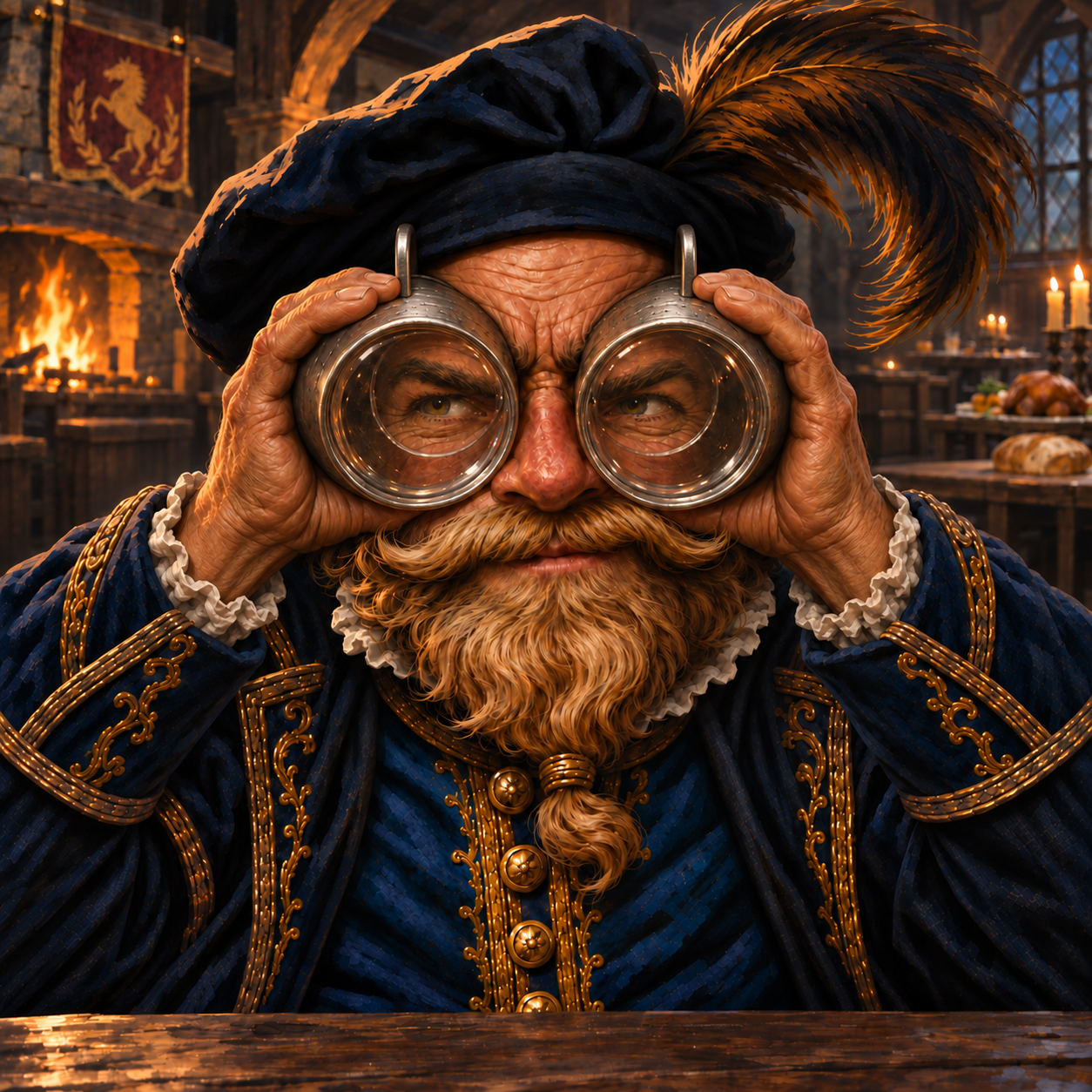
At the Bildhofen Arms, the ale showed amber through the bottoms of the mugs.
Qavitrae turned hers slightly in her hand. Pewter fitted carefully around glass: an unusual expense for an inn on the road. The barkeep had charged an extra penny apiece, and Thindruk had paid without argument.
Their afternoon journey to Grubensreik had been mercifully short. There was good cheese with dinner, fresh produce from the surrounding farms, and a common room full of people bound for Carnival. They were near enough now for everyone to behave as though the journey’s dangers had been left behind.
Wanda lifted her mug and looked through its base. “I can see you while I’m drinking.”
“No sucker punches,” Felrick said.
Thindruk emptied his, borrowed another empty mug, and held the pair before his eyes. Wanda approved the invention wholeheartedly. “You never lose vigilance.”
“Except through drinking,” Qavitrae said.
“Nonsense.”
Qavitrae watched the room over the rim of her single ale. A little more than a third of the patrons had paid for the glass. They tended to be people who kept their belongings close and looked towards the door when it opened. The others were noisier, less watchful, pleased to save a penny on their way to four days of celebration. She mentioned the distinction quietly.
“We’re seasoned travellers,” Wanda said. “We used to be river traders.” There was a pause. “Burning accident.” She drank again. “I can see people.”
“No sea people here, Wanda. We’re inland.”
“Then why does the place keep moving?”
Nora and Felrick had settled into a contest. Nora swallowed, set down her mug, and waited while Felrick attempted to establish that a gnome could drink more than anyone else at the table. He was becoming less steady, but his eye still followed movement in the room. Nora showed little sign of being affected at all.
Around them, Carnival grew larger with every account of it. Four days, people kept saying. Four whole days. When Wanda asked whether anyone had been to the Schaffenfest, some had to ask what it was.
“That sounds like a farm-town fair.”
“Go to both,” Wanda advised. “Different times of year.”
Qavitrae sipped her ale. She had no objection to pleasure. She preferred to know what else was in the room with it.
Two men entered quietly. One wore a hunting sword. The other carried a morgenstern. They took a table, ordered ordinary mugs, and spent more time looking about than drinking.
Later, as the room grew louder, they separated. Each began moving between tables. Neither seemed particularly interested in conversation. The drunker patrons received most of their attention. One drifted towards them while Wanda was explaining her regret over the witch hunter’s hat.
“I should have taken it. Such a nice hat.”
“It would cover all your hair,” Felrick said.
Nora put her mug down. “That’s stupid. It wouldn’t suit you. You need a scarf.”
“An ascot,” Wanda decided.
Qavitrae turned the scarred side of her face towards the approaching man and watched him. Beside her, Felrick murmured, “Coin in his hand. Shilling.” The man glanced at Qavitrae and closed his fingers. By the time he drew level with the table, the silver had vanished into his palm.
Wanda reached out and grabbed his backside. He stopped and looked back, then smirked. “If I weren’t working.”
“What is your work, friend?” Felrick asked. “You’re not serving the beer.”
“Road wardens.”
Across the room, his companion began moving purposefully towards another table. A drinker had just emptied his mug and was holding up a wet shilling, delighted by his discovery. The second man reached him before the delight had time to fade.
“I see you’ve accepted the Emperor’s shilling. You’re a road warden now.”
“What?”
“Hear, hear!” Wanda called, and applauded.
Qavitrae looked down through the glass beneath her remaining ale. So that was what the penny bought.
The first man found another emptied mug. More silver had appeared. The explanations grew louder as the recruits began to understand that this was not a Carnival amusement. In times of trouble, the wardens could increase their numbers by offering a shilling. Accepting it meant a year and a day in the Emperor’s service. Refusing after acceptance meant desertion, and the man with the sword explained the consequences of that with sufficient clarity.
Qavitrae offered a penny to the warden who had passed their table. “For your service.”
Wanda gave him a shilling of her own. “Good work. We got here safely. If that gets you another pair of arms, fine.”
His gaze travelled over their weapons. “You know how to fight? We can use more.”
“We’re already employed,” Wanda told him.
“We may enquire after our business in Middenheim,” Qavitrae said. “Is there some particular cause of the trouble?”
Beastmen. Bandits. Mutants. Religious heretics. He gave her a workman’s list, without surprise or any single calamity to explain the rest. Three new recruits had been gathered by then. Their companions were variously laughing, protesting, or studying the bottoms of their own drinks.
Wanda gave the warden her room number.
“I’ve recruits to wrangle.”
“The hard life of a road warden,” she said. His attention was already on the people who might run. Wanda sighed, deprived of a better ending to her evening, and returned to her ale.
Qavitrae set her mug down where she could see its contents. Beyond their table, the celebrations struggled back into motion. Somewhere a chair scraped; someone began explaining again that he had only been drinking his beer.
Wanda remembered little of the evening when they boarded in the morning. Qavitrae saw no urgency in supplying every detail. The coachmen were ready, the horses rested, and the road ahead would bring them to Middenheim that day.
They stopped for an early lunch at Schöninghagen. A brass plaque recorded the treaty signed there in the year of Sigmar 2369, to the glory of Middenland and the Todbringer family. It called on Ulric and Sigmar together to protect them and bless their loyal subjects. Qavitrae read the names of both gods.
Thindruk knew the history and was happy to share it. The old human settlement around Ulric’s temple; the dwarven clans who had helped make the mountain a fortress; the long line of Todbringers, now represented by Graf Boris, an elector with a voice in the choosing of emperors. The city had a reputation for making room for elves and wizards, and for wasting few words on manners. Carnival was its great exception to a working life.
Middenheim had been besieged and battered. It had never fallen.
Qavitrae remembered a siege of her own. She had been among the efforts to break it in the days of Magnus the Pious. The name that had authorised the roadblock belonged to a time she had lived through. She let Thindruk talk while she considered how little of those days a brass plaque could hold.
The road brought them out of the forest. Ahead, the mountain rose, and on its summit stood the city.
The sight quieted even the conversation in the coach. Qavitrae looked up at the walls, trying to find familiar shapes in the distance. Around them the traffic thickened: carts, riders, people on foot, all funnelling towards the road that climbed in turns along the mountainside.
Some had come for four days of pleasure. Others carried goods to sell them. Their own coach bore armed travellers, an inconvenient face, and news of things that might be waiting below the streets.
The horses slowed among the arrivals. At the entrance ahead, officials were already sorting the traffic. People waited beside their carts with papers in their hands. The coach joined the queue, and Qavitrae rested her crossbow across her knees while they waited their turn.
Delbers: a hurried household visit The northbound journey resumed with a brief midday stop in Delbers, where the company had originally set out. The Castle Rock coach stopped at the Wheel and Anchor near the river, an inn owned by the merchants’ guild. The Great Oak, named for its courtyard tree, instead served Four Seasons coaches under an exclusive arrangement. Wanda regretted that the company could no longer make this arrival aboard its own boat. Qavitrae asked whether Josef’s boat was in port, but Josef was still away trading during the summer; he normally returned home in winter. Wanda wanted to leave word that he could collect the boat payment at the bank. Nora also felt obliged to greet her family, including her aunt, rather than pass through town without visiting. During the short lunch stop, the company managed a hurried household visit and left a message for Josef. The message reached his household, but Josef himself was not contacted, and the company did not know whether he would receive it or collect the payment. Bella Kurz stayed in Delbers to pursue her cartographic business, including the dispute over the town’s placement or river naming. The Castle Rock coach continued toward Sauterm without her. The forest road: the Order of Righteous Fury About halfway between Delbers and Sauterm, near the dense Drakwald, the travellers smelled smoke. Qavitrae read the wind and placed its source ahead and to the northwest, in the direction of a farming enclave. She moved forward along the coach roof to warn the driver, who suggested an ordinary campfire. Qavitrae readied her crossbow. Felrick then caught sight of a substantial plume through a break in the trees, enough to suggest a sizable current or recent fire. The armed coachman checked his blunderbuss. The companions never saw what was burning or learned who had started it. Around a bend, wagons and horses blocked the road beneath banners bearing Sigmar’s hammer. The coach slowed roughly seventy-five yards away. The roadblock consisted of fifteen armed followers and a witch hunter wearing a tall, broad-brimmed hat and carrying a pistol. The followers had limited armour, chiefly leather, marked with a hammer and flame. Their leader claimed that Emperor Magnus the Pious had granted the Order of Righteous Fury authority to inspect travellers. He demanded that the coach submit to inspection and search, assuring the innocent and devout that they had nothing to fear. Thindruk attempted to secure passage through courtesy and shared piety, vouching for everyone aboard. The witch hunter initially respected his title and invoked Sigmar’s historic friendship with dwarves. Thindruk answered, “We both definitely love hammers.” The conversation became more dangerous when the hunter asked whether any passengers worshipped Ulric. Thindruk denied it, concealing Wanda’s faith, and instead condemned the prejudiced former passenger whom they had left at an Ulrican shrine. His challenging Guile attempt benefited from Forked Tongue, but an initial failure became a critical failure on a fortune reroll. The hunter grew more suspicious and insisted on questioning everyone. The witch hunter spoke privately with a follower. Wanda tried to overhear or read their lips but learned nothing of the exchange. Felrick’s scrutiny was more successful: he saw the follower retrieve a folded paper from a saddlebag and hand it over. The hunter studied the paper, repeatedly compared it with Thindruk, returned it, and adjusted his pistol. The paper carried a likeness, but the companions did not learn its wording or named subject. The comparison suggested another encounter with Thindruk’s mistaken-identity problem, without confirming that this particular notice concerned Lackerson. Thindruk proposed taking the leader hostage if necessary. Nora stepped down with her weapon undrawn, appearing cooperative while measuring a direct route to him. Wanda joined her and tucked her wolf necklace inside her clothing. Felrick remained above with his bow. The hunter then accused the man travelling as Thindruk Steelbone of being a heretic and criminal. Thindruk disputed the identification; Nora and Wanda defended his title and cited the company’s fight against the heretics at Wittgenstein. Wanda challenged the identification directly: “Are you saying all dwarves look alike?” The witch hunter proposed determining Thindruk’s guilt or innocence at the Order’s chapter house. Wanda’s local knowledge placed it in the hills north of Isenbutl, a detour of roughly two days there and back. Such an inquiry carried an ominous reputation. Felrick also sought to understand what they might face: witch hunters were generally highly trained martial opponents rather than wizards. The company did not agree to accompany the hunter or visit the chapter house. Instead, seeing some companions off the coach, he decided to identify all of Thindruk’s allies and ordered his followers to take everyone aboard into custody. Felrick responded to the mass-arrest order by drawing to shoot. The witch hunter reacted first with a quick draw and fired his pistol. Felrick accepted the hit rather than use the remaining fortune to force a reroll. The shot inflicted 11 damage and left him lightly wounded. His answering bow attack used an ability that made the hit unavoidable; its final damage was 41. The arrow passed completely through the hunter’s chest and leather long coat. He looked down and collapsed dead in the road. Nora and Wanda did not make the proposed charge, and nobody seized him as a hostage. The fifteen followers hesitated, but a wider fight was close. Felrick kept his bow ready, Qavitrae stood with her loaded crossbow and denied that there were heretics present, and a coachman had his blunderbuss prepared. Wanda invoked the company’s official Imperial business. She accused the dead hunter of betraying the Emperor by obstructing Lord Steelbone with false charges and threatened punishment for anyone who continued the interference. Using Meeting of the Minds, she achieved a critical Intimidate success, inflicting seven peril on each follower. Her threat stopped the imminent volley of bolts into the coach. One follower called for everyone to hold, apologized to Lord Steelbone, and ordered the wagons moved. Thindruk acknowledged their compliance with a flourish: “As you were, citizens, you’re welcome for disposing of this ne’er-do-well.” The followers cleared the road, and no general battle followed. Their surrender of the immediate confrontation secured passage, though it gave the company no assurance about how the Order would regard the killing afterward. Felrick climbed down with his bow ready, turned over the corpse, and took the discharged pistol from the dead man’s hand along with a bag of shot and powder. The bag contained just one remaining bullet. Wanda asked about the likeness and learned that it had been returned to the follower. The company left it there rather than seize or destroy it. Wanda walked beside the coach as it passed through the cleared roadblock, maintaining the threat until it was safely beyond the followers. Once they were out of earshot, Felrick acknowledged how much the gunshot hurt. The company had escaped with only his light wound, leaving fifteen witnesses and the identifying paper behind. The smoke off the road remained unexplained; the companions did not know whether the fire had anything to do with the witch hunters. Sauterm: paying to keep moving The other passengers were unsettled by what had happened. Count Bormann asked why a witch hunter had singled out Thindruk so soon after Imperial representatives had gone to considerable trouble to find him. Thindruk attempted a reassuring story about hostile forces conspiring against him, but his storytelling attempt failed critically. Concern about the dead hunter’s colleagues undermined his explanation. Bormann did not pursue the questioning, yet he and the sisters remained unconvinced. Nora warned that returning to this area might now be unsafe. Qavitrae judged the coachmen chiefly relieved to have escaped and eager to finish the journey. At Sauterm that evening, Wanda urged the coachmen to continue to the next town instead of stopping for the night. She wanted more distance between the company and the witch hunters, arguing that everyone aboard had been present and might face repercussions. She offered Qavitrae and Felrick as watchful defenders and cited Felrick’s shooting. The drivers resisted: bandits, beastmen, and travel after sunset posed dangers of their own, while they regarded the trouble with the Order as the company’s problem. Wanda bargained successfully with Qavitrae’s assistance. The agreement cost one crown for each coachman, paid by Thindruk: two crowns in total for an additional three or four hours on the road. The drivers publicly announced that travel irregularities required them to press on, citing the earlier lost day even though that time had already been recovered. Porters reversed the unloading, returned baggage to the coach, and bundled dinner for the journey. The extra payment bought distance from the roadblock rather than any guarantee against pursuit. Several passengers refused the night journey. Gunder would not take Bertha and her sister onto the roads after dark. Bertha said their cousin Kirsten Jung’s wedding was still sufficiently far off that a delay would not make them late. The sisters stayed in Sauterm with their bodyguard. Count Bormann also took the opportunity to separate from the company and had his luggage removed. Nora helped unload his baggage and claimed his vacated seat inside. Alex Eisen chose to continue because he did not want to miss any of the carnival, although he had become quieter since the witch hunter’s death. The unnamed captain also remained aboard. All five companions continued together, with enough room now available inside the coach. Wanda, Felrick, and Qavitrae nevertheless rode above with weapons ready, including Qavitrae’s arbalest and Wanda’s arrow-deflecting shield. The coach departed again after about twenty minutes. Malstedt: the white wolf on the Imperial Crown The late journey passed without an encounter. Around nine or ten that night, the coach reached Malstedt, near the hills where the dense northern Drakwald began to open out. The horses were tired, and the coaching house’s gate was already closed: coaches normally arrived there around midday. The staff questioned the arrival through a slit. When the coachmen invoked important passengers who needed to make time, the gatekeeper demanded to see one of them. Thindruk presented himself under his own name, relying on his noble dress, accent, and manner. His first Charm attempt failed, but Shaken, Not Stirred allowed a reroll that critically succeeded. The gates opened, admitting the coach and travellers. The staff offered another meal despite the provisions already eaten on the road. Blücher’s travel allowance remained unexhausted. The inn’s sign displayed a golden crown set with painted sapphires and rubies, crudely covered by a white wolf’s head. Wanda initially welcomed the Ulrican symbol, brought out her own wolf medallion, and patted the sign. The keeper explained that the establishment was the Imperial Crown and that the wolf was unwanted paintwork left by disruptive visitors. According to him, men calling themselves Sons of Ulric had started fights with patrons and defaced the crown. The keeper reported wider unrest in Middenland, including open talk of secession. He said the visitors promised to liberate the land from the Emperor’s oppressive rule. He knew no names, but described one prominent man as large and blond, with a thick beard and a good mustache. He thought the group came and went from Middenheim and had travelled north. Wanda took his hand, insisted that Ulricans need not behave so crudely, and advocated coexistence within one nation. She thanked the staff for shelter. They hoped the trouble would pass and were reluctant to prolong the political discussion. At breakfast, Alex complained that the coachmen intended to rest the hard-driven horses until midday, comparing their schedule unfavourably with his own riverboat routine. His conversation with Qavitrae turned into an argument about mutation. Alex blamed Middenlander inbreeding, swamps, and strange biting insects; Qavitrae countered with the Chaos wars and lingering pockets of Chaos. Alex persisted despite her long experience. Wanda went upstairs to check on Heinrich, one of the two coachmen. Repeated knocking brought him to the locked door, sleepy but well. She kept him from ending the conversation immediately and asked for better communication about schedule changes, while accepting that the horses needed rest. Heinrich confirmed departure after lunch and arrival at Middenheim the following day. He then chose to come downstairs for breakfast. The coach did leave around midday, as other coaches were arriving. Felrick’s gunshot wound could be cleared through time spent tending it and a night’s rest, without a bandage or medical roll. The overnight stop provided rest and time to tend the wound. His injury remained light, with no lasting injury imposed or mandatory medical expenditure. With the morning available, Wanda successfully gathered rumours about witch hunters and conditions farther north. Travellers generally connected witch-hunter activity with agitation by people calling themselves Sons of Ulric. Nobody she consulted could say whether the Sons formed one coordinated organization or several separate bands. These reports reinforced the keeper’s account of religious tension without identifying leaders or a common command structure. One traveller from Middenheim wanted witch hunters sent into the sewers. He claimed that, in moonlight, he had seen a rat as large as a man emerge into a street, sniff around, and retreat underground. He rejected the suggestion that it had worn clothes. According to him, a sewer jack had said they knew about the creatures and were handling the matter, but the traveller doubted their ability and advocated holy fire. The companions recalled giant rats and Skaven from Wittgenstein; they did not know whether his sighting involved either. Wanda reviewed the wolfsbane and animal bane already available, but used neither. No sewer expedition was agreed. Grubensreik: glass-bottomed tankards A shorter afternoon journey brought the coach to Grubensreik, a small market town serving the surrounding farms and villages, with local produce and good cheeses. The company took rooms and dinner at the Bildhofen Arms. Its patrons were celebrating the approaching Middenheim carnival, which they described as lasting four days and contrasted favourably with the Schaffenfest. At the first round, the barkeep offered glass-bottomed pewter tankards for an extra penny each. Thindruk accepted the surcharge, and the round was served in the special mugs. The company was unfamiliar with the carefully made vessels and joked about watching the room through them; Thindruk held two empties in front of his eyes like spectacles. Qavitrae noticed that roughly a third of the room used the glass-bottomed mugs. Further scrutiny suggested that these drinkers were experienced road travellers, while many patrons with ordinary mugs were less watchful carnival visitors. She quietly warned the table and limited herself to one drink. Nora drank heavily but remained steady and alert. Felrick became drunk while retaining his powers of observation. Wanda became drunk and critically failed her Awareness check, leaving her much less attentive to the room. Two armed men in travelling clothes entered quietly, bought ordinary mugs, and watched the crowd. One carried a hunting sword and the other a Morgenstern. As the evening grew louder, they began circulating separately among the drunker tables. One approached the company, where Qavitrae fixed him with a conspicuous stare from the scarred side of her face. Felrick spotted a silver shilling held between the man’s fingers. Seeing that he was watched, the man palmed the coin and passed on without dropping it into a mug. Wanda grabbed the passing man’s backside. He stopped, smirked, and indicated that he was working rather than free to respond. Felrick asked his occupation, and the man said he served with the road wardens. What that work involved soon became clear elsewhere in the room: a drinker emptied an ordinary mug and fished out a shilling. A warden announced, “I see you’ve accepted the emperor’s shilling.” The men made the same claim over other drained mugs and gathered confused patrons together. In troubled times, accepting a road warden’s recruiting shilling committed the recipient to a year and a day of service. The wardens used coins hidden in opaque-bottomed mugs to claim that acceptance had occurred, threatening anyone who refused with treatment as a deserter. Three drinkers were ultimately conscripted and kept under watch. The purpose of the glass bottoms was now apparent: they allowed drinkers to see a coin before unknowingly accepting it. None of the companions was recruited, and the company did not intervene to release the three patrons. Wanda applauded the wardens and their recruits. Qavitrae gave the nearby warden a penny for his service, and Wanda donated a shilling toward obtaining another pair of arms. When asked whether they could fight, the companions explained that they already had employment and declined service. Qavitrae suggested that they might check in after finishing their Middenheim work, without making a firm arrangement. Asked why recruits were needed, the wardens named beastmen, bandits, mutants, and religious heretics. They supplied no specific unusual threat or new report about sewer rats. Wanda also gave one warden her room number, but he remained occupied with keeping the three new recruits from escaping. No private visit followed. The company stayed overnight, and the next morning Wanda said she remembered nothing of the evening. Qavitrae’s and Felrick’s vigilance had kept their own table clear of the recruiting trick, while the explicit donations cost Qavitrae one penny and Wanda one shilling. Schöninghagen: history on the final road After leaving Grubensreik, the companions kept watch for the dangers the wardens had listed. Wanda recalled an older map showing three points arranged in a triangle, including a location associated with a swamp. A fresh look corrected the idea that it lay nearby: the remembered site was roughly a hundred miles away. The company agreed to no detour and continued toward Middenheim. The map’s sites and their wider significance remained unresolved. At an early lunch stop in Schöninghagen, a brass plaque commemorated a treaty signed there in the year of Sigmar 2369. Its inscription honoured Middenland and the Todbringer family and asked both Ulric and Sigmar to protect them and their subjects. The plaque prompted recollections of the region’s history. Middenheim had grown from early human settlement around an Ulrican temple on the mountain. Humans and dwarves had shared it for millennia, and dwarven work had helped turn it into a fortress that had resisted repeated attacks without falling. The Todbringers had ruled for generations; Boris Todbringer was the current Graf and an elector count. The city’s historical openness to dwarves, elves, and wizards made the recent exclusionary reports especially striking. Carnival also stood out as an exception to the region’s customary emphasis on work. The old Chaos-war siege and its relief by Magnus the Pious’s forces recalled part of Qavitrae’s own past: she had participated in the effort to break that siege. Thindruk successfully recalled regional history as well, while Wanda remembered little of the material. Beyond the forest, Middenheim finally rose above the travellers. The road climbed the mountainside in switchbacks, joining increasing traffic bound for the city. The session ended with all five companions still aboard the Castle Rock coach on the approach to the entrance. Entry procedures and administrative formalities lay ahead; the company had not yet entered the city, paid a new entry tax, or completed either of its standing assignments. Where things stand At Middenheim’s entrance: Qavitrae, Thindruk, Wanda, Nora, and Felrick remain together. Alex Eisen and the unnamed captain are still fellow passengers. Bella Kurz stayed in Delbers; Count Bormann, Bertha, her sister, and Gunder stayed in Sauterm. The coach escaped the roadblock intact and reached the mountain approach without another attack. The company’s work remains pending: Captain Sherlock’s delivery has not been handed over. Nacht’s Purple Hand investigation also awaits action inside the city. The existing lead is to present Nacht’s black-skull coin to Uri Breitner at the Templar Arms and await the unnamed liaison. Neither the inn visit nor the liaison meeting has occurred. The Order may remain a danger: Felrick killed the roadblock’s witch hunter, and fifteen followers survived to witness the encounter. One retained the likeness compared with Thindruk. The company bought distance because it feared repercussions, but no pursuit or organized retaliation appeared. The identity named on the paper and the cause of the nearby smoke remain unknown. Reports worth following: The Imperial Crown’s keeper linked men calling themselves Sons of Ulric with intimidation, vandalism, and secessionist rhetoric. Travellers associated religious agitation with increased witch-hunter activity, without knowing the Sons’ organization. A separate traveller claimed man-sized rats were emerging from Middenheim’s sewers and that sewer jacks knew about them. The creature’s identity and the authorities’ actual response remain unverified. Resources and recovery: Felrick holds the discharged pistol and a shot-and-powder bag containing one bullet. His 11-damage gunshot left only a light wound, eligible to clear through tending and overnight rest without a medical roll or bandage. Thindruk spent two crowns on the extra journey; the glass-bottomed tankards added a penny per mug to the drinks bill. Qavitrae donated one penny to the road wardens, and Wanda donated one shilling. Blücher’s travel funds were not exhausted. Every companion received 100 reward points.Session Notes