The candle flame stood between Thindruk and the woman in green velvet, throwing their shadows across shelves of pickles.
There were two stools, a little worktable, and scarcely enough room for courtesy. Thindruk had offered her the first seat, but she had declined to put her back to him. “For the time being, I prefer to keep my eyes on you,” she had said. He could appreciate the principle, even if he disliked being its object.
“I assure you, my dear lady, you are worth more to me alive than dead. As I apparently am to you.” He arranged himself on the stool. The knife concealed on his person pressed reassuringly against him. “But I don’t wish to be rude.”
Above the cellar, armed men held his companions at bay. Somewhere outside, a pistol had already been fired. It was a poor foundation for a private conversation, but she had gone to considerable trouble to obtain one. “There are easier ways for such a fine lady to get my attention,” he said. “But you’ve certainly got it.”
“Good. I need to be sure you’re listening.” She sat opposite him and produced a polished hardwood pipe. Beneath the velvet cloak, her belt carried the practical leather pouches of someone dressed to travel. She began packing tobacco with an unhurried precision that Thindruk found more interesting than a drawn weapon. “I know you are Lackerson. Magister Impedimentae of the Purple Hand, late of Nuln. I know you established the alias Viscount Thindruk Steelbone some decades ago. I know you went to Bögenhoffen to collect a substantial inheritance, and left empty-handed after joining members of the city council in a deeply heretical ritual. Subsequently, you travelled the Reik under the guise of a merchant. You have repeatedly rebuffed your masters in Middenheim, but have finally submitted to their summons.” She looked up from the pipe. “Why?”
Ah. What an accomplished piece of workmanship. Their journeys, their misfortunes, even their victories: all fitted together into a cage.
“You spin quite a tale,” Thindruk said. “I recognise elements of fact, but much of it is fabricated of whole cloth. Either you’re unaware of that, or you’re attempting to manipulate me into participating in your flight of fancy. Which is it? Ignorance or malice?” He considered her. “Perhaps there’s a third possibility.”
“Dedication.” She paused. “I am remiss. I have failed to introduce myself. You may call me Lady Emmanuelle Nacht.”
That name he knew. Altdorf society. Imperial confidence. The Emperor’s representative in negotiations over Ubersreik’s petition for the status of a free city. A woman with business far above the cellar of the Forest Hearth Inn.
“I serve the Emperor’s Black Chamber,” she added. “That name, I’m sure, means something to you, Lackerson.” It did not. Her expectation told him something; the soldiers upstairs told him rather more. He let neither discovery trouble his expression.
“A network of agents throughout the Reikland has been monitoring you,” she said.
“Then I am afraid to discover that its reputation exceeds its capabilities.” She reached into another pouch. “You’re about to show me a picture of a dwarf who looks remarkably like me,” Thindruk said. She unfolded the parchment. “With the appellation Lackerson,” he added.
“Yes.”
“Before we go further, I must insist that you desist with that name. I am aware of it. I find it distasteful.” She weighted the sketch upon the table. His own face stared up at him from the candlelit paper.
Felrick had a better view of his adversary than his adversary had of him, and he meant to keep it that way. The tower lamp stood unlit. Beyond the inn’s walls the Drakwald lay in darkness; within them, moonlight picked out roofs, corners, the open ground a man would have to cross to reach the tower. Adolphus remained tucked behind a building, exposing just enough of himself to watch.
“Throw down your weapons,” the bounty hunter called, “or I’ll light that tower on fire.”
Felrick set another arrow to the string. “I dare you to cross that space.” Adolphus did not.
Below the tower, the inn and its outbuildings had become a collection of doors from which trouble might emerge. Felrick had already shot the watchman who had shared his post. The man lay nearby, past the reach of any further argument. Whatever bargain was being discussed inside, it would have that to account for. “Is this about the bounty,” Felrick called, “or the horse?”
“Both.”
“Well, if it were only the bounty, I wouldn’t kill you. Professional courtesy. Same guild and all.” He kept the arrow ready. “But if it’s the horse, I’m sorry.” The corner offered no improvement in their relations.
Inside the inn, Qavitrae stood at the upper railing with her hands below its edge. Some of the soldiers knew she had a pistol. They could occupy themselves with wondering what she intended to do with it. They were well equipped: mail to the thighs, protection at knees and shins, weapons carried without fuss. More troublesome, they were alert without swagger. She had supplied enough fighting men to recognise the distinction between soldiers who looked expensive and soldiers who might justify the expense.
“Oi, mayflies,” she called down. “Already back from Kislev?”
There was a little grumbling among them. “Yes,” one answered. “We fought the Ice Queen’s armies.”
“Well, I thank you for your service.”
“Stay where you are. No fast moves.” A competent answer, if an ungracious one.
Nora, below, tried a different approach. She drifted towards the guarded cellar stairs until a mailed fist barred her way. “Stay by those stairs.” The soldier indicated the flight to the upper floor.
“I just want to know our friend’s all right. Look at you. All that armour, and I’ve got a fancy jersey. What am I going to do to you?”
He pressed his fist against her sternum and guided her back. Nora yielded. She had come down without her armour or ordinary weapons, as requested, but she still had her weighted Blitzball. Qavitrae watched her return to the permitted patch of floor. At least the soldier understood that a jersey did not make Nora harmless. Nora kept watching the cellar entrance.
Nacht held her pipe to the candle until the tobacco caught. “You are impressively unflappable.”
“The Purple Hand has found that to be the case as well.”
“Which would make you a capable agent of theirs.”
“To some appearances, yes. I wonder whether that might be to your advantage.” Thindruk leaned forward a little. “Is this an organisation the Emperor would prefer destroyed? Chasing one suspect can hardly be the principal interest of someone so highly placed.”
“The Black Chamber has sought to eradicate them for decades.”
“Then I have excellent news. I am not Lackerson, but I do appear very much like him. To you, to people who knew him, and to the Purple Hand itself. They have approached me repeatedly with hand-jive mumbo-jumbo and increasingly insistent instructions. At our last meeting I believe I made my objections quite clear.”
“And yet you are travelling to Middenheim.”
“Business takes me there.” She listened while smoke curled between them. The reports, she maintained, corroborated one another. The route, the timing, the inheritance: all accorded with what her agents expected of Lackerson.
“Were there reports of a caravan attacked by beastmen?” Thindruk asked.
“Sadly, too many. The Middenheim–Altdorf Road is not as safe as it was.”
He would have to explain the dead dwarf, the papers they had found, and the attraction of an inheritance intended for someone else. That last detail would hardly improve his appearance of innocence. Still, it was preferable to allowing her version of Bögenhoffen to stand unchallenged.
“So I am to believe,” she said, “that you are an unwary, unlucky lookalike.”
“Unwary I might dispute. Unlucky—things have gone up and down.”
She studied him through the smoke. “You are correct that I have a use for you. Middenheim is in a precarious position, Herr Lackerson.”
“Listen. You may call me Lord Steelbone. You may call me Viscount. If you insist upon Lackerson, this conversation will swiftly end.”
Her mouth moved slightly. “Apologies, my lord.”
“You were saying?” Middenheim’s ruler had withdrawn from affairs of state, she told him. Its priests were at one another’s throats. New laws were squeezing dwarfs, elves, wizards and priests until the people upon whom its defences depended could scarcely afford to stay.
“One might attribute it to incompetence, religious fervour, or the ordinary stupidity of government. Unfortunately, I suspect something more deliberate.” The Black Chamber had reason to believe the Purple Hand was involved. Whether the cult had engineered the crisis or merely taken advantage of it remained unclear. Someone, Nacht believed, was undermining one of the Empire’s greatest fortresses.
Thindruk listened with a growing recognition. Letters, journeys, the names left behind in ruined places: they had been making their own way towards that city long before a woman with soldiers decided to send them. “I suspect I can add something to your understanding,” he said. “But first, we have already heard a pistol. I hope the death was neither one of your soldiers nor one of my people. How this conversation proceeds may depend upon ensuring nobody else finds themselves at the business end of another.”
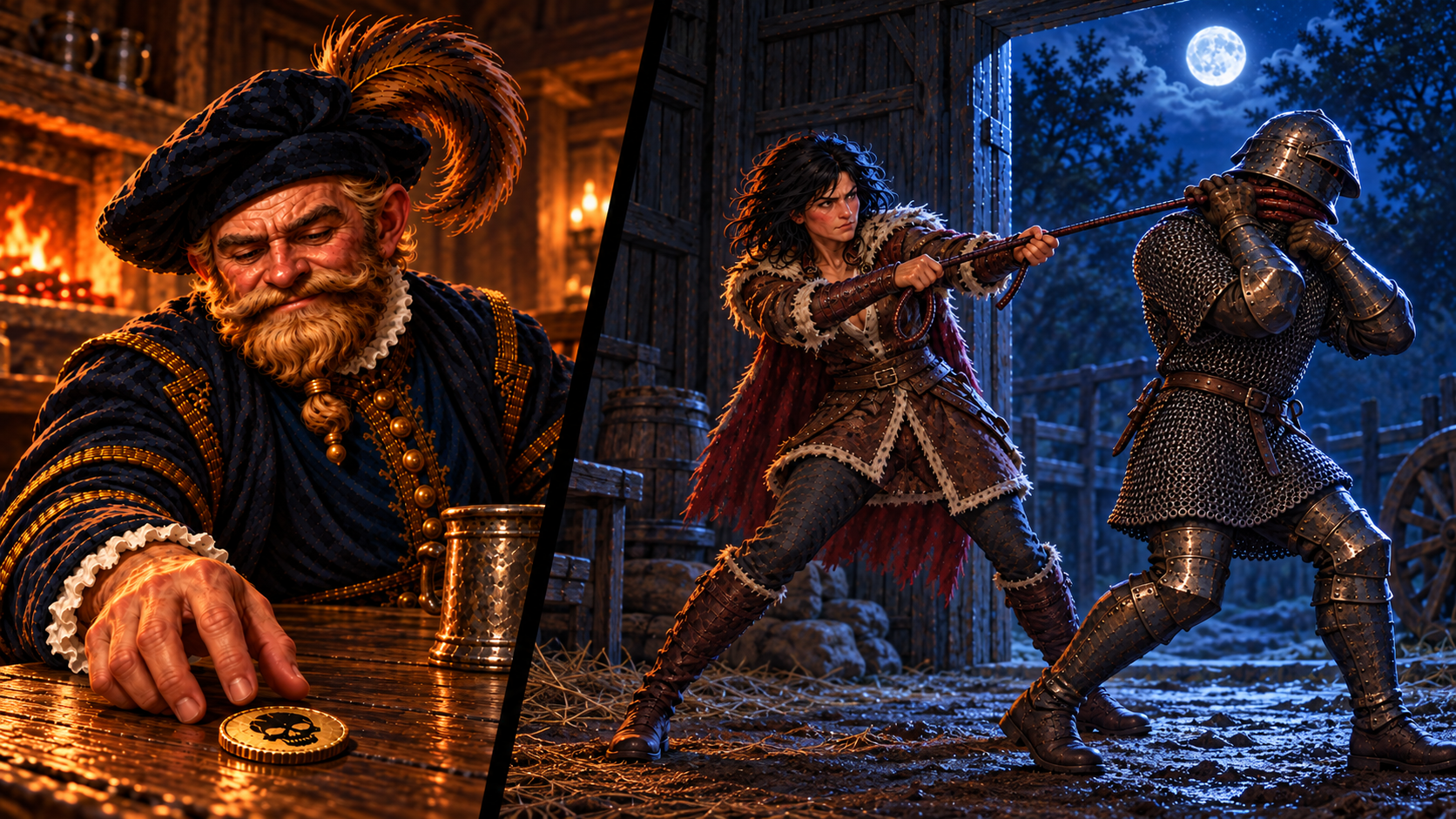
The outbuilding door creaked open. Wanda waited behind it, a few paces into the dark. Moonlight outlined the soldier’s mail and the shape of his head as he paused on the threshold, eyes struggling to adjust. Hers had adjusted already.
The whip went out with a small snapping sound. Leather slapped softly round his throat. She hauled it tight before he could make anything useful of the breath in his chest. His hands flew to the coils. Wanda drew him backwards, into the corner behind the door, and booted it shut. His armour made quiet, troublesome sounds as he struggled. She braced herself and held him.
There was another soldier to deal with before it was over. By the time Thindruk’s voice reached her from outside, both lay unconscious, and she was kneeling among the rewards of having chosen darkness over a courtyard full of pistols.
“Wanda! Felrick! I hope you haven’t done anything we can’t take back. We’re trying to calm things down.”
She looked at the sword, the fighting axe, the pistol. “I’m working on it!” Felrick called from somewhere above. “Somebody’s been shot.”
“One of ours?” Thindruk asked.
“No.”
Wanda gathered the weapons. A woman’s voice carried across the courtyard. “Adolphus. Stand down. We’re all friends here now.” That seemed a large claim for the amount of time that had elapsed.
“Wait,” Wanda called. “I’ve almost got their trousers off.”
“There may be time for that later,” Thindruk answered. “As the lady says, we’re friends now.”
Outside, the soldiers from the inn were assembling in the courtyard. The settlement appeared to require everyone to stand out there while Thindruk and the lady went on talking. Wanda could see merits in a settlement that left her armed. She told the soldiers where their companions were. “They’re unharmed.” She did not return their weapons.
Adolphus made his crossbow visible around the corner, removed its bolt and released the tension. He leaned it where Felrick could see it, then withdrew. Even so, the gnome took some persuading to descend. “Shouldn’t I keep watch for beastmen?”
Knowing their luck, Wanda thought that an excellent suggestion. The invitation to come down remained. Qavitrae emerged with her swords strapped on and her pistol close. The two groups settled roughly ten yards apart, with enough room between them for everyone to continue disliking the arrangement.
Wanda considered the soldiers’ equipment again. “I don’t recognise the colours.”
“They’re Imperial Army colours, Wanda.”
“Oh. Shit.”
Qavitrae looked from her to the men recovering their composure. “Are you sure you’re all veterans? Wanda is very good, but that’s disappointing.” Wanda smiled at the soldiers. They did not appear to enjoy any part of it.
They chose a table near the hearth when they returned inside. Thindruk preferred the last embers of a fire and a proper chair to a cellar stool, particularly now that he had established he might be permitted to survive the conversation. Nacht did not confuse cooperation with loyalty. “I have no illusions about your allegiances. I don’t know that you would lose sleep over Middenheim. Or the Empire.”
“I am a loyal subject of the Emperor.”
“I hope so. But I can offer something everyone values. Self-preservation.” There it was, freed of the cellar’s courtesies. If she began to entertain the possibility that he was not Lackerson, others would remain convinced. She had spent considerable time and Imperial resources locating him. Her superiors could do the same if they believed him beyond control.
Thindruk let that settle. “I’m glad the Empire’s opposition to Chaos remains strong. I would be happy to assist in removing this rot. But your informants may have missed some pieces.”
She produced a little leather-bound book, a pen and ink. “I will listen to anything you have to say.”
Some of what he intended to tell her could be made to sound very incriminating. Her opening account had demonstrated that admirably. He asked her to consider, as she listened, the possibility that he was who he claimed to be, with the motives he professed.
“I will consider it in fullness,” she said. “I treat knowledge as coin. It is not to be spent frivolously.”
Once he began, the telling took time. He described the signs of corruption they had encountered, the beastmen, the ritual at Bögenhoffen they had stopped rather than joined. He spoke of Atelka Herzen’s activities and her death, and of the horrors of Wittgenstein. He explained the corpse whose face had resembled his own, the papers that accompanied it, and the regrettable appeal of an unearned inheritance.
There were people he left out. The wizards who had helped them, and whom they had helped, were not his coin to spend. Nor did he offer every dangerous secret in their keeping. Nacht accompanied him to recover the correspondence from their trunk. She remained careful in his presence, without seeming afraid. As he laid out the documents, her questions became more precise.
“Atelka Herzen,” she said, reading a name. “The Herzens of Nuln.”
“Known to you?”
She let him continue. He watched her as he talked. There were parts she doubted; he could see that. But Herzen’s involvement did not surprise her as an outrageous accusation should have done. She was fitting his account to things already in her possession, and the shape she had expected to find here tonight was changing.
When she read the letter bearing the blasphemous salutation and emblem, she tore away its lower portion. Thindruk watched her hold it to the candle. “That bad?”
The paper blackened and curled. She let it burn to ash. “Neither the symbol nor the phrase should be left for unwary eyes.”
He thought of other things they had encountered and allowed the little heap of ash to suffice. Gotthard von Wittgenstein’s letter received a different treatment. Nacht wished to keep it, to ascertain whether he had truly written it.
“The Grey Wizards will know. If they confirm it, I may have another task for you. You have already eliminated one von Wittgenstein. I imagine you wouldn’t object to another.”
No task quite yet, then. A letter awaiting authentication, and a possibility after it. “I understand the castle needs a new lord,” Thindruk observed.
She continued reading. By the time she packed another pipe, he believed he had achieved something more useful than impressing her: he had become more valuable.
She still warned him that she had to treat his words as honey dripping from a serpent’s tongue. Enough of them agreed with things she knew, however, that she hoped she could trust him. “Honey and serpents aside,” he said, “even I admit the resemblance is uncanny. My companions have concocted a flight of fancy about doppelgangers invading the Empire.”
Nacht rose abruptly.
“You know about the doppelgangers?”
For a moment he could hear the small sounds of the hearth. He had offered her a ridiculous explanation to illustrate how ridiculous the matter had become. Her reaction left it sitting between them with quite a different weight. It supplied no answer to the question of his own resemblance, and he could not have said what she knew. But he would remember how quickly she had stood.
Her proposal brought them back to things he could negotiate. Whether through design or misfortune, he had standing with the Purple Hand. Her agents could not simply walk into a meeting and expect a welcome. He might.
She offered a reprieve. He would continue to Middenheim, contact his “associates”—she gave the word a small, pointed gesture—and discover what they were doing. “Names. Intentions. Evidence.”
He would report to her designated agent. On reaching the city, he was to take rooms at the Templar Arms, ask for the proprietor, and pay with a particular coin. The coin she placed on the table resembled a gold crown on one face; the other bore a skull painted black. “Uri Breitner,” she said. “He will put you in a secure room. Your board and food will be handled. My agent will find you there.”
Thindruk turned the coin. After all the men, threats and documents, the practical reward appeared to be accommodation. “Trust goes both ways. I trust this isn’t an elaborate scheme to apprehend me for passing counterfeit coin.”
“Counterfeiting Imperial currency would be among the least of the crimes attributed to Lackerson.”
He accepted the coin. “I hope the services I have already rendered, and intend to render, may eventually merit something more than a reprieve for crimes committed by someone who resembles me.”
“If your work in Middenheim is effective, I will endeavour to convince my superiors that, regardless of your identity, you are of value to the Empire.”
They could begin there, though a substantial practical difficulty remained. “The Purple Hand expects this Lackerson to arrive with a considerable sum. The inheritance. Explaining its absence may prove awkward. Your resources are extensive. Perhaps you can find a solution.”
“The inheritance was, and shall remain, a clever ruse.”
He looked at her. So much trouble, so many miles, for money that had never waited at the journey’s end. He had understood the bait well enough; now he wondered how closely Nacht had been involved in laying it.
“Use the promise of the money to open doors,” she said. “Don’t let them close those doors behind you. You’re a resourceful dwarf, Lord Steelbone. I trust you’ll solve the problem.”
“One of my chief resources is the resources of those willing to help me.” She appeared content with the resources already offered.
He asked what else he ought to know about the organisation for which he was now to work. The Black Chamber served the Emperor; Nacht was a trusted agent, not its chief. It operated quietly. Dropping its name among the nobility would gain him little. Her liaison would be one of her most capable people, and the only other person who would know he worked for her.
“Not our bounty hunter?”
“No. Adolphus is highly capable, but his talents are concentrated in a particular area.” There was also, she explained, his belief that the party had caused the deaths of his prized horse and his protégée.
“His protégée being separate from the horse?”
She chuckled despite herself. A young woman he had been training, she clarified. Thindruk recalled the ambush outside the place where they had gone to claim the inheritance, and what had happened to the people waiting there. There was little comfort to offer Adolphus in the distinction.
On Middenheim’s religious strife, Nacht remained concerned that someone was feeding the old quarrel between Sigmar and Ulric for a purpose. The taxes, the ruler’s withdrawal, the timing: together they troubled her. About the peculiar decree concerning mutants, she would say nothing. Thindruk could tell the subject concerned her. He could get no more.
Nor did she appear to know about their burned boat. Her informants, for all their reach, still required news to travel. No conspicuous gifts would accompany them north. She intended to apologise to the inn’s guests for a mistake and a disturbed night. People would tell stories; those stories must not describe the party leaving with Imperial patronage. Her soldiers would depart at dawn, before the coach. At last Thindruk could hear his bed calling more clearly than any further question. He put away the black-faced coin and rose.
By morning, Nora could piece together how the trap had closed. Nacht and the soldiers had been concealed in the cellar. The innkeeper had known, as had others about the place. The friendly welcome, the watch, the apparently secure walls: none had meant what the party had taken them to mean.
The soldiers controlled movement while they prepared to leave. With them went the body of the watchman Felrick had shot. The account the party was instructed to accept was simple: he had taken his money and run away in the night. That was how a dead man left an inn without becoming a murder.
The two soldiers Wanda had subdued were alive. Adolphus was leaving. Thindruk was still Thindruk, at least among his friends, and they were going north with an arrangement that seemed considerably better than the alternative. They found a quiet moment over breakfast to discuss it.
“There is an Imperial organisation that already knows about the threat from Chaos,” Qavitrae said, with gathering disgust, “and we’ve been getting the runaround all this time?”
“Bureaucracy,” Felrick said.
“We’re all spies now,” Wanda said. She considered Felrick. “We need better hats.”
He already had a good hat. The point remained open to discussion. Nora listened, relieved enough to enjoy the argument. No one had to charge the cellar stairs. No one had to discover how many armoured soldiers they could put down before the others fired. Their coach had been repaired during the night; after breakfast, it was ready. They climbed aboard.
The coachmen drove hard to recover the lost time. Breckle passed in a brisk exchange of horses and urgent conversation at the coaching house. There was no leisurely midday meal: salted meat and dried fruit would have to serve while the wheels kept turning. Late in the afternoon they reached Mittelberg and the Halfway House. The summer sun still stood well above its walls. Qavitrae knew those walls.
Two hundred years altered a place unevenly. Qavitrae found the road ordinary enough, the bustle of arriving travellers familiar, but here was a spot where memory put something large and loathsome across the ground.
“There,” she told Wanda, pointing. Wanda looked, and Qavitrae went on. “A Chaos spawn. Great flabby thing. Tentacles everywhere. We dragged it down and cut it into a hundred pieces.”
There was only road to see now. She led them farther into the compound, talking of the old fighting. The inn was practically a fortress; it had served as a bulwark against Chaos long before its present guests arrived to complain about coaches.
Count Bormann kept his distance, though his displeasure with them was evidently struggling against his appetite for old battlefields. He kept looking over, and Qavitrae did not lower her voice; she saw no reason to make the contest easy. Whenever she caught him attending, he discovered something of urgent interest elsewhere.
Inside, a shilling bought a fine meal, as much drink as one could manage, and a souvenir mug. The mug settled any question. It consisted of two pewter half-pint vessels pinned together: one polished and rather fine, the other plain and sturdy, Reikland and Middenland joined at the middle. Qavitrae approved of its possibilities. Felrick approved of the refill arrangements. For once, she joined him in making full use of them.
The room was crowded with travellers going both ways, loud with news and greetings, comfortable with well-prepared food. The first drinks made a celebration of being halfway. Later ones made it difficult to remember which half of the mug had just been emptied. Felrick encouraged her at every refill. “I’ve drunk more than you,” she informed him, “because I’m older.”
He received this with appropriate respect and another drink. Thindruk helped establish the proper custom for the mugs. Link them with another drinker’s, take a handle apiece, and drink together. A linked drink could not be refused. By the time the schnapps appeared, the custom had become extremely popular.
Qavitrae and Felrick began a game. It involved cards. It also involved dice. As the evening progressed, its rules developed to accommodate circumstances which neither of them could have explained sober. Qavitrae nevertheless found them perfectly manageable.
Wanda had drunk enough to enjoy the room without losing her purpose in it. While the game gathered spectators, she sought people coming south from Middenheim and asked after the Sons of Ulric. No one supplied a leader’s name. Fanatics, hoodlums, religious bandits: the descriptions were plentiful, the particulars less so.
The position of Ar-Ulric, the god’s highest priest, proved more interesting. He had challenged the Sons’ claim to direct descent from Ulric. There was talk that he ought to abdicate in favour of one of them; he had called upon the Graf to outlaw their public assemblies. Yet, according to the travellers, he had failed to condemn their persecution of Sigmarites. Wanda listened carefully to that distinction. A man could object to being overturned by fanatics without objecting to everyone they trampled on their way towards him.
Thindruk was enjoying an evening in which people seemed positively pleased to speak with him. He asked about Graf Boris Todbringer. The answers carried admiration for the man he had been: a warrior, a strong ruler, a leader who could command a loyalty spoken of in the same breath as Karl Franz’s. What had happened lately was less certain. Family tragedies. A son terribly ill. Grief that had drawn the Graf away from public affairs. His closest advisers were said to be making decisions. The people at these tables could offer no useful names.
There was worse. The Emperor had reportedly called military commanders to Altdorf over the problems in Middenheim, and summoned the Graf himself. Todbringer had not yet come. To one traveller, that meant grief had left an old man unable to travel. To another, it meant an Elector Count was refusing his Emperor. Talk of war between Reikland and Middenland passed across a table furnished with little pewter vessels celebrating their union. Thindruk asked questions, listened to incompatible answers, and kept his own conclusions to himself.
Nora watched the crowd, finding interest but none that looked especially sinister. A very drunk wood elf winning at an increasingly peculiar game was enough to explain most of it. When the onlookers pressed too close, Nora edged them back and gave Qavitrae room. She stayed near the players while the celebration ran its course. For once, the people watching seemed to want nothing more dangerous than a better view of the game. By the end, Qavitrae was five shillings ahead and Felrick ten down.
“You’re not getting a tip,” he told someone who had taken his money.
“I don’t work here.”
“I can tell. You’re not getting a tip.”
The next morning made distinctions among the company that the previous night had largely dissolved. Nora was steady enough. Qavitrae and Felrick had considerably more to carry into the coach than their luggage and souvenir mugs. The wheels began turning again, indifferent to the condition of those above them.
At Delbers they stopped for lunch. Over the meal, Nora heard that Bella Kurz had gone to the mayor’s house to deliver an impassioned argument that the place was not Delbris. The mayor had apparently been thoroughly confused. After the night’s talk of divided provinces, withdrawn rulers and secret cults, Nora found the dispute almost restful.
Then it was time to board again. She settled into her place as the coach left Delbers behind. The party had passed the point from which their earlier journey had begun. Ahead lay Sauterm, and beyond it the city where Thindruk was expected by people who knew him under the wrong name.
For now, the road remained open. Beside Nora, a pewter mug knocked against a buckle as the coach gathered speed north.
Felrick remained in the watchtower while Adolphus sheltered around a building corner below. The bounty hunter threatened to burn the tower unless Felrick threw down his weapons. Felrick answered by challenging him to cross the exposed ground and nocking another arrow. Adolphus stayed behind cover, and his threat produced neither a surrender nor another exchange of shots. With the tower lamp unlit, Felrick could see his opponent more clearly than Adolphus could see him. Wanda waited unseen inside a dark outbuilding near the stables and coach house. Rather than expose herself to pistol fire, she positioned herself to attack anyone entering the doorway. Her shelter gave her a chance to force a close encounter on her own terms while Thindruk remained separated from the others in the cellar. From the upper-floor railing, Qavitrae assessed the ten soldiers inside the inn. Their thigh-length chain mail, lower-leg protection, alertness, and disciplined bearing suggested a well-equipped, well-trained force. Testing their experience against her knowledge of the eastern campaigns, she called down, “Oi, mayflies, already back from Kislev?” One soldier claimed they had fought the Ice Queen’s armies, then ordered her to remain still. Their competence was apparent; their claimed service remained their own account. Nora tried to get close to the cellar stairs so she could watch over Thindruk and intervene if he needed help. Unarmoured, wearing her jersey and carrying her weighted Blitzball, she argued that the armoured guards had little to fear from her. Her persuasion failed. A soldier planted a mailed fist against her sternum and sent her back toward the upper stairs. Nora backed away without gaining a position near the cellar entrance. Below the inn, Thindruk faced the woman in the green velvet cloak across a candle. The cramped cellar had a packed-earth floor, shelves of preserves, a canning table, and two stools. He offered her the first seat, but she would not turn her back on him. Thindruk assured her that he would take no hostile action without provocation and sat down. She settled into the interview while packing a slender, polished hardwood pipe. The woman accused him of being Lackerson, Magister Impedimente of the Purple Hand, formerly of Nuln. In her account, Steelbone was an alias he had maintained for decades. She interpreted the journey to claim an inheritance in Bögenhoffen, involvement in a heretical ritual, and subsequent river trading as parts of a cult career. His northbound journey, she maintained, meant that he was finally answering his masters’ summons to Middenheim. Thindruk disputed the account: it contained recognizable events, but her interpretation of them was largely wrong. She introduced herself as Lady Nacht. Thindruk recognized the name of an influential Altdorf political figure, reportedly close to the Emperor and appointed to represent him in negotiations over Ubersreich’s bid for free-city status. Nacht said she served the Emperor’s Black Chamber and that its agents had tracked his movements. Her political reputation was familiar to Thindruk; the secret organization she now described was new to him. Thindruk insisted that he was Steelbone and objected to being called Lackerson. Nacht unfolded a parchment likeness that closely resembled him, supporting her identification without resolving his denial. He described the Purple Hand’s repeated approaches, gestures, and demands, including its expectation that he bring an inheritance to Middenheim. He had no affection for the cult and proposed that his resemblance to its missing agent could be useful against it. Nacht countered that the Black Chamber had been trying to eradicate the Purple Hand for decades and that reports matched the expected journey through Altdorf to Bögenhoffen. Thindruk continued explaining the mistaken identity and the dangers encountered along the route, including Beastman attacks. Neither persuaded the other outright, but his offer gave the discussion a different direction: instead of merely defending himself against her accusation, he was proposing cooperation on terms both could accept. A soldier slowly opened the outbuilding door and peered from the moonlight into darkness. Wanda remained concealed a few paces back, within reach of her whip but beyond his immediate grasp. Before he could defend himself, she looped the bullwhip around his throat and pulled it tight. The surprise attack inflicted 10 physical peril. He grabbed at the whip and choked while she dragged him into the corner behind the door and kicked it shut. Wanda maintained the chokehold rather than exposing herself to a wider fight. Her attack restrained the soldier without a recorded wound; his eventual unconsciousness followed as the struggle continued. The dark room and closed door kept the encounter separate from the larger confrontation, allowing her to subdue a pursuer without a pistol exchange. At the tower, Felrick tried to establish whether Adolphus’s pursuit was professional or personal. Asked whether it concerned the bounty or the horse, Adolphus answered that it concerned both. Felrick invoked courtesy between bounty hunters while making clear that a private vendetta changed matters. Adolphus still refused to leave his corner. The two remained at an impasse, with neither the bounty nor the horse grievance settled. Thindruk again rejected the name Lackerson, and Nacht apologized and began addressing him as lord. She then explained why she wanted access to the Purple Hand in Middenheim. According to her, the city’s ruler had withdrawn from government, its priests were fighting, and ill-conceived laws were driving out dwarfs, elves, wizards, and priests—people important to the fortress city’s defence. She suspected deliberate weakening and believed the Purple Hand was involved, but did not know whether it had created the crisis or was exploiting it. Before giving his full account, Thindruk demanded that the immediate danger be reduced. He wanted to prevent anyone else from ending up at the business end of a pistol. Nacht agreed that loyal soldiers’ blood should not be spilled unnecessarily. Each side was concerned about leaving its leader surrounded by the other’s followers, so they settled on sending both groups into the courtyard while the negotiations continued inside. Meanwhile, Wanda overcame a second soldier entering the outbuilding. Both men were unconscious when she disarmed them; neither was killed. She took a fighting axe, a longsword, and at least one pistol before hearing Thindruk call for calm. When she emerged, she told the soldiers where their two companions were and that they were unharmed. She initially refused to return the captured weapons and offered arms to her companions, but no particular onward handover was settled. Nacht ordered Adolphus to stand down. He visibly unloaded and relaxed his crossbow, then leaned it against the corner. Qavitrae strapped on her swords and kept her pistol close. Felrick considered remaining in the tower to watch for Beastmen but eventually came down when encouraged. The two groups gathered roughly ten yards apart in the courtyard, and no further attack followed. Thindruk and Nacht moved from the cellar to a more comfortable table near the common-room hearth. Nacht offered self-preservation as a reason to cooperate. She acknowledged that she was beginning to entertain Thindruk’s denial, while warning that her superiors and others still considered him a dangerous cultist. She had become willing to hear his explanation, but had neither cleared his name nor accepted his identity beyond doubt. Her approach to the exchange was explicit: “Know that I treat knowledge as coin, not to be spent frivolously.” Thindruk professed loyalty to the Emperor and recounted the company’s encounters with Chaos, including Beastmen, the creatures in the tower, Bögenhoffen, and Wittgenstein. He asked that incriminating-looking details be judged in light of what the company had been trying to accomplish. He also explained finding Lackerson’s body, acquiring the inheritance papers, and being tempted by an unearned fortune. Pursuing that inheritance, he admitted, had been an error. Nacht took notes and accompanied Thindruk to retrieve correspondence and evidence from the company’s trunk. He shared selectively, withholding the retained warpstone, the helpful Grey Wizard, the fugitive brown wizard, and the plenipotentiary affair. He wanted Imperial recognition for the company’s work against Chaos while protecting sensitive allies and secrets. His exceptionally sharp scrutiny of Nacht revealed that Herzen’s name already meant something to her and that his information was making her revise her assessment. Whatever she believed about his identity, she increasingly saw his value. Thindruk watched Nacht’s reaction to the letter recovered from Herzen, the noblewoman the company had previously killed in Kemberbad. After reading it, Nacht tore off the lower portion containing a Chaos invocation and symbol, held it to the candle, and burned it to ash. She warned that the phrase and symbol should not be left where unwary eyes might encounter them. Only that lower portion was destroyed; the rest of the letter was not burned with it. Nacht treated the letter attributed to Gotthard von Wittgenstein differently. She asked to retain it so Grey Wizards could determine whether he had written it, and Thindruk agreed. If its authorship was confirmed, she expected to have another task for him. Referring to the company’s elimination of another von Wittgenstein, she suggested he might not object to eliminating Gotthard as well. This remained a possible assignment dependent on authentication, rather than an immediate order to kill him. After the documentary exchange, Thindruk mentioned that his uncanny resemblance to Lackerson had led his companions to imagine doppelgangers invading the Empire. He presented their theory as a flight of fancy. Nacht abruptly leapt to her feet and asked whether he knew about the doppelgangers. No explanation followed. Her reaction left open what she meant or knew, without answering why Thindruk resembled Lackerson or confirming the companions’ theory. Nacht proposed using Thindruk’s apparent standing with the Purple Hand to reach meetings her own agents could not enter. In exchange for a reprieve, he would go to Middenheim, contact the cult, and investigate it from within. Her requirements were direct: “I want names, intentions, and evidence.” Thindruk accepted, while making clear that he wanted future service to earn more than temporary relief from accusations arising from someone else’s crimes. She gave him a distinctive coin approximately the size of a gold crown. One face resembled an ordinary crown; the other bore a skull painted black. On reaching Middenheim, he was to take a room at the Templar Arms, ask for its proprietor, Uri Breitner, and pay with this token. Nacht said Breitner would provide a secure room, board, and food. Her designated agent would then find Thindruk there and serve as his reporting contact. The liaison’s identity remained secret. Nacht described him as trusted and capable, and said he would be the only other person in her operation who knew Thindruk was working for her. She also explained that she served the Black Chamber rather than leading it, and that the Chamber served the Emperor. Although she described it as well resourced, its influence depended on discretion: invoking its name would gain Thindruk little, even among nobles. Thindruk raised a practical obstacle: the Purple Hand expected him to arrive with a substantial inheritance. He suggested that Imperial resources might supply the missing money. Nacht called the inheritance a clever ruse and refused to fund it. He would have to use the promise of money to open doors while ensuring those doors did not close behind him. She supplied neither the supposed fortune nor new horses or conspicuous travel resources. Any later support through the liaison remained unspecified. Preserving his cover shaped the departure arrangements as well. Nacht’s party would leave at dawn before the coach, and the explanation offered to the other guests would be that the confrontation had been a mistake. Stories travelling ahead to Middenheim should therefore give no reason to think the company had entered Imperial service. The agreement gave Thindruk an opportunity and a reprieve, but left the missing inheritance and his continuing resemblance to Lackerson as problems he would have to manage. Further questions established that Adolphus would not be the liaison. Nacht said he blamed the company for both his prized horse and a young woman he had been training—the protégé killed by a demon at the earlier inheritance trap. She also suspected someone was deliberately inflaming Sigmarite–Ulrican tensions. She would not comment on the mutant decree, though Thindruk could tell it concerned her. Asked about the earlier boat fire, she seemed unaware of it. Her reaction supplied no answer about who had caused the fire. Nacht and her soldiers had been concealed in the cellar before their sudden appearance. Sieghilda and several other members of the inn staff knew they were there, explaining the hostess’s earlier misleading reassurance. Their cooperation established foreknowledge of the hidden force, but did not identify whoever had sabotaged the coach. Nor did it settle Kurt’s exact role in the night’s events. The soldiers dealt with Kurt’s body, which had remained in the tower after Felrick killed him the previous night. Before departing, they controlled access outside the inn and took the body with them. They instructed the company to say that the hired man had taken his money and run away during the night. The cover story allowed the company to leave without an immediate prosecution of Felrick, while concealing what had happened to Kurt. Around breakfast, the companions had an opportunity to discuss the broad outline of their new arrangement privately. Wanda recognized that they had become spies. Qavitrae was disappointed to learn that an Imperial organization already knew about the Chaos threat while the company had struggled to obtain help. The agreement had ended the immediate armed detention, but had also drawn the companions into secret work for an organization whose reach and methods they were only beginning to understand. The Castle Rock coach had been repaired overnight. After breakfast, the company resumed its journey north using its existing transport. The breakdown no longer prevented progress, although the identity of the saboteur remained unresolved. With Nacht’s party departing separately, the companions could continue toward Middenheim without an obvious change in their travelling circumstances. The coachmen drove hard to recover time lost to the breakdown. At Breckel in mid-morning, they quickly changed horses and collected salted meats, dried fruit, and other portable food. The passengers ate on the road instead of taking a leisurely midday stop. Around six in the evening, later than usual but still in strong summer daylight, they reached Mittelberg and the fortified Halfway House, halfway between Altdorf and Middenheim. The Halfway House was effectively a fortress, enclosed by a substantial wall. Qavitrae knew it from fighting Chaos there two centuries earlier, when it had served as a bulwark against the threat. She pointed out remembered positions and actions to her companions, talking especially with Wanda about dragging down and cutting apart a tentacled Chaos spawn and taking a Chaos warrior’s head. Ordinary-looking parts of the compound carried very different memories for her. Count Bormann listened from about fifteen yards away while pretending not to. He repeatedly glanced toward Qavitrae’s account and looked away when noticed. Her firsthand recollections caught his interest, but he continued keeping his distance. His attention did not resolve the existing hostility between him and the company. The crowded inn offered a fine meal, unlimited drink, and a souvenir mug for one shilling per participant. The company joined enthusiastically, with Qavitrae explicitly paying the admission price. The pewter souvenir consisted of two half-pint vessels joined by a sturdy pin or clamp: one polished and fancy, the other plain and sturdy, representing Reikland and Middenland. The linked halves became part of a friendly drinking custom during the celebration. Felrick and Qavitrae egged one another on as the refilled mug halves made it difficult to track how much they had consumed. Schnapps followed, and both became extremely drunk. Thindruk caroused cheerfully and amiably, while Wanda remained comparatively restrained and Nora steadier still. The celebration gave the companions a welcome evening among travellers moving in both directions, and an opportunity to hear more about the city ahead. Wanda concentrated her inquiries on religious unrest rather than taxes. Travellers arriving from Middenheim described the Ar-Ulric as Ulric’s chief speaker and reported that he had not condemned the Sons of Ulric’s persecution of Sigmarites. Their account was more qualified than a simple claim that he had said nothing against the group: they said he had challenged its claim of direct descent from Ulric as highly apocryphal and asked the Graf to outlaw its public assembly in the city. The distinction mattered. According to these travellers, the Ar-Ulric opposed the Sons’ claims and their challenge to established authority while failing to condemn their anti-Sigmarite conduct. There was also sentiment that he should abdicate in favour of one of the Sons. None of Wanda’s informants could name the group’s leader. The reports supplied a more specific religious lead, but established no connection between the Sons of Ulric and the Purple Hand. Thindruk asked about Graf Boris Todbringer’s withdrawal and who was governing in the resulting gap. Travellers remembered him as a powerful military leader and inspiring ruler, but attributed his reduced public activity to family troubles, including reports of his son’s serious illness. They said he relied on close advisers, without supplying any names. Thindruk gained possible explanations for Nacht’s concerns, but no clear account of who was making decisions in Middenheim. Further reports claimed that Karl Franz had summoned military commanders to Altdorf to discuss Middenheim and had also summoned Todbringer, an elector. The Graf reportedly had not answered. Some travellers treated this as defiance and warned of possible war between Reikland and Middenland; others thought grief explained his absence. These remained competing interpretations of travellers’ news, rather than confirmation of rebellion, impending war, or a conspiracy among the unnamed advisers. Nora watched the crowd for people paying unusual attention to the company, concerned by their repeated misfortunes. She identified no suspicious observer. Qavitrae nevertheless attracted a considerable audience as a conspicuously drunk elf winning at an evolving mixture of cards and dice. Nora stayed nearby and pushed back the more intrusive spectators, protecting Qavitrae’s space while the gambling continued. Despite the disadvantage of her intoxication, Qavitrae finished the gambling five shillings ahead. Felrick, barely able to keep track of the proceedings, finished ten shillings down. Those changes were separate from the celebration’s admission costs; his losses were not simply all winnings transferred to Qavitrae. The evening ended with both thoroughly drunk, while Nora’s watch had produced no identified pursuer. The following morning, the company boarded the northbound coach in varying condition after the celebration. Delbers was the midday lunch stop. Bella Kurz’s dispute over the town’s name continued with an impassioned appeal to the mayor: she insisted that the place was not Delbris, leaving him confused. After lunch, the coach continued north toward Sauterm. Middenheim still lay ahead, along with the company’s new assignment and the contacts waiting at the Templar Arms. The company’s restraint earned all five companions 100 reward points. Thindruk declared purchases of Fellowship Bonus advances and a Perception Bonus advance, seeking improvements to opposed social checks and initiative. Nora has a Blitzball playbook from the Doom Lord stadium and intends to use it to practise reading, approaching the task through a subject she already knows well. The immediate confrontation at the Forest Hearth has ended, and the repaired coach is carrying the company onward toward Sauterm and ultimately Middenheim. Thindruk’s conditional arrangement with Nacht makes the Templar Arms their first concrete intelligence contact: ask for Uri Breitner, present the black-skull coin, and await the unnamed liaison. His identity dispute remains unresolved, and the cult still expects money he does not have. Middenheim’s troubles now have several possible points of inquiry: the Purple Hand’s plans, the Sons of Ulric and their unknown leader, the Graf’s unnamed advisers, and the conflicting explanations for his withdrawal and unanswered summons. Nacht also holds Gotthard’s letter pending authentication. The company has leads and a covert assignment, but the causes behind the religious and political crisis remain to be discovered.Session Notes
The Forest Hearth: a divided confrontation
The cellar: Lady Nacht’s accusation
The outbuilding: Wanda’s ambush
The Forest Hearth: a crisis and a ceasefire
By the hearth: evidence changes the bargain
The black-skull coin: a conditional mission
Dawn at the Forest Hearth
Mittelberg: an old battlefield and a halfway feast
The Halfway House: religious and political rumours
Delbers and the road to Sauterm
Where things stand