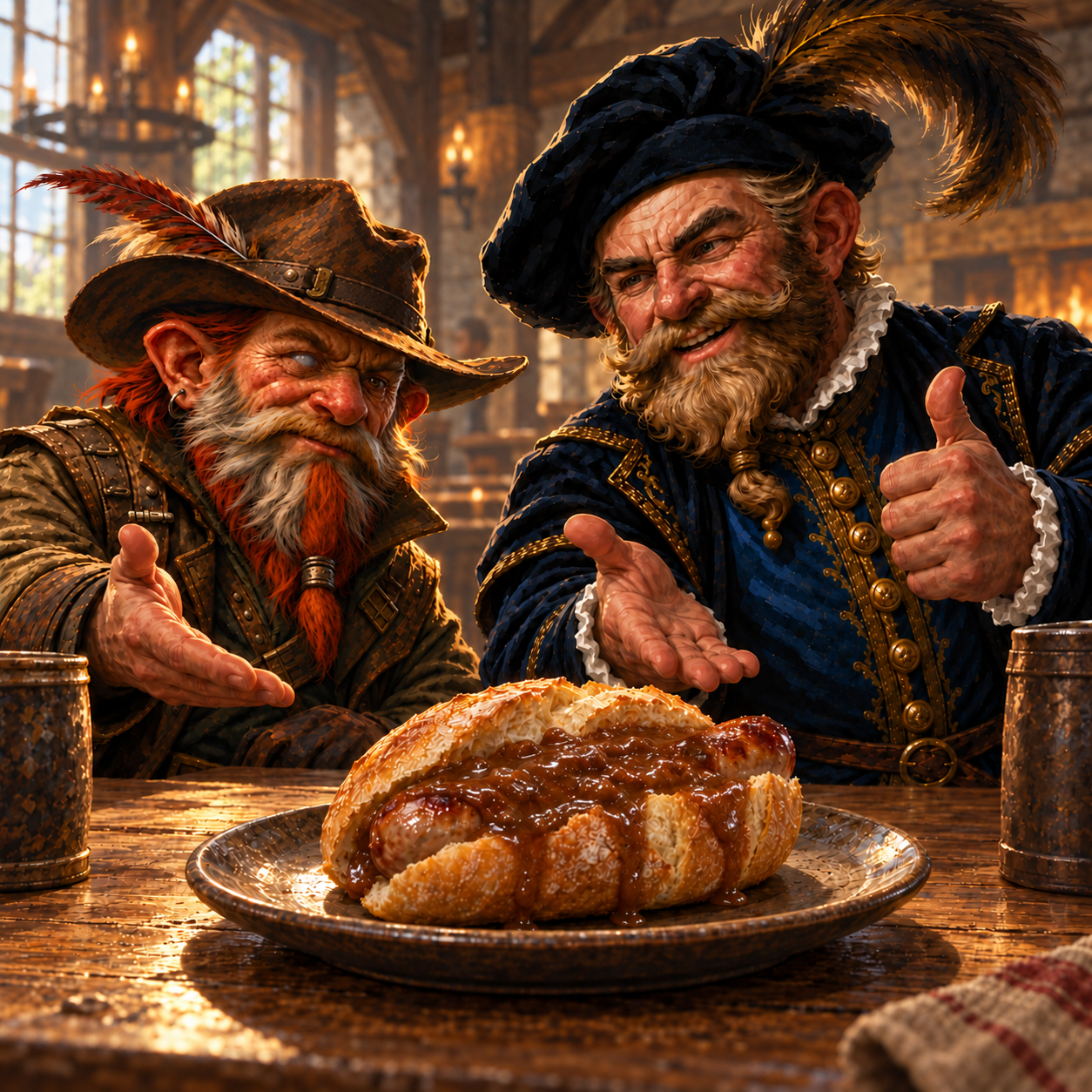
Gravy squeezed out between Felrick’s fingers and fell onto the plate.
He studied the split roll, adjusted the sausage inside it, and took another bite. The landlord of the Dove watched with the expression of a man witnessing damage to a perfectly serviceable piece of furniture.
“You eat them together anyway,” Felrick said.
Across the table, Wanda began fitting her own sausage into her roll.
“To Felrick,” said Thindruk, lifting his drink. “Legendary hero. Culinary innovator.”
The bread had already begun to surrender to the gravy. Felrick kept eating. An invention did not have to be tidy to be useful.
Outside, Frederheim lay in the summer heat: a coaching inn, a few shops, farms, and the road onward to the great hospice of Shallya. After the crowded coach, even this small place offered the luxury of standing without another person’s knee against one’s own. Sister Adelaide made her farewells here. Felrick watched the retired captain recover the seat he had yielded to her, climbing into the coach with the unhurried assurance of a man whose rightful place had merely been kept warm.
“Surely you wouldn’t leave a barbarian woman on the roof,” Felrick suggested.
The captain’s progress did not noticeably falter. It was a fine day for riding outside, fortunately: clear, hot, with enough wind once the horses moved.
They had several days of this ahead before Middenheim. Felrick wiped his fingers and considered how the roll might perform without gravy.
The two young sisters were discussing the season’s fashions in Altdorf, and Thindruk was contributing with just enough conviction to suggest he had opinions.
He possessed a title, centuries of experience, and a useful sense of when to nod. These were generally sufficient for polite conversation. The girls were carefully polite themselves, practising their manners upon Lord Steelbone while the coach rocked them northward.
“Surely you ladies don’t mean to partake in all the carnival festivities?”
Bertha, the younger brunette, explained that they would be staying with their cousin, who would doubtless show them the more respectable entertainments. There were operas as well as street processions; plays as well as tavern drinking; exhibitions of martial skill. Everyone celebrated, right up to Graf Boris Todbringer himself.
“It has been a long time since I attended a decent opera,” Thindruk said. “I had understood the event to be rather less refined.”
Alex Eisen had a different assessment of why anyone should travel to a carnival and then sit through an opera. Thindruk conceded that there seemed to be something for everyone.
Their cousin was Kirsten Jung, a lady at court. The name came with a gentle inquiry into his own acquaintances in Middenheim.
There it was. Beneath the talk of sleeves and performances lay the practical question of whom he might introduce them to: important people, preferably with eligible sons, or eligible important people themselves.
For much of his life, Thindruk’s title had chiefly been useful in obtaining drinks. Only recently had he begun to inhabit it with any greater ambition. A boat captain could become accustomed to being listened to; a viscount ought perhaps to expect it. Neither experience had furnished him with a circle of handsome young courtiers.
“My good friend Count Bormann,” he said, “has a great interest in the histories.”
The count looked up from his book.
Calling Bormann a good friend required more generosity than either man could reasonably supply, but the girls turned towards him. Bormann needed very little encouragement to begin explaining the period of the Three Emperors. He had supplied the beginnings of a lecture before Thindruk found a suitable opening.
“There was a prince of that period,” Thindruk suggested, “whose appearance was said to rival his accomplishments?”
Bormann gave him a look. The look did nothing to interrupt the lecture.
“His good looks,” the count declared, “were surpassed only by his tactical genius.”
“How good-looking?” one of the sisters asked.
The conversation recovered beautifully. Thindruk settled back, satisfied that a thousand years of imperial division had at last accomplished something agreeable.
By evening the coach reached Kutenholz, near the southern border of Middenland. The Wolf’s Head offered first choice of rooms, reduced prices, and little glasses of fierce herbal spirits waiting for the Castle Rock passengers. Thindruk approved of arrangements that anticipated a traveller’s needs.
He approved less of what the travellers already there had to say about Middenheim.
The new taxes had been mentioned before. A dwarf returning south put particulars to them, sitting over his pipe while the common room filled with the noises of supper.
“They’ll tell you it’s not a tax on dwarfs,” the traveller said. “Mining guilds. Engineering guilds. Tools. Our trades. Everyone knows whose work that is.”
Wizards were being charged heavily for the materials of their profession, too. Precisely how the elves were being taxed seemed less clear. The dwarf offered a sour remark about the length of their ears, then returned to the taxes he knew.
These were sums that could break a working household. Some were leaving the city. The clansfolk he had visited were considering going south themselves.
“Raising money on the backs of working folk,” Thindruk said. “Do they need an army?”
The dwarf leaned closer through his pipe smoke.
“Listen to those Ulricans and you’d think war was exactly what they wanted. Loud enough about it. The Graf must hear. And their great wolf priest hasn’t said a word.”
His silence, the traveller plainly thought, mattered. Whether it meant what the dwarf suspected was another question.
There was already fighting and jostling along the eastern borders, between Talabecland and Ostland. Who was to say the west could not have its own war?
“Typical human foresight,” Thindruk said. “Drive off your smiths and miners just before you need them.”
The traveller laughed. Cannons and rotary guns would have their uses on the battlefield of tomorrow, whatever the wolf’s followers thought of fighting face to face.
Thindruk let the humour settle, then asked more about those contemplating departure. He was in logistics, after all. If people needed their possessions moved south, there might be work for someone who knew how to move them.
The talk became practical: households, goods, distance. He preferred it that way. A rumour of war could fill a tavern. Getting a family’s tools and furniture safely out of a city required a different conversation.
Before retiring, he paid to have the sealed crate brought to his room. It was too large for one person to carry conveniently, and Wanda’s offer of help was kind, but a few pennies spared his companions the labour. He watched it arrive and made certain it stayed with him.
Wanda had gone towards the shrine of Ulric beside the inn and found Conrad going there too.
Even devotion could occasionally feel like a failure to escape one’s fellow passengers.
Later, in the warmth of her room, she attempted the meditation she had been taught. A happy memory. Something that would let her find that inward warmth.
She had tried very hard in Altdorf. Concentration had not made the invisible pyramid appear. Wanting the power to strike at Chaos had apparently not been enough to make the first step towards it any easier.
This time she thought of the boat.
Not the fire. Not any of the dreadful things they had carried or found or fled. She thought of the good travelling days: the crew together, the river carrying them, ordinary work done among people whose company she wanted. There had been enough of those days to remember. They were among the happiest she had known.
She let herself remain there for a while.
Below, someone laughed over supper. Her belly was full; her room was warm. Whatever hidden things she was meant to learn to see, sleep found her first.
Morning took them into the Drakwald.
Qavitrae watched the forest close around the road, the trunks standing back in a depth of green shadow. They had travelled this way before. That was not a reassuring thought.
Someone proposed a pool on whose double would turn up next.
“A gnome,” Wanda said. “They’ve done dwarfs. Gnomes next.”
“No two gnomes look alike,” Felrick said.
“Then we’ll know.”
There was comfort in being ridiculous about it. The coachmen, at least, were sober enough for their work, and the horses kept a good pace beneath the trees.
At midday the Forest Hearth appeared behind twenty-foot walls crowned with spikes. Beastmen’s heads had been displayed above them. The inn stood alone in the forest, but its welcome began with a gate that could be barred.
Within, Qavitrae found a busy compound: stables, a coach house, outbuildings, the inn itself. Several coaches had stopped for the midday meal. The hospitality lacked the Wolf’s Head’s little refinements, though the walls offered a refinement of their own.
Thindruk took the opportunity to introduce the kitchen to the Deadeye Dog.
“No gravy,” Felrick specified.
“That would be a sloppy Deadeye Dog,” Thindruk agreed.
“Mustard,” said Felrick.
“Pickled cabbage,” Wanda suggested.
The first response was a plate bearing a sausage beside a roll. The cook had plainly understood the ingredients and rejected the argument.
Thindruk tried again, explaining how the bread caught the juices and kept the fingers clean. Felrick supplied encouragement. One traveller listening nearby requested the same thing. Then another decided to try it.
By the time they left, the idea had acquired customers.
Less than an hour later, something beneath the coach made a sharp metallic crack.
The back dropped.
Qavitrae caught herself as the coachman swore and brought the horses to a halt. Around her, weapons appeared with a speed that interested the man carrying the blunderbuss.
“Do you see something?”
“Not yet,” Felrick said, setting an arrow to his bow.
Wanda strapped on her shield and loosened her great sword. Thindruk made reassuring noises for the sisters while fitting his buckler. Qavitrae looked back along the road and into the trees.
Nothing moved that she could put a name to.
Wanda climbed down to stand guard over the coachman as he crawled underneath. His second oath carried rather more information than the first.
An axle pin had sheared. Its companion still held, but they could not continue to their intended stop on it. They would have to turn back to the Forest Hearth, slowly enough to spare the remaining pin, and stay the night.
Wanda looked up at Nora when the question of lightening the load arose. The athlete frowned down from the roof.
Qavitrae could sympathise. Ten miles alongside a crippled coach was a substantial contribution to someone else’s maintenance problem.
The old overturned coach came to mind. Mutants, damage, and the familiar unpleasantness of finding trouble waiting beside a road. Had that one broken in the same way? Nobody could say whether its wheels had been damaged before it overturned or afterwards.
There would be time to inspect this coach once it was standing still.
They turned south. A single passing coach went by, and then the road belonged to them. Northbound travellers had already passed this stretch; southbound ones were ahead. At their reduced pace, the shade beneath the canopy seemed to last far longer.
A crooked branch caught Qavitrae’s eye.
“There.”
Heads turned. Weapons shifted.
It was a branch.
A little farther on, another shape resembled antlers until the coach had changed the angle.
“Qavitrae,” Wanda said, “how much did you drink?”
“They gave me a flask.”
The herbal spirits had been bracing. They remained bracing. She was beginning to find her companions’ interest in the quantity rather tiresome.
By the time the Forest Hearth’s walls came into view, her warnings had ceased to produce the response she considered prudent.
The people at the gate saw them coming and armed themselves.
Thindruk noticed the readiness: weapons in hand, someone climbing towards the watchtower, faces assessing the returning coach before offering welcome. Once the broken pin had been explained, they admitted the passengers and barred the gate again.
There was room for everyone. The charges were reasonable. The family running the place gave the impression that keeping travellers alive in the Drakwald was work they took some pride in.
Someone had even chalked Deadeye Dog onto the board.
He would have liked to accept the evidence of a comfortable evening.
Instead, he went to the coach house with Qavitrae and Wanda.
The coach was unloaded and raised so the work could be done safely. The coachmen and the inn’s maintenance man removed the rear axle and brought out what remained of the pin. Thindruk asked to examine it.
For part of its width, the break was smooth. That was to be expected. The pin had been under shearing strain.
He turned it into better light. Qavitrae leaned nearer.
Along the other portion, his fingers found a rougher texture.
Filing.
Someone had worked partway through the metal and left the weight of the coach to finish.
Thindruk looked towards the tools. There were suitable files in the workshop, well used, carrying the residue of well-used files. Nothing there would tell him who had taken one to this pin, or even whether one of these had been used.
He kept his expression mild.
“These things can go in pairs,” he told the coachmen. “We ought to look at the other one.”
They agreed readily. With the first broken, the second had borne more than its share on the journey back. It showed the strain, but no corresponding signs of interference. They had meant to replace it anyway. Their talk ran towards a badly fitted pin and somebody’s poor work back in Altdorf.
Thindruk did not correct them yet.
Away from their hearing, the companions considered the timing. A pin weakened that much was unlikely to have survived the whole journey from Altdorf. Today was more likely: Kutenholz that morning, perhaps, or here during lunch.
The coach had been parked inside the coach house then. Other companies’ passengers and crews had been passing through. There had been plenty of people and plenty of opportunity.
None of that supplied a culprit.
“If somebody meant to keep us here tonight,” Thindruk said, “they may already be inside.”
“Or their agent,” Qavitrae said.
The boat had burned. Now the coach had been tampered with. There were ways for misfortune to repeat itself without help, but Thindruk did not feel obliged to trust them.
A watch would be sensible. So would a conversation with the owner.
“It might be a good evening to make friends,” Qavitrae suggested quietly.
“It’s always a good evening to make friends. They may bring out the reserve wine.”
He paid to have the crate carried upstairs again.
Felrick retired early, intending to be awake while everyone else slept. Beyond the walls, the afternoon had grown close and heavy. The storm took time to gather, which Thindruk found reassuring, insofar as he found anything about a forest thunderstorm reassuring. It had neither arrived unnaturally fast nor stained the sky green.
He went to the hall before the rain began.
The room had space for several coaches’ worth of hungry passengers and looked larger still with only their own company in it. A fire burned in a hearth tall enough to walk into. When Sieghilda joined him, she settled near the warmth and stretched her fingers towards it.
She was a stout woman, busy even when sitting still, with the air of someone who knew what was happening in each of her outbuildings.
“You honour us, my lord.”
“The pleasure is ours. Though I regret arriving with so many unplanned guests.”
She accepted that courteously. Thindruk let the civilities run a little longer before lowering his voice.
“There is something troubling me that I thought you should know.”
He described the filing. He made no accusation against her man Verner, whose work had seemed thorough, nor against anyone else. But if the damage had been deliberate, whoever had done it might have wanted them here tonight.
Sieghilda’s first concern was that Verner had said nothing about it.
“No reason he should have noticed,” Thindruk assured her. “It was subtle.”
“Wouldn’t that be bandits’ work? Stopping you on the road? If so, they missed their chance. You’re safe within the walls now.”
“Quite possibly. And I certainly feel safer here.”
He asked about recent additions to her staff. The newest hired sword had been with them about three months and had given no trouble. The household staff tended to stay for years.
Three months was a good deal longer than he had hoped for. He said as much, gently, and assured her that he had only wished to warn her.
There was always a night watch, she told him. Anything untoward would bring a bell ringing loud and long.
“Then, with your permission, some of my crew will join it. If trouble comes here on our account, we ought to help watch for it.”
Sieghilda considered him.
“I assure you, it’s unnecessary. But extra eyes never hurt.”
They turned to lighter matters before her duties called her away. Thindruk watched her return to work as the first great drops struck outside. He had done what he could without accusing an entire inn of conspiracy.
For the moment, that would have to serve.
Wanda woke when the others were preparing for bed.
Rain had washed the courtyard and left the dark full of small dripping sounds. She found the night guards getting into leather jerkins and taking up their weapons. Sieghilda had told them to expect help.
Felrick climbed to the watchtower with Kurt. Wanda remained below with Wolfram, checking the walls on foot.
He was an Ulrican. They compared wolf talismans, and that made a pleasant beginning. He had served in Middenheim’s army, mustered out a couple of years before, and since then sold the skill they had taught him. A straightforward enough account, delivered by a man who seemed reasonably down to earth.
He answered her questions about the place and flirted when she flirted.
That, too, was pleasant. She allowed it to remain so without allowing it to become a reason to abandon their rounds.
This was still the Drakwald. There were doubles in their history and a filed axle pin in the coach house. She could enjoy a man’s company and keep walking.
She and Wolfram made another circuit.
The night passed midnight. Near one, with the buildings black around her and the wall close at hand, Wanda heard a small, distinct click behind her.
The hammer of a flintlock pistol.
“Turn around slowly. Keep quiet.”
She turned.
Two men stood there in uniforms she could not place. One held the pistol upon her. He was beyond easy reach, though near enough that he would have little difficulty shooting her.
Her shield remained strapped to her arm.
“Easy,” she said. “We’re guarding the place. What do you want?”
The pistol stayed steady. She resisted the urge to make him prove whether it would fire.
“Miss, I know you travel with that dwarf. Maybe you don’t know it, but he’s an enemy of the Empire.”
She looked from the gun to the man.
“The lady will sort it out. If you’re innocent, it’ll come to light.”
“What’s his name?”
“Lord Thindruk Steelbone. Do you know him by another?”
No mistaken identity, then. No convenient double to explain it.
Wanda kept her hands where he could see them and looked for a chance to move.
Thindruk woke before he knew what had woken him.
He lay listening. Beneath the remnants of the storm came the quiet creak of wood, then a shuffle. People moving downstairs.
He took up his crossbow and eased his door open.
Across the unlit passage, Nora’s door opened almost in answer. She had her sword. They exchanged a glance and listened.
“What room is he in?” a man asked below.
An older woman answered. Sieghilda, unless Thindruk was badly mistaken.
“Second on the upper floor. On the left.”
His room.
“He seemed a good sort.”
A different woman replied, her voice composed and cultivated.
“Well. That’s just the way he likes it.”
Feet struck the stairs.
Thindruk drew back into the cover of his doorway and brought the crossbow to bear. Opposite him, Nora retreated enough to give herself room to rush anyone who came at the door.
The first man appeared.
Imperial uniform.
Thindruk’s finger rested against the trigger. He knew that uniform: the emperor’s army, not merely some provincial lord’s soldiers. Or somebody wanted him to believe so. The clothing established how official this was intended to look. It established very little else.
He held the bolt.
Felrick had stopped listening to Kurt some considerable time before.
Kurt had begun as a carrier for a mercenary company in the Reikland, learned to fight, and acquired scars. He had also developed an inexhaustible interest in the telling of it. His little wet snort punctuated stories that had ceased to carry meaning. He never asked a question. Felrick had accomplished things worth telling, yet here he sat, a captive audience to somebody who apparently regarded carrying a mercenary’s baggage as an unsurpassable adventure.
The droning voice and the dark had drawn him down into a shallow doze.
Noise from the inn brought him back.
Voices. Movement.
Kurt looked at him.
For once, Felrick found the man’s face interesting. That look was wrong. It was not the startled glance of a watchman asking whether his companion had heard trouble. Kurt seemed to be measuring Felrick’s surprise.
Felrick drew his pistol and shot him.
Kurt had just time to look astonished before he died.
The report cracked across the courtyard.
The man holding Wanda at gunpoint looked towards the sound.
She raised her shield and ran.
“Hey! Surrender!”
She rounded the coach house and went for cover. No shot followed her. That did not make her hurry any less.
“Stop shooting!” she shouted, loudly enough to carry. “That wasn’t me!”
Somewhere above, Felrick was moving. She could not see what had happened to him. She could not see what Wolfram meant to do either, and at that moment she had no desire to give anyone a clearer target.
She got inside the coach house with the shield still up.
Thindruk let his voice fill the corridor.
“I see you’re not common bandits. But you’re hardly showing the decorum appropriate to my station. Who are you, and what’s your business?”
“Steelbone. You’re under arrest.”
“By whose authority?”
“The Imperial Army.”
“The whole Imperial Army? Who commands this operation?”
The soldier ordered him back from the door.
“For all I know, you’re a thug in a stolen uniform.”
Qavitrae emerged behind the confrontation with a pistol. Whatever sleep had delayed her, the feet on the stairs and the shot outside had finished it.
From downstairs, the cultivated voice rose.
“Lord Steelbone. I must needs have a private conversation with you.”
“My lady, this is an unusual calling card. But I should be happy to receive you.”
“Allow my man to escort you.”
“I assure you, I’m well escorted.”
The soldier’s sword remained in his hand. His gaze searched the darkness towards Thindruk’s voice; he plainly could not see his target as well as Thindruk could see him.
Outside, a gruff voice offered to investigate the shot. A door opened.
Thindruk kept his crossbow steady.
“Stand your men down, and I’ll come and have your chat.”
The woman required them to come unarmed.
Qavitrae’s response was considerably less courteous than his own.
“No arms,” she said, “unless they want their heads removed as well.”
“My lady,” Thindruk said, “I mean no disrespect to you or the emperor. But sabotaging my carriage and entering an honest inn under cover of darkness with armed men claiming to be imperial soldiers hardly builds a foundation of trust.”
A soft chuckle came from below.
“You’ve been an incredibly difficult dwarf to find.”
She did not offer an explanation.
Instead, she called her men back to the ground floor.
“Lord Steelbone, when you’re ready, come and join me. Please come unarmed. You and your companions.”
“Do I have your word for our safety?”
For a moment he heard only the ordinary sounds of the inn, made strange by everyone listening.
“On this evening,” she said, “you’re of more value to me alive than dead.”
Not the promise he had asked for. Probably the only one available.
In the tower, Felrick looked down over Kurt’s body and searched the courtyard.
A man stood close to the corner of the inn, sheltering most of himself behind the building. He carried a hefty crossbow and was watching the tower.
Felrick put away the empty pistol and took up his bow.
The man began to move out.
Felrick loosed.
His target snapped back behind the corner. The arrow struck timber with a hard thunk.
A growl came from cover.
“Are you the bastard who killed my horse?”
Felrick reached for another arrow.
“I didn’t have to miss.”
The man stayed behind the wall.
“It’s over for you. You and your whole band. I don’t know what evil you’ve been sowing up and down the river, but I’ve finally caught you.”
Felrick set the next arrow to the string. Below him lay the wet compound, the closed gate, and too many places he could not see.
Thindruk left his rapier, crossbow, and shield upstairs.
The knife he concealed on himself scarcely disturbed the line of his clothes.
Other guests had opened their doors. The sisters’ bodyguard looked out in bewilderment. Bormann permitted himself a narrow view of the proceedings, then closed his door as Thindruk entered the passage.
Nora put away her sword and came with him. She carried her Blitzball tucked beneath one arm, which Thindruk found oddly reassuring. Qavitrae took a position above the stairs with her weapons out of sight below the railing.
“Who was shot?” she demanded.
“My man is looking into it,” the woman answered.
Through the walls came muffled shouting. Thindruk could not make out the words.
He descended beside Nora.
About ten uniformed men occupied the common room. Among them stood a woman in a green velvet cloak. He saw no badge that explained her office, no sign that resolved what sort of authority she possessed.
The room had seemed oversized earlier. Now there was very little space in it he could safely use.
The woman turned to Sieghilda.
“May we have the use of your wine cellar?”
“It’s just a cellar,” the innkeeper said.
That would apparently do.
The woman arranged for a guard outside its door. The conversation was to be private: herself and Lord Steelbone.
Thindruk glanced once towards his companions. Qavitrae remained above, Nora close behind him. Beyond the thick walls, somebody was still shouting.
Then he followed the green cloak down to the cellar.
The company resumed its northbound coach journey at Frederheim, a small way station serving travelers bound for the great hospice of Shallya. At the Dove, lunch consisted of sausage and a roll cut open and filled with gravy. Felrick put his sausage into the roll, Wanda followed his example, and Thindruk enthusiastically praised the invention. The practical difficulties of combining sausage, bread, and gravy began a culinary project that would follow them to their next stops. Sister Adelaide made her farewells and left the traveling company. The retired captain reclaimed the inside coach seat he had previously yielded to her. Felrick appealed to his consideration for a woman left riding outside, and Wanda pointed out the elf and warrior among their company, but neither persuaded him to surrender the seat. Fortunately, the summer weather was clear and warm enough for riding on the roof. On the road, the two young sisters drew Thindruk into polite conversation about Altdorf fashions and their plans for Middenheim. Bertha, the younger sister, described a carnival with entertainments for every social rank: opera, plays, martial exhibitions, street celebrations, and tavern drinking. Middenheim was the seat of Graf Boris Todbringer’s court. The sisters said they were visiting their cousin Kirsten Jung, a lady at court, giving Thindruk a possible social connection at the destination, although no introduction was arranged. The sisters hoped Thindruk could introduce them to influential people and eligible bachelors. Having only recently begun embracing his noble station, he lacked the useful Middenheim connections they wanted. He welcomed the prospect of opera, while Alex Eisen questioned the attraction of such refined entertainment. To redirect the sisters’ inquiries, Thindruk brought Count Bormann into the conversation. Bormann remained unfriendly toward Thindruk, but readily took up a discussion of history and the period of the Three Emperors. Drawing successfully on his own historical knowledge, Thindruk steered the lecture toward a handsome prince. Bormann described the prince’s exceptional looks and tactical genius, and the sisters became considerably more interested in the former. The conversation carried the coach north without producing any reconciliation between the count and Thindruk. The coach reached the Wolf’s Head in Kutenholz as the sun lowered. The inn’s arrangement with Castle Rock gave its passengers priority in choosing rooms, discounts on food and lodging, and a welcome drink of herbal spirits. The expected journey from Altdorf to Middenheim remained six days, with arrival a little after midday on the sixth. Changing horses around midday allowed the coaches to cover at least sixty miles in a day. Although coach fare did not itself include rooms, Blücher’s existing travel advance was sufficient for ordinary food, lodging, and other travel costs on both the outward and return journeys. There might be some money available for discretionary spending, but extravagant carnival expenses could still leave the companions paying personally on the way home. No remaining balance was calculated. Thindruk successfully gathered more news about Middenheim’s reported taxes. His most informative source was a pipe-smoking dwarf returning to Altdorf after visiting clan in the city. Travelers described recent measures affecting dwarves, elves, and wizards. According to the dwarf, the burden on his people operated through mining and engineering guilds, tools, and associated trades, making it effectively a tax on dwarven livelihoods. He also reported taxes on wizard supplies, including paper and unusual powders. The provisions affecting elves remained unclear. The dwarf called the burden ruinous for some residents and said people were leaving or considering moving south. Thindruk offered his experience in logistics as something that could help those relocating. The traveler was willing to discuss the possibility, but no commission, payment, or definite business arrangement resulted. Tax rates, enforcement, the treatment of gnomes, and the precise legal scope of the measures remained unknown. Asked whether the money might be intended to fund an army, the traveler pointed to loud Ulrican calls for war and the apparent lack of opposition from the Graf and the senior wolf priest. His suggestion that the authorities must know what was happening remained speculation. The eastern fighting under discussion concerned the border conflict between Talabecland and Ostland; nothing established that Middenheim’s taxes were financing a new war. Wanda visited the large shrine of Ulric beside the inn; Conrad also went there. Continuing her meditation practice, she sought inner warmth by concentrating on a happy memory. She chose the good days aboard the boat with her companions: “Those have been my happiest days so far.” She contemplated those memories and rested comfortably after food and warmth, but experienced no demonstrated magical perception or breakthrough. Thindruk kept close watch over Captain Sherlock’s sealed delivery crate. It was a large, awkward two-person load, so he preferred paying inn staff a small copper tip to asking his companions to carry it. They brought it to his room overnight and took it down for reloading while he ate breakfast. The crate remained unopened and in the company’s custody; its contents were not inspected. After a comfortable night and breakfast, the coach left Kutenholz and traveled into the Drakwald. Familiar stretches of country recalled earlier trouble along the route, including an overturned coach, mutants, and doppelganger suspicions. Those memories encouraged caution, but no such encounter occurred on this journey. The current coachmen appeared competent and fit for their work despite having drunk the previous evening. Around midday, the travelers reached the Forest Hearth, an isolated coaching inn built like a small fort. Twenty-foot walls topped with spikes enclosed the compound, and beastman heads stood on stakes outside. The inn had stables, a coach workshop, a brewhouse, a watchtower, and cultivated ground. Its hospitality was less polished than the Wolf’s Head’s, but it appeared intact and well defended. Several coaches from different companies had stopped for lunch, bringing travelers moving in both directions. Thindruk announced the latest roadside culinary fashion: the Deadeye Dog, Felrick’s sausage served inside a roll. The keeper initially brought the sausage and bread separately, requiring further explanation. Felrick rejected gravy as part of the standard recipe, while he and Wanda suggested sauerkraut and mustard. Thindruk explained the practical advantage: the roll would catch the sausage juices and keep the eater’s fingers clean. With Felrick’s assistance, Thindruk successfully persuaded other passengers to try the dish. Their promotion earned the invention customers, although it brought the company no royalties or other income. After lunch and midday beer, the companions departed expecting to reach their scheduled overnight stop. When they returned later, they would find the Deadeye Dog already listed on the Forest Hearth’s chalkboard. About forty-five minutes and roughly ten miles beyond the inn, a sharp metallic snap accompanied a sag at the rear of the coach. The coachmen stopped the horses. Felrick readied his bow and nocked an arrow, Qavitrae watched the rear, and Wanda strapped on her shield, loosened her greatsword, and climbed down to protect the man inspecting beneath the vehicle. Seeing the companions arm themselves, the other coachman took up a blunderbuss. With the brake engaged, the inspecting coachman found that an axle pin had sheared. The other pin still held, allowing a cautious return, but could not safely carry the loaded coach all the way to the intended stop. The coachmen proposed turning back to the Forest Hearth for repairs and rooms. Wanda considered jogging alongside to reduce the load, drawing a frown from Nora on the roof, but no jogging arrangement was put into effect. The companions suspected interference and compared the failure with their earlier experience of an overturned coach. They postponed a close examination until the vehicle was safely stationary. During the return, which took close to two hours at little more than walking speed, they watched for an ambush. Qavitrae repeatedly mistook branches in the shaded woods for beastman antlers, causing alarm and then irritation, but no enemy appeared. The Forest Hearth’s household reacted defensively to the unexpected coach, bringing weapons to the gate and sending someone into the watchtower. Once the breakdown was explained, they admitted the travelers, barred the gates, stabled the horses, and arranged reasonably priced rooms. Their preparations and welcome gave the impression of people who took pride in providing a secure refuge in the forest. In the coach house, the damaged vehicle was unloaded, supported, and partly dismantled. Qavitrae proposed examining the failure using her quartermaster experience. Thindruk investigated the engineering problem with her assistance, while Wanda conducted a separate inspection using her knowledge of driving. In good light, the removed pin showed a smooth shear over about half the break and a rough, filed texture over the remainder. It had apparently been partly filed through before it failed, strongly supporting deliberate interference. The likely opportunity was earlier that day: either at Kutenholz before departure or at the Forest Hearth during lunch. Damage inflicted back in Altdorf seemed unlikely to have survived so much travel. The coach had stood in the Forest Hearth’s workshop at lunchtime, when several coaches and their passengers were present. Suitable files were available there, but used tools in an active workshop identified no particular culprit. Thindruk initially withheld the filing discovery from the coachmen and instead urged them to check the other pin, suggesting that failures could come in pairs. They were already inclined to inspect and replace it. That pin showed additional strain, but no filing was identified. The repairers favored poor original fitting or maintenance as the explanation for the break. No suspect emerged. Qavitrae briefly reconsidered the wounded traveler previously picked up on the road, but he had left at Frederheim the day before, outside the likely window. Felrick observed that the company’s boat had also burned, raising the possibility of a pattern of attacks on their transport. No evidence connected the two incidents. The companions decided to make inquiries, approach the proprietor, and arrange additional vigilance rather than accuse anyone prematurely. Thindruk repeated his overnight cargo precautions, paying two copper pennies to have the sealed crate carried to his room. Felrick retired early so that he could wake for watch duty when the other guests went to bed. Toward evening, an ordinary summer thunderstorm rolled in gradually, bringing humid air, heavy warm rain, and thunder. It bore none of the distinctive features of the company’s earlier unnatural green storm. In the large common hall, Thindruk invited Sieghilda, the stout matriarch who ran the inn, to sit beside the tall fireplace. He apologized for the unexpected guests and privately explained the filing marks. He took care to say that he was neither accusing her employees nor criticizing their competence. His concern was that someone might have intended the passengers to spend the night there, making extra vigilance prudent. Sieghilda said her coachman Verner had reported no sabotage. She suggested that roadside bandits might have weakened the coach intending an ambush, then missed their opportunity. Asked about recent employees, she said her newest hire had worked there about three months without trouble, while regular staff often stayed for years. These assurances supplied background but did not resolve the source of the damage. Sieghilda described the inn’s night watch and its warning bell. Although she considered additional precautions unnecessary, Thindruk successfully charmed her into allowing members of the company to help. Wanda also slept early in preparation. The companions recovered stress while resting in the fortified inn; no individual stress totals were itemized. When the guests retired, Felrick joined Kurt in the roughly thirty-foot watchtower, reached by ladder. Wanda patrolled the enclosed grounds with Wolfram. The twenty-foot walls had no walkway, and trees limited the tower’s view despite its height. Wolfram wore a wolf talisman like Wanda’s and said he had served in Middenheim’s army, mustered out a couple of years earlier, and subsequently sold his sword skills. They flirted, but Wanda declined to abandon their duties because she regarded the danger as serious. Neither companion’s initial scrutiny established anything sinister about the guards. Wanda found Wolfram apparently down to earth. Kurt said he had begun carrying equipment for a Reikland mercenary company and acquired combat training there, but his repetitive snorting and lengthy, self-involved stories irritated Felrick. Felrick spent a fortune coin to reroll his unsuccessful assessment and still learned nothing useful. Eventually he tuned Kurt out. Midnight passed without an alarm. Around one in the morning, Wanda failed to notice danger approaching in the darkness, even after spending a fortune coin on a reroll. Felrick’s watch failed more badly: he had begun dozing in the tower while Kurt talked. Armed visitors reached the grounds and the inn’s interior before the companions detected them. How they entered, and whether anyone deliberately helped them, remained unknown. Wanda heard the recognizable click of a flintlock hammer behind her. A quiet voice ordered her to turn slowly and remain quiet. She complied and found two men in apparent uniforms, one aiming a pistol from close enough for an easy shot but beyond a simple attempt to seize it. She could not identify their uniforms. With her metal shield already strapped to her arm, she considered force but chose conversation. Wanda successfully calmed the pistolman, drawing on her ability to seek compromise. He said he knew she traveled with the dwarf, accused that companion of being an enemy of the Empire, and claimed that a lady would sort matters out and establish any innocence. Wanda tested whether they had the wrong dwarf. The man explicitly identified Lord Thindruk Steelbone, and she acknowledged that he was her companion. The accusation concerned Thindruk by his correct name; no specific offense, warrant, or evidence was supplied. Meanwhile, Thindruk and Nora woke to quiet shuffling downstairs and cautiously opened their separate doors into the dark upper hall. Nora took her sword, and Thindruk prepared his crossbow. They heard a man ask which room contained his target. An older woman’s voice, sounding like Sieghilda’s, identified Thindruk’s room and said he had seemed a good sort. A cultured woman replied that this was how he liked it. Several people then hurried upstairs, waking Qavitrae. The overheard exchange did not establish whether the older woman was assisting willingly or under pressure. Felrick awoke to the commotion and successfully read Kurt’s reaction. Rather than sharing his surprise, Kurt appeared to be checking how surprised Felrick was and whether he understood what was happening. Felrick took this as evidence of foreknowledge, quick-drew his pistol, and shot Kurt at close range. The shot killed him. Kurt gave no confession or explanation, leaving his precise role unknown. This single pistol report carried across the compound, interrupting the developing confrontation inside and creating an opportunity for Wanda outside. As the armed men reached the upper floor, Thindruk prepared to shoot the first one with his crossbow. Across the hall, Nora readied a charge against a man approaching her doorway. Before Thindruk fired, he recognized the Imperial Army uniform and withheld his shot. Such clothing suggested an Imperial rather than merely provincial force, but did not prove that the men were genuine soldiers or acting under lawful orders. Nora’s intended charge did not take place as Thindruk demanded an explanation instead. A man declared Thindruk under arrest by authority of the Imperial Army and ordered him back from the door. Thindruk challenged both the treatment of a noble and the visitors’ credentials: “Who is your commanding officer? For all I know, you’re a thug in a stolen uniform.” No commanding officer’s name or specific charge followed. The cultured woman downstairs answered his raised voice, requesting a private conversation and proposing that her man escort him. Qavitrae entered the hall armed and cocked a pistol in support of Thindruk, who replied that he already had an adequate escort. The men waited for their leader’s instructions. The woman claimed violence would follow only if the companions pressed matters. During these exchanges, Felrick’s pistol report prompted a gruff-voiced man to go outside to investigate. Those inside did not yet know who had been shot. Thindruk offered to talk if the woman stood her men down. He objected to arriving armed by night, demanding that his companions disarm, and the apparent sabotage of his coach. Qavitrae added forceful threats of her own. The woman chuckled and replied, “You’ve been an incredibly difficult dwarf to find.” Her response did not explicitly admit responsibility for the broken pin. Eventually she ordered the men back downstairs and asked Thindruk and his companions to join her without weapons. Attempts to judge the woman’s trustworthiness produced no reliable assurance. Thindruk spent a fortune coin on an unsuccessful scrutiny reroll, and Qavitrae also failed to read her. When asked for a promise of safety, the woman instead said that Thindruk was worth more to her alive than dead that evening. He accepted the opportunity to talk while retaining a precaution: he left his rapier, crossbow, and shield upstairs but used his automatic concealment ability to hide a knife on his person. Qavitrae took a position above the common room, covering Thindruk while keeping her weapons below the railing and out of obvious view. She questioned who had been shot if the visitors meant to proceed peacefully. The woman treated the matter as secondary and said her man was investigating outside. The indoor negotiation did not settle what was happening to either companion in the grounds. At the sound of the pistol, Wanda’s captor reflexively looked away. She raised her shield and used the opening to run toward cover around the coach house, deliberately making noise to alert her friends. The men shouted for surrender but did not shoot. She escaped the immediate pistol-point confrontation without a recorded injury and was seeking cover near or in the coach house. Wolfram remained unharmed, but his response and allegiance were still unresolved. From the tower, Felrick spotted a man with a hefty crossbow moving in shadows and cover near the inn, apparently toward his position. He switched from his discharged pistol to his longbow, aimed, and fired. His aim was sufficient to threaten the target despite the cover, but the crossbowman evaded the arrow with an exceptionally successful dodge. It struck a corner timber instead, causing no damage to him. Felrick nocked another arrow. From cover, the crossbowman accused Felrick of killing his horse. He claimed to have finally caught the entire company and accused them of spreading evil along the river. His words suggested an earlier grievance, but neither his name nor the circumstances of the alleged horse killing were established. His connection to the woman, including whether he was the man who had volunteered to investigate the shot, remained unconfirmed. Those inside heard muffled shouting without making out the accusations. Other guests began looking out of their rooms. Gunther, the sisters’ bodyguard, appeared confused. Count Bormann peered through a narrow opening and closed his door when he saw Thindruk. Neither reaction established involvement in the visitors’ arrival. Nora chose to accompany Thindruk downstairs so that he would not face the gathering alone. She left her sword behind, maintaining that she remained dangerous without it, and carried her Blitzball under her arm. Qavitrae stayed above to cover them. In the common room, Thindruk and Nora could see about ten uniformed men and their leader, a woman wearing a green velvet cloak. No badge of office or identifying crest established who she was. The woman requested the use of the inn’s wine cellar, and the proprietor corrected her that it was simply a cellar. She arranged to speak there alone with Thindruk and ordered a guard posted outside the door. Facing the numerous armed men, Thindruk judged a private conversation preferable to risking a fight and accepted. His concealed knife remained with him. Nora had accompanied him to the common room but was not included in the proposed private meeting. The session ended with the cellar meeting arranged, before its substantive conversation began. No formal charge, negotiated settlement, or resolution of the outside standoff followed. Each companion received 100 reward points; no advancement purchase was resolved. Thindruk and the visitors: Thindruk has accepted a guarded private meeting with the unidentified woman in green velvet. He carries a concealed knife, with his rapier, crossbow, and shield left upstairs. Nora is downstairs with her Blitzball and without her sword; Qavitrae remains above with her weapons concealed below the railing. About ten men in Imperial uniforms were visible in the common room. Their claimed authority, the grounds for arrest, and the woman’s purpose remain unexplained. The danger outside: Wanda is near or in the coach house seeking cover after escaping without being shot. Felrick remains in the watchtower beside Kurt’s body, facing an uninjured crossbowman in cover near the inn. Felrick has fired his pistol once, with no reload established, and expended one longbow arrow; another arrow is nocked. The companions inside have not heard the crossbowman’s accusations clearly. The coach and cargo: The coach remains under repair at the Forest Hearth, with no completed repair or revised departure time established. Captain Sherlock’s large sealed crate was last placed in Thindruk’s room. It remains unopened and undelivered. The filed axle pin points to interference earlier that day, but neither the culprit nor a connection to the night’s visitors has been proved. Resources and loyalties: No companion sustained a recorded injury, and stress had recovered during the earlier rest. Felrick, Wanda, and Thindruk each explicitly spent a fortune coin on an unsuccessful reroll during the session; remaining totals were not established. Thindruk paid a small carrying tip at the Wolf’s Head and two copper pennies at the Forest Hearth. Kurt’s apparent foreknowledge, the voice resembling Sieghilda’s, and Wolfram’s uncertain conduct leave questions about individual staff members without establishing a household conspiracy. Leads beyond the inn: Middenheim still offers the carnival, the sisters’ claimed connection to Kirsten Jung, and possible logistics work for residents reportedly leaving under the new taxes. The tax mechanisms and their consequences need confirmation, while the suggestion of war funding remains speculation. Wanda’s meditation continues without a demonstrated magical breakthrough. First, the company must learn what the woman wants and resolve the separate confrontation outside.Session Notes
Frederheim: lunch at the Dove and new acquaintances
Kutenholz: tax reports at the Wolf’s Head
The Forest Hearth: a fortified lunch stop
The Drakwald road: a broken pin and signs of sabotage
The Forest Hearth: precautions before the night watch
The Forest Hearth after midnight: an undetected intrusion
The upper hall and courtyard: negotiation and resistance
The common room: an invitation to the cellar
Where things stand